
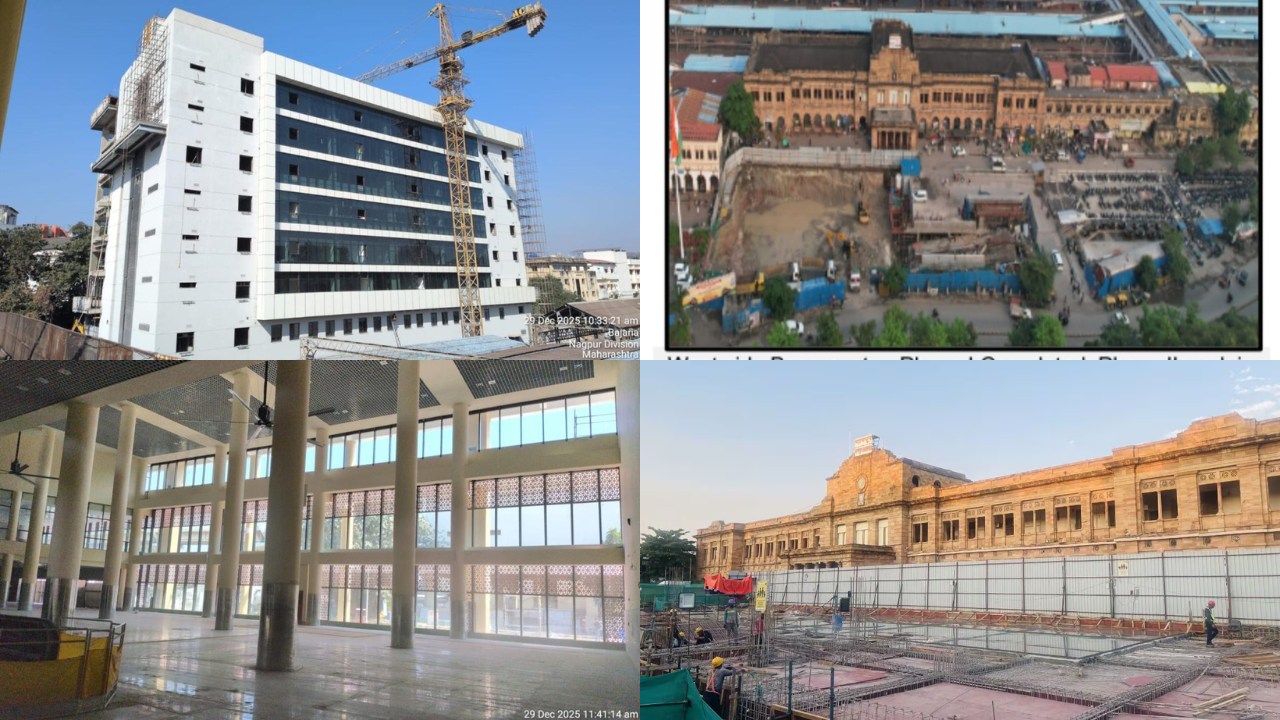
East and West wings record rapid structural and finishing work as heritage restoration and modern facilities move in sync.
The redevelopment work of Nagpur Railway Station is moving forward at a steady and impressive pace, marking a major transformation of one of Central India’s busiest railway hubs. With key structural milestones already achieved and finishing works advancing rapidly, the revamped station is on track to emerge as a modern, passenger-friendly hub that blends heritage with cutting-edge infrastructure.
A flagship project under the Indian Railways’ modernization plan, the redevelopment of Nagpur Railway Station is designed to create a world-class travel experience for passengers. The project covers both the East and West wings of the station, featuring extensive upgrades in building design, passenger amenities, and circulation facilities to ensure greater comfort, convenience, and safety.
Major Progress on East Wing
The East Wing of the station has witnessed remarkable progress across multiple components. The East Side Arrival Building (EW-1) — comprising a Basement, Ground, and five upper floors — has completed slab casting up to the terrace level. At present, internal finishing works and critical Mechanical, Electrical, Plumbing, and Fire-fighting (MEPF) services are in full swing.
Similarly, the East Side Departure Building (EW-2) has also achieved slab casting from the basement to the terrace level. Alongside this structural progress, teams are actively working on internal finishing, MEPF installations, flooring, and the installation of lifts and escalators. The introduction of modern vertical transportation will significantly improve passenger movement and accessibility, especially for the elderly and differently-abled.
In the Unified Basement (EW-3), another critical component of the redevelopment plan, the dismantling of the old East Side station building has been successfully completed. Following that, foundation and slab casting works have been achieved, and vertical circulation works are actively in progress. Alteration work to the South Foot Over Bridge (FOB) — a key link between different platforms — has also been completed, ensuring smooth integration with the new structures.
West Wing Developments Gaining Momentum
On the West side, construction work has maintained a similar pace. The basement structure (WW-3) has been fully completed and is expected to be handed over to the railway division by September 2025 for its intended use as surface parking. This will help decongest the main passenger areas and create more organized parking facilities for both private vehicles and public transport operators.
Meanwhile, the West Side Administrative Block (WW-4), a ground-plus-seven structure, has achieved major construction milestones. The raft foundation and slab casting up to the seventh floor have been completed, paving the way for the next phase of finishing and installation works. Once operational, this block will house key railway offices in a unified, modern administrative ecosystem.
Heritage Restoration with Modern Upgrades
One of the most notable aspects of the project is the simultaneous preservation and refurbishment of Nagpur’s historic railway building. The redevelopment team has placed special focus on maintaining the station’s architectural heritage while introducing modern infrastructure elements. Restoration work on the heritage building is progressing under strict conservation guidelines, ensuring that the original façade and decorative details are preserved even as new amenities are added.
This thoughtful approach aims to retain the cultural and historical essence of Nagpur Railway Station — a landmark that holds sentimental value for generations of travelers — while bringing it in line with 21st-century infrastructure standards.
Enhanced Passenger Movement and Safety
In parallel with the structural developments, significant progress has been achieved in Foot Over Bridge (FOB) and concourse foundation works across multiple platforms. These upgraded circulation facilities are designed to improve pedestrian flow, enhance passenger safety, and reduce congestion during peak hours.
Once completed, the new station layout will include wider concourses, improved signage, high-capacity escalators and lifts, advanced lighting, and seamless integration between the East and West wings. The redevelopment project also emphasizes sustainability by incorporating energy-efficient systems, advanced waste management, and optimized ventilation design.
A Model for Future Railway Infrastructure
The transformation of Nagpur Railway Station is part of a broader initiative by Indian Railways to redevelop major stations across the country under its station modernization program. As one of the central junctions on India’s railway map, Nagpur plays a crucial role in connecting the North-South and East-West corridors. Therefore, its modernization will not only benefit regional commuters but also enhance national connectivity and operational efficiency.
Officials have expressed optimism about the ongoing pace of development, emphasizing that coordinated efforts by multiple agencies — including civil, electrical, and architectural teams — have ensured smooth progress despite the project’s scale and complexity. With continuous monitoring, resource management, and phased execution, the redevelopment is progressing in line with set timelines.
Blending Heritage with a Modern Vision
The new-look Nagpur Railway Station aims to set a new benchmark for passenger experience in Central India. Featuring modern arrival and departure halls, an integrated concourse, enhanced accessibility features, digital information systems, and improved security, the redeveloped station will embody the perfect mix of comfort, efficiency, and local character.
Beyond aesthetics, the project represents a broader shift in India’s railway philosophy — moving from functional infrastructure to human-centric spaces designed for the comfort and convenience of every traveler. Once completed, Nagpur Railway Station will stand as a symbol of the city’s growing importance and India’s commitment to building world-class transport infrastructure that respects history while embracing progress.