
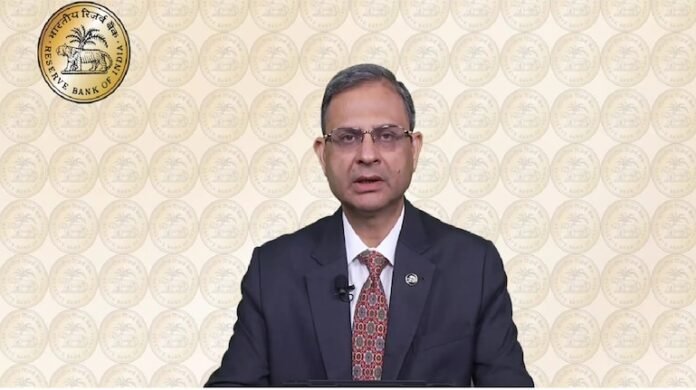
Reserve Bank of India Governor Sanjay Malhotra on Friday urged micro, small and medium enterprises to scale up, invest in technology and artificial intelligence and tap global markets, warning that low productivity and weak use of trade deals are holding the sector back.
Speaking at the SME Finance and Investment Summit in Mumbai, the governor said micro enterprises account for about 99 percent of all MSMEs, and asked them to think bigger. “Too many of our firms are born small and stay small. Being small should not mean thinking small,” he said.
He set out five priorities for the sector: scaling up, investing in productivity and technology, exploring overseas markets, formalising operations to improve access to credit, and making better use of available financing instruments. He also asked enterprises to use the revised MSME classification limits to expand without worrying about losing government benefits.
Low productivity is the biggest constraint
Malhotra flagged low productivity as a major constraint for the sector. The value added per worker in MSMEs is estimated at just 26 percent of that of large enterprises, he said.
Raising productivity to the level of top quartile firms in advanced economies could generate gains equivalent to 11 percent of India’s GDP, the governor said, underlining how much is at stake if small firms modernise.
AI adoption still lags behind
Technology adoption, particularly AI, would be critical, Malhotra said. The MSME sector has an AI adoption rate of about 15 percent, trailing countries such as China, the United States and Germany.
While 76 percent of MSME leaders use AI in some form, only 5 percent have integrated it into their core operations, he said. He asked businesses to begin with practical applications such as digital accounting, inventory management, quality control and customer engagement.
Trade deals remain underused
Malhotra also urged MSMEs to make the most of India’s expanding free trade agreements. Only 20 to 30 percent of eligible exports use the lower tariffs available under these agreements, compared with 60 to 70 percent for exports from partner countries.
Businesses should invest in quality, standards and certification to access overseas markets, the governor said. Market access alone would not guarantee success without stronger competitiveness, he added.
Formalisation opens the door to cheaper credit
Formalisation was another priority. Businesses that maintain proper accounts, file returns on time and transact digitally are better placed to secure loans on favourable terms, Malhotra said.
Increasingly, the data trail generated by a business will matter as much as the assets it can pledge, he said, pointing to a shift from collateral based lending to cash flow based lending.
Banks told to lend on merit, not compliance
The governor asked banks to view MSME lending as a business opportunity rather than a regulatory requirement. He called on lenders to develop sectoral and cluster level expertise, take timely credit decisions and engage early with viable enterprises facing financial stress.
Digital infrastructure should strengthen rather than replace relationship based banking, he said. “The objective is not indiscriminate lending. It is timely, informed and responsible lending to viable enterprises,” he said, urging banks to speed up credit delivery under schemes such as MUDRA, PM Vishwakarma and credit guarantee programmes.
MSME credit grew 27 percent
Bank credit to MSMEs grew 27 percent year on year in the 12 months ended September, against a 19.4 percent growth in overall bank credit, Malhotra said.
He highlighted measures such as the increase in the collateral free loan limit for micro and small enterprises from Rs 10 lakh to Rs 20 lakh and the use of digital infrastructure to improve credit delivery.
The Account Aggregator framework facilitated loans of about Rs 3.5 trillion in FY26, while the Unified Lending Interface is expected to simplify credit assessment by bringing together data such as GST returns, bank statements and land records.
He said the focus now needs to shift towards first time borrowers, women led businesses and enterprises in smaller towns and rural areas.
Frequently Asked Questions
What did the RBI Governor ask MSMEs to do?
Governor Sanjay Malhotra asked MSMEs to scale up, invest in productivity and AI, explore overseas markets, formalise their operations and make better use of financing instruments and free trade agreements.
How productive are MSMEs compared with large firms?
The value added per worker in MSMEs is estimated at just 26 percent of that of large enterprises. Raising productivity to top quartile levels in advanced economies could generate gains equal to 11 percent of India’s GDP.
How fast is credit to MSMEs growing?
Bank credit to MSMEs grew 27 percent year on year in the 12 months ended September, against 19.4 percent growth in overall bank credit. The collateral free loan limit for micro and small enterprises has risen from Rs 10 lakh to Rs 20 lakh.