
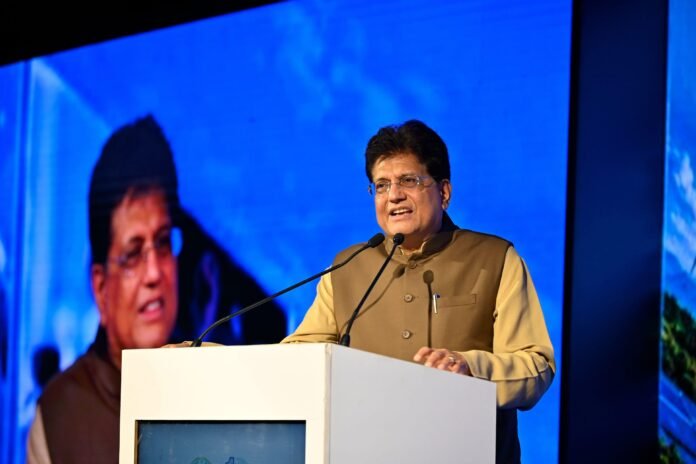
India and the United States are close to finalising their long-pending bilateral trade agreement, Commerce and Industry Minister Piyush Goyal said on Friday, with the process that had held back the deal now taking shape.
“The US trade deal is close to culmination. The process and pathway, which was always something which held back finalising the deal, is now taking some shape,” Goyal said while addressing the India Debt Capital Market Summit 2026, organised by TRUST Group, virtually.
His remarks came days after Washington proposed a fresh tariff framework for Indian goods, offering New Delhi a slightly better rate than several Asian rivals if the two countries conclude a trade pact.
What Washington has proposed
The United States Trade Representative (USTR) has proposed tariffs of up to 25 per cent on goods imported from India, following an eight-month investigation under Section 301(b) of the Trade Act of 1974 into alleged structural excess capacity and production in manufacturing sectors.
The USTR said the rate could be capped at 17 per cent if India and the US reach a reciprocal trade agreement addressing the issues raised in the investigation. India was one of 14 economies covered by the report, alongside China, the European Union, Japan, South Korea, Vietnam, Bangladesh, Indonesia, Malaysia, Thailand, Taiwan, Singapore, Switzerland, Norway, Mexico and Cambodia.
The proposed rates vary by country. With a deal in place, Bangladesh, Cambodia, Indonesia, Malaysia and Thailand would face 18 per cent, while the European Union, Japan, South Korea, Switzerland and Taiwan would face 15 per cent.
India has rejected the US finding of structural excess capacity in any sector. The Commerce Department said hours after the announcement that India does not have structural excess capacity in any sector and that any trade-related concerns should be addressed within the framework of the bilateral trade negotiations.
A deal held up by the tariff framework
India and the US announced a framework for an interim bilateral trade agreement in early February 2026. Under that framework, Washington had proposed bringing reciprocal tariffs on India down to 18 per cent, from a total of 50 per cent, which included a 25 per cent tariff imposed over purchases of Russian oil.
Negotiations then ran into uncertainty after the US Supreme Court struck down the Trump administration’s reciprocal tariffs imposed under the International Emergency Economic Powers Act, overturning the tariff structure on which the framework had been negotiated. India currently faces an additional tariff of 10 per cent under the Section 301 findings on forced labour.
India-EU pact and the wider trade push
Goyal also said the India-European Union free trade agreement is expected to be signed later this year in December and could come into effect by March or April 2027.
He said India’s free trade agreement coverage had expanded sharply in recent years. Nine agreements finalised in the past four to five years, covering 38 developed countries, now give India preferential access to markets representing about 70 trillion dollars of gross domestic product. Another eight or nine agreements under negotiation could add about 15 trillion dollars, taking total coverage to about 85 trillion dollars out of global GDP of 115 to 120 trillion dollars.
“Almost every country in the world wants to do an FTA with India. We will add another 15 trillion dollars. 85 trillion dollars out of 115-120 trillion dollars of global GDP will see India as a trusted partner; will see opportunities for India’s businesses to take forward,” Goyal said.
Goyal on oil prices and the bond market
On crude oil, Goyal said markets were too quick to re-rate or de-rate India on small movements in oil prices. While higher prices do affect an economy, he said, concerns that made sense in the 1990s or up to 2005-06 no longer apply to a much larger economy.
“This could be an important matter of concern when we had much smaller foreign exchange reserves, much smaller remittances coming into the country, much less foreign direct investments coming into the country,” he said, adding that “a few dollars up or down” in oil prices cannot determine the next 20 to 30 year future of the country when the export basket has grown and GDP is growing.
Goyal also urged large corporates, public sector undertakings and infrastructure developers to make the bond market their first port of call, even for long-duration funding for capital expenditure. He asked insurers, pension funds and mutual funds to hold more long-term paper and look beyond AAA-rated issuers.
The minister further asked exporters and their financiers to turn free trade agreements into investment decisions and build capacity for newly opened markets.
Frequently Asked Questions
What did Piyush Goyal say about the India-US trade deal?
Goyal said on 27 November 2026 that the India-US trade deal is close to culmination, with the process and pathway for finalising the pact now taking shape.
What tariffs has the US proposed on Indian goods?
The USTR has proposed tariffs of up to 25 per cent on Indian goods, which could be capped at 17 per cent if India and the US conclude a reciprocal trade agreement.
When is the India-EU free trade agreement expected to take effect?
Goyal said the India-EU free trade agreement is expected to be signed in December 2026 and could come into effect by March or April 2027.

