
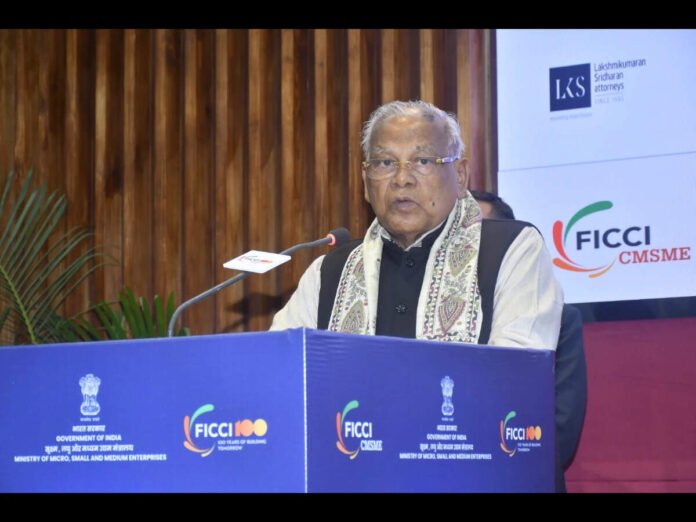
India’s expanding network of free trade agreements is opening new export doors for micro, small and medium enterprises, but market access alone will not guarantee success, Union MSME Minister Jitan Ram Manjhi said on Wednesday. Speaking at the 12th FICCI-CMSME Annual Summit in New Delhi, he said India had concluded nine FTAs over the past six years and pitched growth capital and technology adoption as the priorities for the next phase of MSME growth.
Manjhi said smaller businesses would need to strengthen their capabilities to benefit from the trade partnerships. Access to international markets would need to be accompanied by improvements in technology, production capacity and business processes, he said.
Nine FTAs and what they mean for small exporters
Citing the India-UK and European Free Trade Association (EFTA) agreements, Manjhi said nearly 99% of Indian exports could enter the UK duty-free, while concessions under the EFTA agreement covered tariff lines representing 99.6% of India’s exports. He also pointed to provisions allowing exporters to establish the origin of their products through self-declaration.
“However, market access by itself does not guarantee success,” the minister said, stressing the need to strengthen the competitiveness of Indian businesses.
From survival to scaling up
Manjhi said the government’s approach to MSMEs is shifting from helping businesses survive to enabling them to expand and become globally competitive. “For decades, the focus was on enabling enterprises to survive. Today, the discussion has evolved and it is about helping enterprises scale, building globally competitive businesses, creating national champions,” he said.
He highlighted that MSMEs contribute 31.1% to India’s gross domestic product (GDP), 35.4% to manufacturing output and 48.58% to exports. According to the minister, the sector plays a key role in employment generation, entrepreneurship and regional economic development across the country.
Registrations on the Udyam Registration Portal and Udyam Assist Platform crossed 10 crore on October 30, 2026, he said, and these registered enterprises were associated with employment for around 42 crore people.
Growth capital, not just bank credit
On financing, Manjhi said the challenge is no longer limited to the availability of bank credit. MSMEs also needed growth capital to expand their operations, he said.
He said the Self-Reliant India Fund, with a corpus of Rs 10,000 crore, had seen commitments of Rs 8,305 crore through 72 daughter funds. The fund has mobilised nearly Rs 48,000 crore in additional private capital, according to the minister. So far, 824 MSMEs have received investments worth Rs 21,330 crore, with micro enterprises accounting for around 74% of the beneficiaries, he said.
Building on this initiative, the government has launched a separate Rs 10,000 crore SME Growth Fund. Manjhi said the fund would make direct investments in small and medium enterprises to help growth-ready businesses expand.
Addressing the summit, Manjhi identified three priorities for the next phase of MSME growth:
– Global competitiveness and exports – Access to growth capital – Technology adoption and digital transformation
Women entrepreneurs and formalisation
The minister outlined the government’s target to increase women’s share in enterprises registered on the Udyam platforms to 50% from the current 37.6%. “Women already own 37.6% of the enterprises registered on the Udyam platforms, and we must now aim to take that share to 50%,” Manjhi said.
He also pointed to public procurement as an important source of market access for smaller businesses. During FY27 so far, 118 central public sector enterprises had purchased goods and services worth Rs 31,443 crore, of which 54% came from micro and small enterprises. More than 29,000 such enterprises benefited from the procurement, according to figures cited by the minister.
Technology adoption key to competitiveness
Manjhi identified technology adoption as another priority for improving MSME competitiveness. He said artificial intelligence, automation, cloud computing, digital commerce and data-based decision-making were increasingly becoming accessible to businesses of different sizes.
“Artificial intelligence, automation, cloud computing, digital commerce and data-based decision-making are no longer limited to large companies. They are becoming accessible tools for businesses of every size. Even an entrepreneur operating from a small town can use digital platforms to reach global markets, streamline business processes, improve customer engagement and manage inventory more efficiently,” Manjhi said.
The minister also called for greater participation from women entrepreneurs, young innovators, artisans and businesses from aspirational districts, so enterprises could graduate from micro to small, small to medium, and eventually become nationally and globally competitive businesses.
Frequently Asked Questions
What did MSME Minister Jitan Ram Manjhi say about FTAs?
Manjhi said India has concluded nine free trade agreements over the past six years. Nearly 99% of Indian exports can enter the UK duty-free under the India-UK FTA, and EFTA concessions cover tariff lines representing 99.6% of India’s exports, but market access alone does not guarantee success.
How many MSMEs are registered on the Udyam platforms?
Registrations on the Udyam Registration Portal and Udyam Assist Platform crossed 10 crore on October 30, 2026. Women-led enterprises account for 37.6% of registrations, and the government aims to raise that share to 50%.
What growth capital support did Manjhi highlight for MSMEs?
Manjhi said the Rs 10,000 crore Self-Reliant India Fund has seen commitments of Rs 8,305 crore through 72 daughter funds and mobilised nearly Rs 48,000 crore in additional private capital, with 824 MSMEs receiving Rs 21,330 crore. The government has also launched a separate Rs 10,000 crore SME Growth Fund for direct investments in small and medium enterprises.