
Thursday, March 12, 2026
Home Blog Page 270

Gresham’s law: what happens when governments fix currency exchange rates

0

Gresham’s law:

The law, named after English financier Thomas Gresham, came into play most recently during the economic crisis in Sri Lanka last year, during which the Central Bank of Sri Lanka fixed the exchange rate between the Sri Lankan rupee and the U.S. dollar.

Gresham’s law refers to the dictum that “bad money drives out good.” Gresham’s law comes into play when the exchange rate between two moneys or currencies is fixed by the government at a certain ratio that is different from the market exchange rate. Such price fixing causes the undervalued currency — that is, the currency whose price is fixed at a level below the market rate — to go out of circulation. The overvalued currency, on the other hand, remains in circulation but it does not find enough buyers.

It should be noted that the market exchange rate is essentially an equilibrium price at which the supply of a currency is equal to the demand for the currency. Also, the supply of a currency in the market rises as its price rises and falls as its price falls; while, on the other hand, the demand for a currency falls as its price rises and rises as its price falls. So, when the price of a currency is fixed by the government at a level below the market exchange rate, the currency’s supply drops while demand for the currency rises. Thus price cap can lead to a currency shortage with demand for the currency outpacing supply.

Origins of the term

Gresham’s law is named after English financier Thomas Gresham who advised the English monarchy on financial matters. It applies not just to paper currencies but also to commodity currencies and other goods. In fact, whenever the price of any commodity — whether it is used as money or not — is fixed arbitrarily such that it becomes undervalued when compared to the market exchange rate, this causes the commodity to disappear from the formal market. The only way to get hold of an undervalued commodity in such cases would be through the black market. Sometimes, countries can even witness the outflow of certain goods through their borders when they are forcibly undervalued by governments.

Gresham’s law can be seen at play whenever a government fixes the exchange rate (or price) of a commodity (such as gold and silver coins) far below than the market price of the commodity backing them. In such cases, people who hold commodity money would stop offering the money at the price fixed by the government. They may even melt such commodity money to derive pure gold and silver that they can sell at the market price, which is higher than the rate fixed by the government.

https://instagram.com/mib_india?igshid=MzRlODBiNWFlZA==

Driving out the dollar in Sri Lanka

The law came into play most recently during the economic crisis in Sri Lanka last year, during which the Sri Lankan central bank fixed the exchange rate between the Sri Lankan rupee and the U.S. dollar. The Central Bank of Sri Lanka, at a certain point, mandated that the price of the U.S. dollar in terms of the Sri Lankan rupee should not rise beyond 200 rupees per dollar even though rates in the black market suggested that the U.S. dollar should sell for far more than 200 rupees. In effect, people were banned from paying more than 200 Sri Lankan rupees for a dollar, thus causing the rupee to be overvalued and the U.S. dollar to be undervalued when compared to the market exchange rate. This caused the supply of dollars in the market to fall and the U.S. dollar to be gradually driven out of the formal foreign exchange market. People who wanted U.S. dollars to purchase foreign goods then had to purchase dollars from the black market by paying far more than 200 Sri Lankan rupees for each U.S. dollar.

Gresham’s law, however, holds true only when the exchange rate between currencies is fixed under law by the government and the law is implemented effectively by authorities. In the absence of any government decree fixing the exchange rate between currencies, it is good money that eventually drives bad money out of the market and not the other way round. When the exchange rate between currencies is not fixed and people have the choice to freely choose between currencies, people gradually stop using currencies that they consider to be of poor quality and adopt currencies that are found to be of better quality. This phenomenon wherein “good money drives out bad” is called Thiers’ law (named after French politician Adolphe Thiers) and it is seen as a complement to Gresham’s law. The rise of private cryptocurrencies in recent years has been cited by many analysts as an example of good money issued by private money producers driving out bad money issued by governments.

Latest:
The signals from this ‘Made in China’ smartphone story

0

Huawei, the Chinese smartphone giant, has created ripples within the strategic and business community with its newly unveiled Mate 60 Pro which houses the Kirin 9000 processor. The chipset reportedly used Semiconductor Manufacturing International Corp (SMIC)’s second-generation 7nm fabrication technique, thereby demonstrating China’s capability to manufacture a 7nm chip.

Challenges before China’s quest

Consequently, observers have claimed that the capability marks a major breakthrough in Beijing’s drive to attain self-sufficiency in manufacturing advanced chips. The fact that China succeeded in achieving this feat despite American sanctions on key semiconductor technologies has led many to even question the efficacy of the sanctions. However, while China’s technology demonstration deserves appreciation, the capability itself might not mean much as several challenges besiege its self-sufficiency drive.

To begin with, the fabrication technique used by Huawei-SMIC to manufacture the Kirin 9000 processor is highly inefficient. The wafer yield (a metric of efficiency) of the deployed technology is way less than 50%. In contrast, Taiwan’s Taiwan Semiconductor Manufacturing Company Limited (TSMC)’s 7nm fabrication technique has a wafer yield in excess of 90%. This makes the SMIC’s process extremely expensive — up to 10 times the costs incurred by other players in the market, and therefore highly uncompetitive.

Second, the 7nm fabrication technique represents the zenith of China’s capabilities with the available Deep Ultraviolet (DUV) lithography tools. The United States’s sanctions that cut off Beijing’s access to the most advanced lithography tool in the market — the Extreme Ultraviolet (EUVs) — meant that China had to rely on DUVs to fabricate the Kirin 9000 chipset. While DUVs can technically be used to make 7nm chips, the process is extremely messy and inefficient, thus lowering its yield. For instance, the SMIC technique used multiple rounds of masking or layering on the wafer to manufacture a 7nm chipset, leading to multiple exposures. On the other hand, the TSMC with the EUVs can perform the same task of high complexity with a single exposure.

Third, it is doubtful that Huawei-SMIC could produce the current chipsets on a large scale. The fact that the U.S. and its allies have restricted China’s access to even DUVs lately means that large-scale production of 7nm chips would be a challenge for Chinese companies.

Thus, low yield rates, inefficient and costly procedures along with difficulty in achieving the scale are likely hurdles in Huawei’s attempt to commercialize its new technology product. This is significant because the failure to achieve commercialisation will impact incremental innovation as they reinforce each other. And products that fail to innovate alongside their competition eventually fade away.

The U.S. and China systems, a comparison

Besides, there are several other challenges that plague China’s chip ecosystem compared to the U.S.-led ecosystem. The fact that America’s encompasses the most advanced economies of the world confers upon it several advantages that China’s isolated ecosystem will find nearly impossible to compete with.

First, the extensive and distributed nature of the U.S.-led tech ecosystem allows individual countries to achieve functional specialization according to their respective comparative advantages. The existing supply chain — where the U.S. specializes in EDA tools and designing, the Netherlands in producing lithography tools, Japan in manufacturing specialized materials, and Taiwan and South Korea in fabrication — corroborates the claim.

China, on the other hand, not only has the mandate to become self-sufficient in each segment of the value chain but has to also achieve sophistication in each of these to remain competitive. Achieving specialization in any one segment of the chip value chain itself is highly capital intensive; to achieve so in each of them is impossible. It is also important to remember that advanced chips are only one of the many core technologies that China aims to become self-sufficient in. Given that the Chinese ecosystem is not as elaborate as the U.S.’s and is rather isolated, there are limits to Beijing’s potential with its finite resources.

As for the U.S.-led ecosystem, the costs can be distributed among the participating countries, most of which have much higher per-capita income than China. Therefore, to compete with a larger pool of resources, China will need to strike a higher success rate on every dime it spends on research, which is difficult to achieve given that breakthroughs in basic research are capital intensive and may not yield success as often. If that alone is not enough to burden the scientific community, the pressure to perform and deliver in China’s authoritarian system further compounds the problem. To sum it up, China’s appetite to absorb failures is extremely limited when compared to the U.S. and its allies. 

https://instagram.com/china.travels?igshid=MzRlODBiNWFlZA==

This makes for quite an unconducive environment for innovation given that it thrives best in a free environment. Finally, the U.S.-led tech ecosystem allows it to source talent from diverse regions, owing to its open immigration policy and distributed network. China, on the contrary, will have to solely rely on its national or overseas talent pool as the movement of human capital to China becomes more difficult due to deepening rivalry in the high-tech sectors.

Going forward, China’s tech ecosystem faces a daunting challenge to succeed in everything all by itself. It may score a victory in odd areas, but replicating the feat in every single domain is impractical.

While China’s technology demonstration deserves appreciation, its self-sufficiency drive faces several hurdles.

Latest:

Ridding India of food insecurity

0

food insecurity

India may be the fastest growing large economy of the world, but it is also facing accelerating food-price inflation. The rise in the price of food first accelerated sharply in 2019, and has climbed in most years thereafter. In July this year, annual inflation exceeded 11%, the highest in a decade. An implication of continuing high food-price inflation is that a section of the population could be facing hardship in consuming food of adequate nutritional value.

food insecurity

We now have some evidence to this effect. The ‘State of Food Security and Nutrition in the World’ of the Food and Agriculture Organization (FAO) estimates the proportion of the population across countries unable to afford a healthy diet (reported in this newspaper on August 31, 2023, under a datapoint). The figure for India in 2021 is devastating to note — an estimated 74% of the population cannot afford a healthy diet. Given a population of 1,400 million, this makes for approximately one billion Indians. A shrinking ability of households to finance their food requirement is evident also in studies undertaken in India itself.

Why this finding is plausible

A study reported in this daily (August 30, 2023 under a datapoint), of the trend in the price of food in Mumbai city over 2018-2023 found that while the cost of preparing a thaali at home has risen by 65%, in this period, the average wage of a manual worker rose by 38% and that of a salaried worker by 28%. The implied reduction in purchasing power is considerable, and it would be reasonable to expect that food consumption has been impacted. This would be in line with the reported rise in the prevalence of anemia, mostly induced by nutrient deficiency, in the latest National Family Health Survey undertaken over 2019-21. Over 50% of adult women were estimated to be anemic. This suggests that the FAO’s finding, that over half of India cannot afford a healthy diet, is plausible. Even if we were to assume that the agency has overestimated numbers by 100% we would be left with 500 million people in this category. This is larger than the population of all the countries of the world other than China.

food insecurity :

Ensuring that Indians have access to a healthy diet is the most important task of economic policy today. Macroeconomic policy, relied upon to control inflation, has proved to be useless in the context. The Reserve Bank of India has failed in this task, with the inflation rate mostly higher than the target for four years by now. Its approach of contracting output when the inflation rate rises — misleadingly termed “inflation targeting” — does nothing to manage food inflation stemming from the supply side. 

https://instagram.com/health?igshid=MzRlODBiNWFlZA==

Central banks are incapable of solving this problem, it must be said within any time frame. It is necessary to intervene on the supply side to ensure that food is produced at a steady price by raising the yield on land.

The significance of the Green Revolution

India has rich experience in this area, having engineered a Green Revolution in the 1960s, but it is not being tapped. At the time, reeling under extreme food shortage following two successive droughts, the government orchestrated a supply-side response by providing farmers with high-yielding seeds, cheap credit, and assured prices through procurement. This succeeded spectacularly. Within a few years India was no longer dependent on food imports.

If there was a single event that aided India’s quest to be self-reliant in the highly polarized climate of the Cold War, it was this. Western economists have pointed to the success of the United States’ mission to land a human on the moon as an example of an entrepreneurial state. However, to have engineered the Green Revolution in India at a time when it was a desperately poor country challenged by having to ensure food security to a staggeringly large number is perhaps more significant.

With hindsight, we can see that mistakes were made, among them the rampant use of chemical fertilizer, fuelled by subsidy, which degraded the soil. There was also the reliance on procurement prices rather than productivity increase to ensure farm incomes, which fuelled inflation. We also see that the policy was almost exclusively focused on cereals rather than pulses, the main source of protein for most Indians. However, rather than caring about the errors made in an extraordinarily successful economic policy intervention, we should be correcting them now. 

At the same time, we should focus on the specific goal of lowering the cost of producing food. The first Green Revolution had a specific agenda — of making India self-sufficient in food. In this it succeeded eminently, and in a remarkably short time, but without paying any attention to the cost of producing food. For this, a second agricultural revolution is needed now. To contain the rising price of food would require action on many fronts; a mission mode is necessary. As for policy, it is clear that procurement prices, cash transfers, the Public Distribution System, and priority lending required of public sector banks are not sufficient. 

Yield increasing interventions on the farm are needed to at least contain the cost of production, if not to actually lower it. Agricultural yield is lower in India than in East Asia, pointing to the potential for an increase. Attention is needed to extend irrigation to 100% of the net sown area, an end to restrictions on leasing of land, a quickening of agricultural research and the re-institution of extension.

Initiatives to work on

Expanding on each of these proposals would be in order. It has been pointed out for some time that increased public expenditure on irrigation is not reflected in an increase in irrigated area — whether due to waste or the diversion of funds has not been established. The ongoing fragmentation of already small land holdings lowers the capacity for productivity-enhancing capital investment, for which leasing is a solution. India’s network of public agricultural research institutes needs to be energised to resume the sterling role they had played in the 1960s. Finally, extension has now more or less vanished from where once the gram sevak was a familiar figure in the village, playing a crucial role in the dissemination of best practices. It must be revived. These initiatives should be dovetailed into a programme for the manifold increase of protein production, which India is severely deficient in.

In all the areas identified above, the role of States is crucial. In the 1960s, the States that were chosen for the spread of the new technology worked closely with the central government. This would have to be replicated in order to make a difference to the country as a whole, with the central government taking the States along in a spirit of co-operative federalism. At the same time, it may be asked if the States are playing their part to enhance agricultural productivity rather than relying on food allocations to their Public Distribution System from the central pool.

But, a non-ideological approach would be needed, whether at the Centre or in the States, if a difference is to be made. A noticeable feature of the first Green Revolution was that by relying on private enterprise, the then Prime Minister, Indira Gandhi, chose a capitalist approach (with the objective of making India self-sufficient in food), unmindful of any damage that would be caused to her socialist image. It was the Green Revolution that made the first dent on poverty in India. So, the poor did benefit from this strategy. Similarly, now, in order to ensure that all Indians have permanent access to a healthy diet, no approach consistent with ecological security must be off the table.

Ensuring that Indians have permanent access to a healthy diet is the most important task of economic policy today.

Latest:

Launch of West Asia economic corridor is a historic step: PM

0

West Asia economic corridor

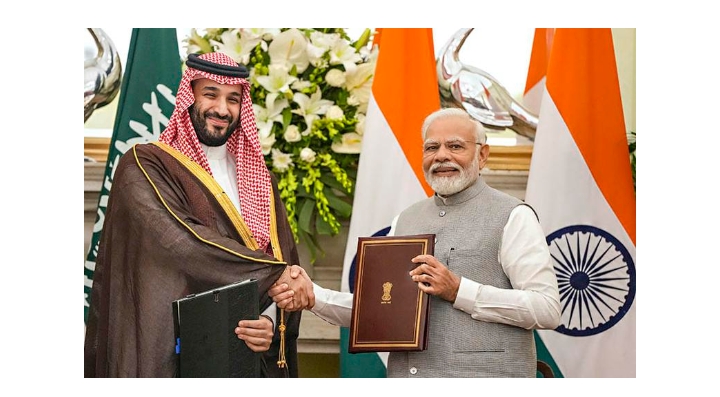
Two days after the launch of the India-Middle East-Europe Economic Corridor, Prime Minister Narendra Modi on Monday described Saudi Arabia as “one of the most important strategic partners of India”.

https://instagram.com/saudi2027?igshid=MzRlODBiNWFlZA==

The exchange between the two sides took place during the state visit of Crown Prince Mohammed Bin Salman of Saudi Arabia when they agreed to set up a joint task force to fast-track the West Coast refinery project.

West Asia economic corridor:

“As two of the world’s fastest growing countries, our partnership is important for the stability of the entire region. Yesterday, we took the historic step to connect India, West Asia, and Europe through an economic corridor. Apart from connecting the two countries, the corridor will help in the increase of economic growth, energy sector and digitisation,” said Mr. Modi, conveying India’s gratitude for the Kingdom’s initiatives to ensure welfare of the resident Indian expats.

Significant visit

Mr. Modi and Prince Bin Salman also co-chaired the first meeting of the India-Saudi Strategic Partnership Council (SPC).

West Asia economic corridor:

The State visit of the Crown Prince is significant as it comes months after Saudi Arabia ended hostility with Iran through a deal that was negotiated by China. It has also come weeks after Saudi Arabia became a member of the BRICS during the Johannesburg summit. The discussion focused on defence, energy, security, education, technology, transportation, healthcare, tourism and culture, space, and semiconductors as areas of possible cooperation.

Latest: 

MCD, Delhi Govt. to build on G-20 assets, expand revamp works to other parts of city

0

MCD

The NDMC Vice-Chairperson said the civic body will continue maintaining installations, including fountains and sculptures, placed in New Delhi over the past few weeks for the summit.

1,400 km of roads under PWD will undergo a makeover, says Minister Atishi; NDMC deploys guards to protect installations, such as fountains and sculptures, installed in the run-up to the summit.

A day after the conclusion of the two-day G-20 Summit, Delhi Ministers and the Mayor said the various beautification initiatives carried out in parts of the city in the run-up to the global event will be extended across the national capital over the coming days.

For more than six months, several agencies, including the Public Works Department (PWD), the Municipal Corporation of Delhi, and the New Delhi Municipal Council (NDMC), worked in tandem to carry out redevelopment works in the Capital to prepare it for the two-day summit, which ended on Sunday.

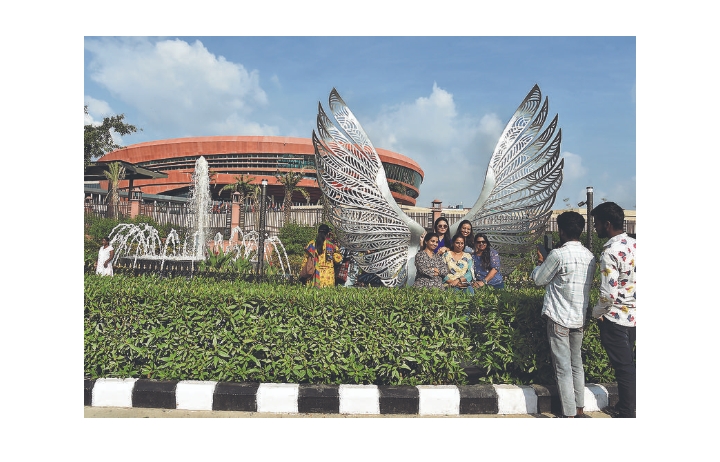
As part of the revamp, the agencies redesigned over 40 key road stretches, placed nearly seven lakh potted plants, and installed several fountains and sculptures in various parts of the city, including the summit venue, Bharat Mandapam.

Addressing a press conference with PWD Minister Atishi on Monday, Urban Development Minister Saurabh Bharadwaj said, “The Delhi government will now take over the responsibility of maintaining the beauty of Delhi. All the government departments and the MCD will work to improve and beautify other parts of the city.”

The PWD Minister said the entire city will be beautified over the coming days on the lines of the New Delhi district, which was given a facelift for the summit. She added that 1,400 km of roads under the PWD will undergo a makeover, including beautification, redesigning, and landscaping of various stretches, along with improvement in the lighting and the footpaths along the roads.

https://instagram.com/arvindkejriwal?igshid=MzRlODBiNWFlZA==

In January this year, Chief Minister Arvind Kejriwal had announced a similar plan to repair and beautify the roads under the PWD. He had said that all such roads would be resurfaced twice in 10 years and that the road markings, zebra crossings, and footpaths would be repainted every three to six months. The CM had also said that a third-party monitoring system would be set up to record the live status of the roads.

Nine-point agenda

NDMC Vice-Chairperson Satish Upadhyay said the civic body had deployed guards at various spots to secure the potted plants and lights put up for the summit. He said the civic body will continue maintaining the installations, including fountains and sculptures, placed in New Delhi over the past few weeks.

Mayor Shelly Oberoi said the MCD will continue to work to keep the city clean and thanked the civic body employees for their efforts to beautify the city.

AAP MLA and party’s MCD in-charge Durgesh Pathak announced a “nine-point agenda” to rid the city of garbage and said the municipality will continue to ensure cleanliness in the city.

Latest:

Aditya L1 completes another step in its journey towards sun

0

Aditya L1

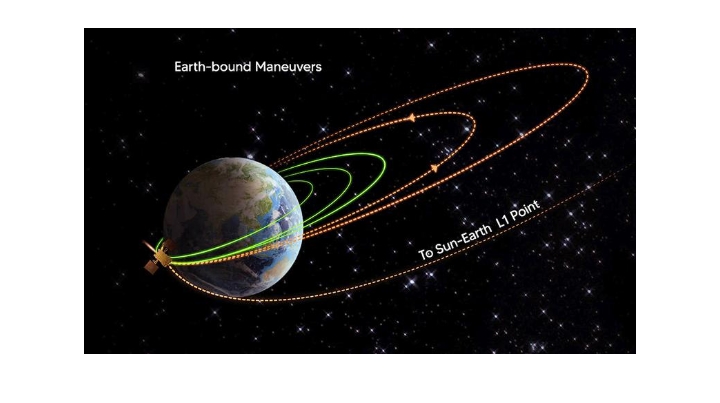
Aditya-L1 will stay approximately 1.5 million km away from earth, which is about 1% of the earth-sun distance. X/@isro

Spacecraft undergoes third earth-bound maneuver successfully, says ISRO; two more maneuvers are scheduled on September 15 and 18

Aditya L1 (Sun)

The third earth-bound manoeuvre of the Aditya L-1 spacecraft, India’s first space-based mission to study the sun, was successfully performed in the early hours of Sunday, the Indian Space Research Organisation (ISRO) said.

Aditya L1 (Journey towards Sun)

The maneuver was carried out by the Telemetry, Tracking and Command Network (ISTRAC) in Bengaluru. “The third Earth-bound maneuver (EBN#3) is performed successfully from ISTRAC, Bengaluru. ISRO’s ground stations at Mauritius, Bengaluru, SDSC-SHAR and Port Blair tracked the satellite during this operation,” the ISRO posted on X.

The new orbit attained is 296 km x 71767 km, the space agency said. Two more maneuvers are scheduled to take place. “The next maneuver (EBN#4) is scheduled for September 15, 2023, around 02:00 Hrs. IST,” it said.

After the final maneuver on September 18, Aditya-L1 will undergo a Trans-Lagrangian1 insertion maneuver, marking the beginning of its 110-day trajectory to the destination around the L1 Lagrange point. Upon arrival at the L1 point, another maneuver will bind Aditya-L1 to an orbit around L1, a balanced gravitational location between the earth and the sun.

Aditya-L1 will stay approximately 1.5 million km away from earth, directed towards the sun, which is about 1% of the earth-sun distance.

As G-20 plans to explore crypto regulation, India may wait to firm up domestic laws

0

With the G-20 countries agreeing to explore a coordinated regulatory framework for crypto assets, India could wait a while longer before firming up its domestic regulations for cryptocurrencies, and initiate a dialogue with stakeholders on the way forward.

An outright ban on cryptocurrencies that was mooted by the Reserve Bank of India, and under consideration by the government, is likely off the cards, a senior government official indicated on Sunday.

“Earlier, India was contemplating a ban on it. A lot of conversation happened. In late 2021, there was a lot of interest in cryptocurrencies, a lot of people were buying it and even advertisements were coming in IPL matches, which we felt was not on,” the official recalled.

When we went deeper into regulating it, we realised one country alone cannot do it. Unless we get into monitoring and controlling every device on the Internet, which is not the kind of regulation we want in India. So whatever we do, all along this thought has been there to build a global consensus,” the official said.

The G-20 leaders’ declaration has endorsed the Financial Stability Board (FSB) recommendations to regulate and supervise crypto-assets’ activities. It welcomed a synthesis paper from the International Monetary Fund (IMF) and the FSB, which includes a road map for a coordinated regulatory framework that factors in risks, including those specific to emerging markets, and pertaining to money laundering and terror financing.

Timely execution

The G-20 Finance Ministers and Central Bank Governors will discuss taking forward this road map at a meeting in Marrakesh next month.

“Any country can allow higher risks if they want, or ban it if they like, but whatever one does, it should not go below a certain level of regulation otherwise It will lead to shifting of the trade to other jurisdictions,” the official pointed out, explaining the G-20 push for timely implementation of FSB recommendations in a consistent manner globally to avoid regulatory arbitrage.

“It has to be taken up not just by the G-20 countries, but others as well. If one country says we will have a very relaxed approach towards it, it will defeat the entire purpose,” the official said.

IMF Managing Director Kristalina Georgieva said on Sunday that “more work lies ahead” in the realm of digital money and crypto assets.

How did a China-based hacking group compromise Microsoft’s cloud security

0

China

The company said that the group, identified as Storm-0558, breached U.S. government-linked email accounts of 25 organizations, including emails from top American officials such as Commerce Secretary Gina Raimondo and U.S. Ambassador to China Nicholas Burns.

The story so far:

In July, Microsoft said that a China-based hacking group breached U.S. government-linked email accounts. The company said the group identified as Storm-0558, gained access to email accounts of 25 organizations, including Western European government agencies, email accounts from top American officials such as Commerce Secretary Gina Raimondo, U.S. Ambassador to China Nicholas Burns, and Assistant Secretary of State for East Asia Daniel Kritenbrink. The attacks stemmed from the compromise of a Microsoft engineer’s corporate account. The company further explained that hackers were able to extract a cryptographic key from the engineer’s account to access email accounts. The flaw has been fixed now.

When did the attacks start?

The attack on email accounts of American government officials was first noticed when customers reported abnormal activity on June 16. Microsoft then began an investigation which revealed that from May 15, Storm-0558 gained access to email accounts affecting approximately 25 organizations in the public cloud including government agencies as well as related customer accounts of individuals associated with them.

What is Storm-0558?

Microsoft Threat Intelligence “with moderate confidence” assessed that Storm-0558 is a China-based threat actor with activities and methods consistent with espionage objectives. The group is thought to operate as its own distinct group and its core working hours are consistent with working hours in China, Microsoft said in a blog post.

In the past, the group has been seen to have primarily targeted U.S. and European diplomatic, economic, and legislative governing bodies, and individuals connected to Taiwan and Uyghur geopolitical interests. The group has been targeting Microsoft accounts since August 2021 and had reportedly obtained credentials for initial access through phishing campaigns and exploited vulnerabilities in public-facing applications to gain access to victims’ networks.

How did the threat actors breach Microsoft’s security?

The China-based threat actor was able to compromise Microsoft’s cloud security systems by using an acquired MSA key to forge tokens to access Outlook Web Access (OWA), Microsoft’s web-based mail client that is part of the company’s Exchange Server, Outlook.com. MSA keys are token signing keys used by a service to validate authentication tokens for the service.

Hackers then used the acquired key to forge a token that was used for validation issues to impersonate Azure AD users and gain access to enterprise email.

What is a cryptographic key?

A cryptographic key is a string of characters used within an encryption algorithm to alter data making it eligible to someone without the correct key. Like a physical key, a cryptographic key encrypts data and is used to decrypt the encased data by the holder of the key.

In the case of SSL encryption (HTTPS), two types of encryptions are used. They can be symmetric and asymmetric encryptions. In symmetric encryption, both sides of a conversation use the same key for turning plain text into cyphers (encrypted) text.

However, in asymmetric or public key encryption, the two sides of the conversation use a different key. A public key and a private key, the private key is never shared by the party with anyone. When plaintext is encrypted with the public key, only the private key can decrypt it, not the public key.

How did hackers acquire MSA keys?

Microsoft, after its technical investigation into the attack, revealed that the key was stolen from its corporate environment due to a series of errors. Threat actors compromised a Microsoft engineer’s account gaining access to the company’s network and debugging environment. A debugging environment is used by companies to test their products during production and fix errors and bugs in the source code before they are released to the public.

In this case, the consumer signing key was present in the debugging environment due to a consumer signing crash in April 2021, that resulted in a snapshot of the crashed process. A crash dump is a file of digital records related to the crash. The crash dump should not have included the signing key of the consumers, Microsoft said in a blog post. And, since Microsoft says it was not aware of the presence of the key in the crash dump, the dump was moved outside the isolated production network into the company’s debugging network, connected to its internet-connected corporate network.

Microsoft’s investigation into the report further adds that the company does not have logs related to the “specific evidence of this exfiltration by this actor”, the engineer’s account, due to their log retention policies. The company, however, says that this was the most probable mechanism by which the actor acquired the key.

How has China responded to reports of the attack?

China called the Microsoft report about the China-based hacking group breaching government-linked email accounts “disinformation”, a report from AP said. A Chinese foreign ministry spokesman, Wang Wenbin, further added the accusation was “disinformation” aimed at diverting attention from U.S. cyberattacks on China. “No matter which agency issued this information, it will never change the fact that the United States is the world’s largest hacker empire conducting the most cyber theft,” Mr. Wang added in a routine briefing.

Japan keen to deepen defence ties with India, says Kishida

0

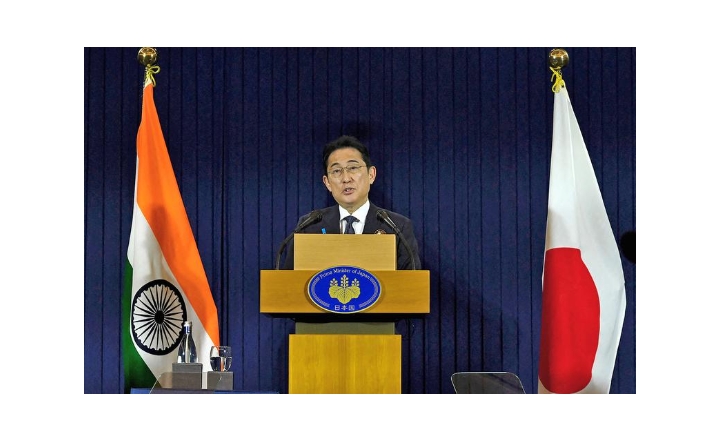
Making a point: Japan’s Prime Minister Fumio Kishida speaks during a news conference after attending the G-20 summit, in New Delhi on Sunday.

Japan Prime Minister refers to the harsh security environment in the region, and says the country is ‘opposed to unilateral changes to the status quo in East and South China Seas’; he defends the Delhi 

Declaration as a ‘meaningful achievement’

Japan sees India as an “indispensable” partner in the Indo-Pacific and is keen to develop deeper defence cooperation to ensure maritime security in the region, Prime Minister Fumio Kishida said on Sunday.

“Our Self-Defence Forces and the Indian Armed Forces have already conducted joint exercises this year between all services of land, sea and air. Our cooperative relationship is deepening steadily,” Mr. Kishida said to a question from The Hindu on India’s role in his new Free and Open Indo-Pacific (FOIP) strategy.

“For example, as we did last year, our maritime Self-Defence Forces and the Indian Navy engaged in joint exercises this July and the Japan-Australia-India-U.S. Quad joint drill Malabar was also held on a continuous basis. So, going forward, to ensure the Indo-Pacific will not be a region that will be decided by force, and will be a region that values freedom and rule of law, we will continue active defence cooperation and exchanges with India.”

Mr. Kishida stressed that Japan’s FOIP was “an inclusive and open concept and has no specific country in mind.”

Security environment

At the same time, he described “an increasingly harsh security environment in the region”, and said Japan was “opposed to unilateral changes to the status quo in East and South China Seas”, and also “firmly condemned North Korea’s missile activities”.

“The FOIP that Japan is promoting is a concept to uphold and reinforce a free and open international order based on rule of law in the Indo-Pacific region. And by doing so we aim to ensure peace and stability and prosperity in the entire region and ultimately across the world. That is the vision.”

Mr. Kishida had announced his new FOIP plan during a visit to India in March this year. “As a concrete measure we announced the reinforcement of our support to maritime law enforcement capabilities and for maritime security,” he said. “In particular, India is an indispensable partner to realise a FOIP.”

Mr. Kishida defended the G-20 New Delhi Declaration as a “meaningful achievement” when asked about the absence of a reference to Russia’s aggression against Ukraine, which was mentioned in last year’s Bali Declaration, but warned it was “shaking the foundation” of the G-20.

Russian invasion

“Today as the world faces complex crises, collaboration at G-20 as premier forum for economic cooperation is becoming increasingly important. Russia’s aggression of Ukraine is shaking the very foundation of cooperation at G-20. It could shake the basis of cooperation at G-20. Further, it is causing enormous impact to the world economy through factors such as protracted rise of food and energy prices,” he said.

At the same time, he said the fact that the declaration “was adopted along with support of Russia is very meaningful”. “There are various comments such as this being a weak declaration without explicit condemnation,” he said.

Even in comparison to the Bali Declaration… we have applied new expressions… for example, the call for refraining from use or threat of use of force to seek territorial acquisition….. On Russia’s aggression against Ukraine, throughout the meetings Japan has pressed for immediate withdrawal of Russian troops and realization of a just, durable peace in Ukraine. We underscored our position that Russia’s nuclear threat, let alone use of nuclear weapons is absolutely unacceptable. We also highlighted the importance of assistance by the global community to vulnerable populations under conflict,” he added, which was mentioned in the declaration.

Source: The Hindu 

G-20 Summit concludes ; Modi calls for virtual review meet in November 

0

G-20 Summit concludes

New Delhi Declaration, African Union membership among high points of the event; PM hands over the ceremonial gavel to President Luiz Inacio Lula Da Silva, as Brazil is set to take over next G-20 Presidency; he holds meetings with visiting leaders.

The G-20, under the Indian Presidency, should convene virtually towards November-end to take stock of the progress made on the proposals received during the September 9-10 summit, Prime Minister Narendra Modi said here on Sunday.

Mr. Modi handed over the ceremonial gavel to Brazil’s President Luiz Inacio Lula Da Silva, initiating the process of transition of the President’s Chair for the next round of the G-20 in Brazil.

“In these two days, all of you have put forth many things, given suggestions, that have come forward, to see how their progress can be accelerated. I propose that we hold another virtual session of the G-20 Summit at the end of November,” Mr. Modi said, expressing hope that the goals of the G-20 will be further advanced during the upcoming Presidency of Brazil. The virtual meeting will be held at the end of the Indian Presidency in November.

G-20 Summit concludes:

The Delhi summit witnessed a high point with the admission of the African Union as a new G-20 member. This was followed by a personal announcement by Prime Minister Modi on the “Joint Declaration” of the summit which was adopted through consensus overcoming sharp differences among members regarding the Ukraine crisis.

Soon after he declared the end of the summit, Mr. Modi held a series of meetings with visiting leaders that included German Chancellor Olaf Scholz, President Lula Da Silva, President of the European Commission Ursula von der Leyen, Turkish President Recep Tayyip Erdogan and South Korean President Yoon Suk Yeol. 

Source: The Hindu