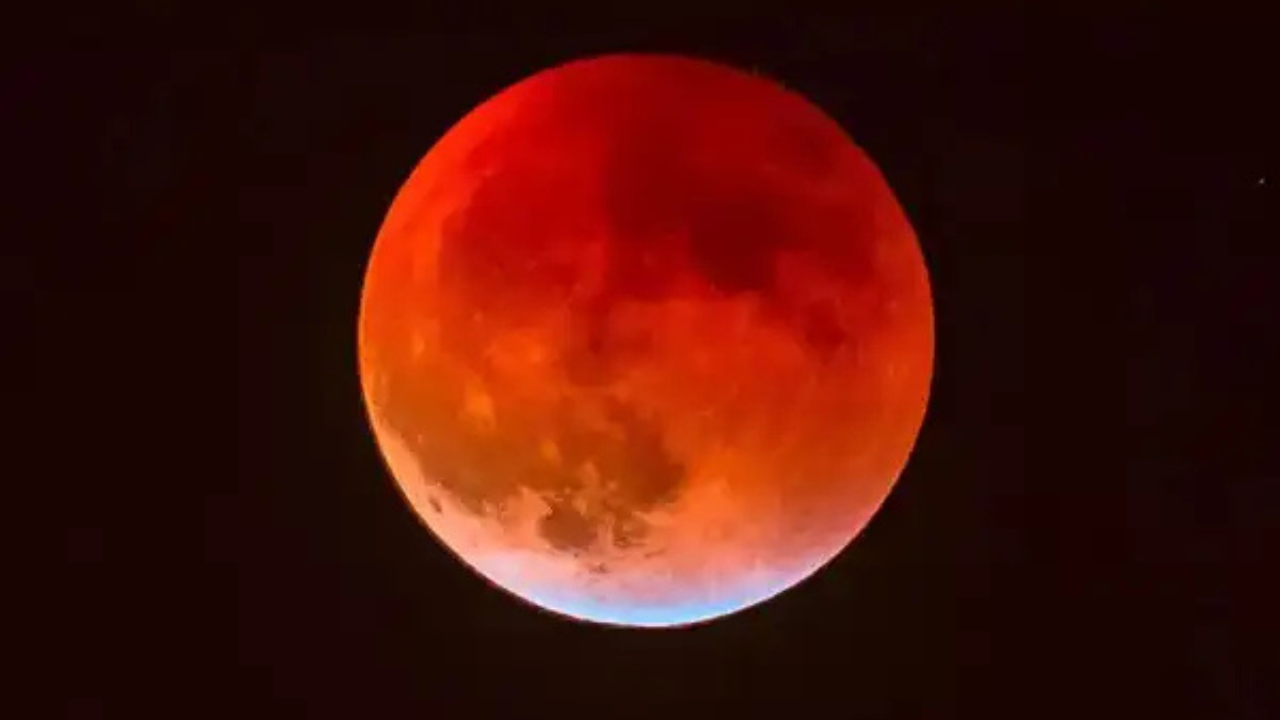
A rare astronomical spectacle lit up the skies last night as millions of people across continents witnessed the much-anticipated Blood Moon. The striking event drew global attention, inspiring sky-watchers, photographers, and astronomy enthusiasts to look upward and share the surreal beauty of one of nature’s most remarkable phenomena.
A Celestial Display of Wonder
The Blood Moon occurs during a total lunar eclipse, when the Earth passes precisely between the Sun and the Moon. As the Earth’s shadow covers the lunar surface, sunlight bends through the atmosphere, scattering shorter wavelengths, and casting a deep reddish or coppery hue on the Moon’s face. This phenomenon is widely regarded as mysterious yet breathtaking, and it has fascinated human civilizations for centuries.
For cultures across history, lunar eclipses have carried symbolic meanings, from omens of change to powerful celestial markers. Last night’s eclipse proved once again how natural events can unite humanity in collective awe, transcending boundaries of geography, culture, and belief.
Global Interest and Enthusiasm
From the bustling cities of Asia to the quiet countrysides of Europe and the vast open skies of the Americas, observers were treated to a memorable show. Crowds gathered in parks, on rooftops, and at observatories, hoping to capture the eclipse with telescopes, cameras, or simply the naked eye. Social media platforms turned into virtual observatories as photographs and videos spread instantly, documenting the stages of the eclipse in real time.
Professional astronomers streamed live sessions explaining the science behind the reddish glow, while amateur stargazers added to the global conversation by sharing artistic impressions. In many schools and universities, educators used the opportunity to engage students with lessons on planetary motion, atmospheric science, and cultural traditions linked to lunar events.
The Visual Splendor
The eclipse unfolded in dramatic stages. As the Earth’s shadow started creeping across the Moon, it initially created a dark curve that slowly engulfed the bright lunar surface. Viewers then watched as the Moon transformed from a gleaming silver orb to a dim, rust-colored disc suspended against the night sky.
The moment of totality when the Moon was fully covered was the highlight of the evening. For around 85 minutes, sky-watchers were able to marvel at the full Blood Moon, glowing with intensity and brilliance. Many described it as surreal, otherworldly, and even spiritual a reminder of the universe’s grandeur and humanity’s small yet intimate place in it.
Cultural and Scientific Significance
The Blood Moon has long been a subject of legends and folklore. Some ancient cultures viewed it as a sign of divine intervention, while others associated it with renewal and change. Today, while science has clarified the phenomenon, the sense of wonder remains stronger than ever.
Modern astronomy sees such eclipses not just as visual events but also as moments to study Earth’s atmosphere. The reddish tint, for instance, gives clues about the amount of dust and particles suspended in the air at a global scale. Scientists often analyze eclipse light scattering to better understand our planet’s climate and atmospheric conditions.
For cultural communities, the eclipse continues to serve as a unifying symbol. In many parts of the world, festivals, rituals, and night-long watch parties were held to honor the celestial event, making it both a scientific and a cultural celebration.
Shared Experiences Across Borders
Images from Australia showed crowds lying on open lawns as telescopes pointed skyward. In India, entire families watched from balconies and temple courtyards as chants and cultural traditions accompanied the spectacle. Across Europe, historical landmarks provided dramatic backdrops for photographs as the glowing Moon hovered above cathedrals, castles, and coastal cliffs. North America joined in as well, with eclipse parties organized in city parks and observatories, blending scientific outreach with communal joy.
Online platforms became a digital gallery of creativity photographers experimented with long exposures, combining cityscapes with the reddish Moon, while artists used the event as inspiration for paintings, sketches, and storytelling.
The Next Blood Moon
Astronomers have set their sights on the next visible Blood Moon, which will occur in the coming years, offering yet another opportunity for global audiences to witness the marvel of cosmic alignment. Enthusiasts are already marking their calendars, eager to relive the spectacle and perhaps capture even better images next time.
Space agencies and science communities encourage the public to use these moments as reminders of the importance of space exploration and environmental awareness. Observing celestial motions not only strengthens human curiosity but also underscores the fragility of Earth within the vastness of space.
A Night to Remember
The Blood Moon of last night will be remembered as a unifying event, captivating billions with its rare mix of science and beauty. In a time where daily lives are often fragmented by schedules and headlines, a celestial harmony unfolded above, reminding the world that the sky continues to be a canvas of shared human wonder.
As technology advances and more people turn their eyes toward space, events like these become both accessible and globally shared. But beyond the cameras, telescopes, and digital feeds, the essence of the Blood Moon remains timeless a natural wonder that connects humanity to the eternal rhythms of the cosmos.
What is a Blood Moon, and how does it differ from a regular lunar eclipse?
A Blood Moon is simply another name for a total lunar eclipse, which occurs when the Earth moves directly between the Sun and the Moon, casting its shadow over the entire lunar surface. During this alignment, all direct sunlight is blocked from reaching the Moon, and the only light that illuminates the Moon comes through Earth’s atmosphere. This filtered sunlight is bent and scattered, allowing primarily red and orange wavelengths to reach the Moon and give it a striking reddish or coppery glow hence the term “Blood Moon”.
In contrast, a regular lunar eclipse can be either partial or penumbral. A partial lunar eclipse only covers part of the Moon with the Earth’s shadow, and a penumbral eclipse results in a much subtler dimming, with no pronounced color change. The vivid red color unique to the Blood Moon is caused by the totality of the eclipse, where the Moon passes completely into Earth’s umbra the darkest part of the shadow. The scientific mechanism behind this color is Rayleigh scattering, the same effect that causes beautiful red shades during sunrise and sunset.
To summarize, every Blood Moon is a total lunar eclipse, marked by its deep red hue, while not all lunar eclipses result in a Blood Moon only those where the Moon is fully within Earth’s umbral shadow show this dramatic coloration.
What is the best way to view a Blood Moon do you need special equipment?
The best way to view a Blood Moon is simply by looking up with the naked eye it is completely safe, and no special equipment is required for observation. The Moon’s reddish hue during a total lunar eclipse is vivid and visible without filters or glasses, unlike solar eclipses which require protective eyewear.
For a more enhanced experience, binoculars or a small telescope can provide closer views and reveal more detail in the lunar surface and the changing colours as Earth’s shadow moves across the Moon. Cameras (including basic smartphones) can be used for photos, often with tripods for stability, but advanced gear is not necessary unless aiming for professional images.
For the best view, select a location away from city lights a rural area, open rooftop, or hilltop to avoid light pollution. Make sure to check weather conditions in advance, since clear skies are essential. The entire event is safe for the eyes, so anyone can participate in this celestial spectacle without worry.
How often does a Blood Moon occur?
A Blood Moon meaning a total lunar eclipse occurs about once every one to three years somewhere on Earth. While lunar eclipses happen roughly twice per year, not all are total; only total lunar eclipses produce the vivid red coloring known as a Blood Moon. Statistically, just under a third of all lunar eclipses reach totality, making Blood Moons less frequent than partial or penumbral lunar eclipses.
From any single location on Earth, viewers may expect to see four to five total lunar eclipses (Blood Moons) per decade, though visibility depends on timing and geography. Occasionally, four total lunar eclipses (a lunar tetrad) occur in succession across two years a rare cycle that happens a few times per century.
So, while lunar eclipses are common global phenomena, the dramatic spectacle of the Blood Moon is a special event visible on average every few years.