
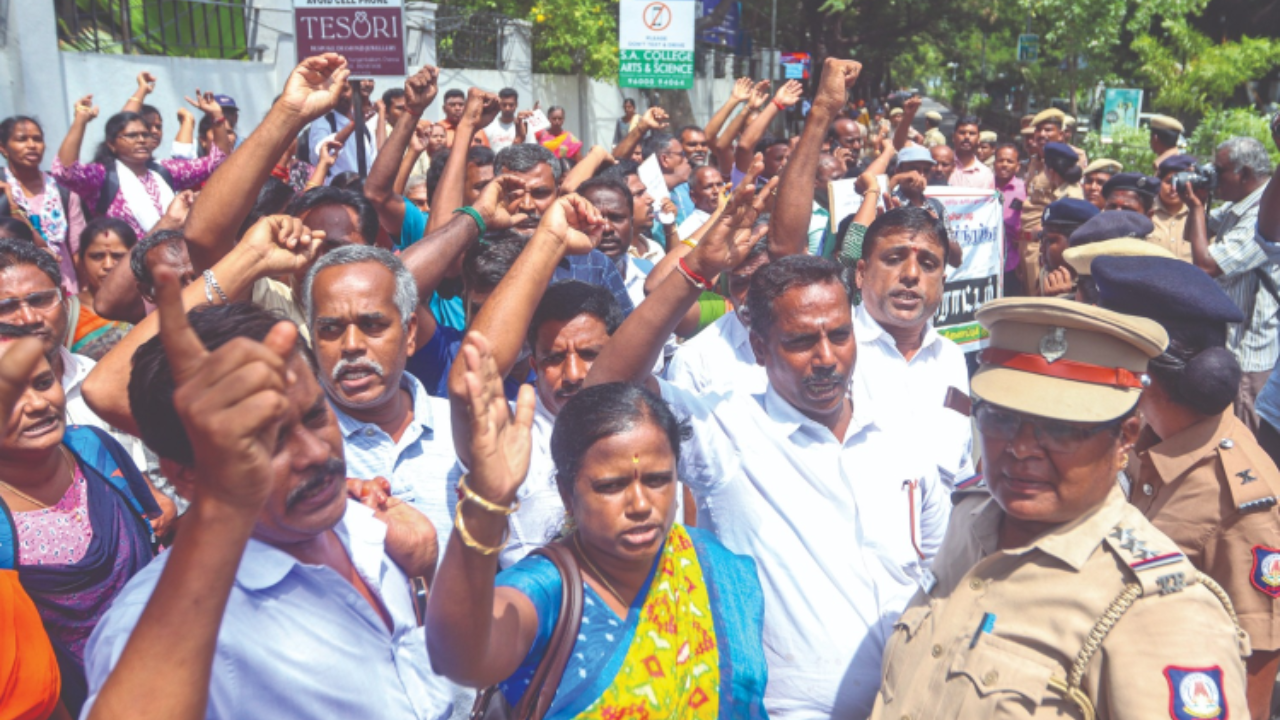

In a major development affecting the state’s education system, around 80 schools remained closed today after teachers participated in a state-wide protest, commonly referred to as “Shikshkancha Elgar” — a loud call for teachers’ rights and immediate government action on long-pending demands.
Teachers Unite for Pending Demands
Thousands of teachers from various districts joined hands under the banner of Shikshak Sanghatana and other unions to voice their concerns regarding salary parity, permanent appointments, and delayed arrears. The protest, which took place across multiple cities and towns, saw teachers leaving classrooms to assemble at protest sites and demonstrate peacefully.
According to reports, nearly 80 schools, including government and semi-government institutions, suspended activities for the day due to the absence of teachers. In some districts, local administrations declared holidays to maintain order and ensure student safety.
Root Causes Behind the Protest
Teachers have been demanding equal pay for equal work, timely salary disbursements, and improvements to the teacher recruitment process. Many educators working on contract or temporary bases argue that despite years of service, they have not been regularized, leaving them vulnerable to insecurity and unequal treatment.
One protesting teacher from Nashik said, “We are not against the system, but we cannot continue working without respect and fairness. The government should acknowledge our contribution and meet our basic demands.”
The Shikshkancha Elgar movement is not just a single-day protest but a symbolic outcry against years of administrative neglect. Teachers have also demanded clear policy action on promotions, pension benefits, and classroom infrastructure.
Impact on Students and Parents
The sudden closure of 80 schools has disrupted daily learning schedules across several districts. Parents expressed concern about the uncertain situation, particularly for students preparing for board examinations. Some schools shifted to online mode to keep the academic calendar on track, while others remained completely shut.
A parent from Pune shared, “We respect the teachers’ right to protest, but we also hope the government listens soon. Our children are losing valuable study time.”
Education experts believe the government should act promptly to resolve the stand-off and avoid long-term academic disruptions. Reconciliation, they argue, is necessary to maintain the credibility of the public education system.
Government’s Initial Response
State education department officials acknowledged awareness of the teachers’ grievances and said discussions are underway. A senior official commented, “We have received the memorandum from teacher unions. The government is committed to finding a solution that ensures educational continuity and fairness to teachers.”
However, union leaders remain skeptical, emphasizing that they have raised the same issues several times in the past with little progress.
“We welcome talks, but words must be followed by concrete action,” said a representative from Rajya Shikshak Sena. “Teachers have been patient for too long. Now it’s time for results.”
Opposition and Public Reactions
Several political parties have extended support to the protesting teachers, calling the movement justified. Opposition leaders criticized the government for ignoring educators’ demands for months. Social media also flooded with messages supporting the protest, with hashtags like #ShikshkanchaElgar and #TeachersProtest trending regionally.
Civil society members noted that teachers’ protests reflect broader concerns within the public sector—issues of delayed wages, contractual employment, and insufficient policy execution.
Hope for Dialogue and Resolution
As discussions continue, education unions have warned of intensifying the protest if their demands are not addressed promptly. They have also hinted at statewide demonstrations and possible strikes in January if the government fails to respond constructively.
Meanwhile, parents and stakeholders hope for a balanced resolution that protects both educators’ rights and students’ education. Experts stress that investing in teachers’ welfare is directly linked to the overall improvement of the education system.
Looking Ahead
The Shikshkancha Elgar movement has reignited the conversation around teachers’ dignity, financial stability, and the urgent need for education reforms in the state. With 80 schools already affected, the situation acts as a wake-up call for all concerned parties.