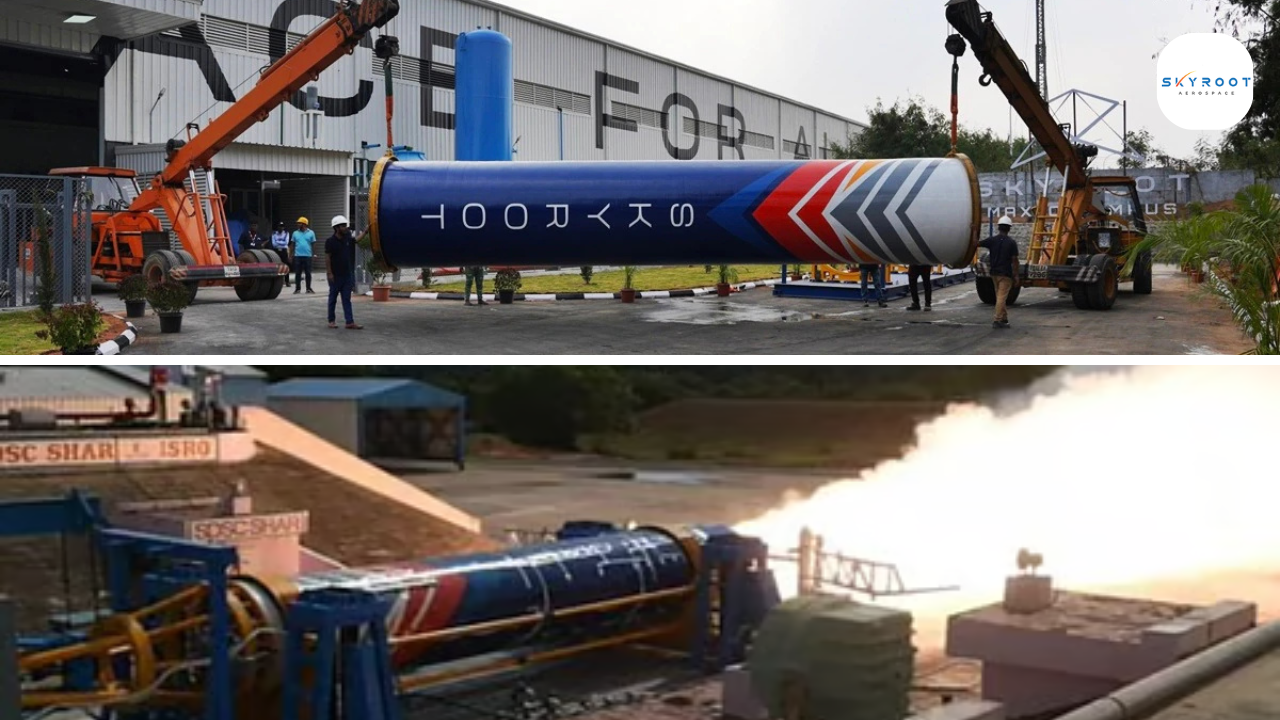
Hyderabad-based spacetech pioneer Skyroot Aerospace has marked a significant leap in India’s private spaceflight journey by successfully conducting the first static test of its KALAM 1200 solid rocket motor, the first stage of the upcoming Vikram-1 launch vehicle. This critical milestone brings the company closer to its mission of enabling affordable, reliable, and rapid access to space for small satellite operators worldwide.
The landmark test took place at 9:05 a.m. IST on August 8, 2025, at the Static Test Complex of the Satish Dhawan Space Centre (SDSC) in Sriharikota, under the guidance and support of the Indian Space Research Organisation (ISRO) and the Department of Space. The event marks one of the most advanced private-sector rocket motor tests ever undertaken in India.
Engineering Feat: KALAM 1200 – The Heart of Vikram-1’s First Stage
The KALAM 1200 motor is a monolithic composite rocket motor that stands 11 meters in length and 1.7 meters in diameter, with an impressive propellant mass of 30 tonnes. Designed for maximum thrust efficiency, it is the longest solid rocket motor prepared at the Solid Propellant Plant in Sriharikota.
The motor’s casing is built using state-of-the-art carbon composite materials, ensuring high strength while reducing weight. This makes the stage not only structurally robust but also more efficient, allowing Vikram-1 to carry heavier payloads without compromising cost-effectiveness.
One of the highlights of the program is that the ISRO team provided the design for the test stand, ensuring the trial met stringent spaceflight and safety standards. The collaboration between Skyroot and ISRO demonstrates the growing synergy between India’s government-led and private space sectors.
The Test: Proving Performance and Reliability
The static test was conducted to validate:
- Thrust performance over the burn duration.
- Structural integrity under maximum operational pressure.
- Propellant grain performance in various thermal conditions.
- Nozzle efficiency and flow uniformity.
According to preliminary data, the KALAM 1200 motor performed exactly as predicted by simulations, delivering consistent thrust and stable combustion, with no anomalies detected. Engineers monitored hundreds of real-time data channels to confirm performance across temperature, pressure, and vibration metrics.
“This is more than just a test—it’s a demonstration of India’s growing capability to design, build, and qualify advanced rocket motors in the private sector,” said [CEO Name], Co-Founder & CEO of Skyroot Aerospace. “With KALAM 1200’s success, we are one giant step closer to launching Vikram-1 into orbit.”
Vikram-1: A Game-Changer for Small Satellite Launches
Named after Dr. Vikram Sarabhai, the father of India’s space program, Vikram-1 is a three-stage, solid-propellant launch vehicle designed to carry small satellites into Low Earth Orbit (LEO) with unprecedented cost efficiency.
Key features of Vikram-1:
- Payload Capacity: Up to 290 kg to a 500 km Sun-Synchronous Polar Orbit (SSPO).
- Rapid Turnaround: Ability to be manufactured and launched in under 72 hours from contract confirmation.
- Modular Design: Stages can be configured for different mission requirements.
- Green Propellants in Upper Stages: Eco-friendly propulsion for orbital maneuvers.
The first stage, powered by KALAM 1200, is designed for high thrust-to-weight ratio, ensuring the vehicle clears the atmosphere with efficiency and speed.
India’s Space Economy and Private Sector Role
India’s space economy is projected to reach USD 44 billion by 2033, with private players expected to account for a significant share. The 2020 space policy reforms opened the door for private companies like Skyroot to build and operate launch vehicles, enabling the country to compete in the rapidly growing small-satellite launch market.
“Today’s successful test shows that private sector innovation, combined with government support, can make India a global leader in affordable space access,” said [CTO Name], Co-Founder & CTO of Skyroot Aerospace. “The KALAM 1200 is not just an engine—it’s a foundation for many future space missions.”
The successful KALAM 1200 test, Skyroot Aerospace will proceed with:
- Integration of the first stage with subsequent stages of Vikram-1.
- Qualification tests for avionics, guidance, and payload fairing systems.
- Full vehicle integration tests ahead of the maiden Vikram-1 orbital launch scheduled for [Tentative Month & Year].
The company is also developing advanced variants of its KALAM series motors for larger payload capacities and reusable launch systems.
Establishe in 2018 by former ISRO scientists, Skyroot Aerospace is India’s leading private space launch vehicle company, committed to democratizing space access. Headquartered in Hyderabad, Skyroot develops a family of cost-effective, modular, and reliable small satellite launch vehicles. Its Vikram series is designed for quick turnaround launches, enabling satellite operators worldwide to deploy payloads rapidly and affordably.
Skyroot’s achievements include:
- First private Indian company to test a cryogenic engine.
- First private Indian company to launch a rocket into space.
- Multiple collaborations with ISRO and international partners.