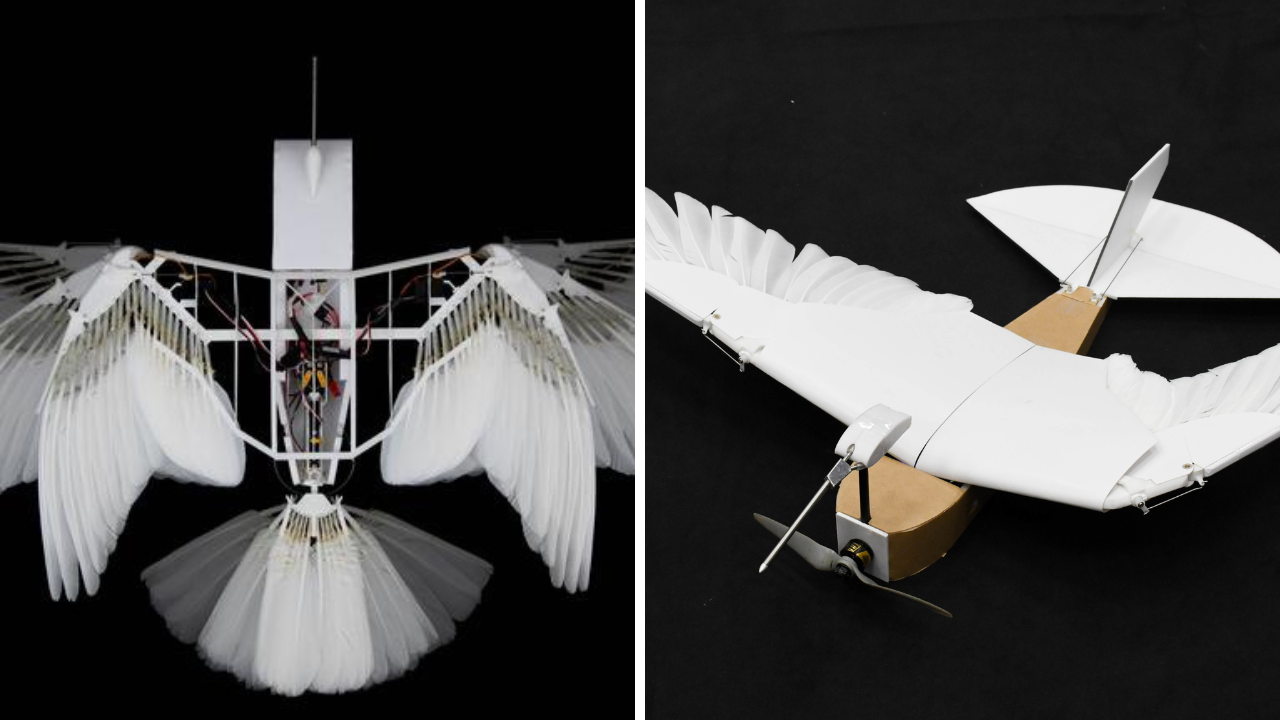
The skies over Groningen just gained a new and remarkable flier. The University of Groningen’s Professor of Biomimetics, David Lentink, along with his research team, has unveiled PigeonBot II — an advanced robotic bird that doesn’t just take inspiration from nature but literally wears it. Outfitted with authentic pigeon feathers and engineered to reproduce the subtle, mid-flight wing and tail adjustments of real birds, PigeonBot II marks a major breakthrough in the field of bio-inspired robotics.
In an era where drone and aerial robotics innovation is often defined by propellers and rigid wings, PigeonBot II dares to ask a different question: What if we could fly like nature intended?
A Flight Born from Biomimicry
Professor David Lentink, renowned for his pioneering work in biomimetics — the science of imitating biological systems to solve engineering challenges — set out to study one of the most refined flight systems in existence: that of birds. His research has shown that avian wings are not static surfaces, but dynamic, shape-shifting tools capable of fine control, stability, and maneuverability that modern drones can only dream of.
PigeonBot II is the culmination of years of study into avian aerodynamics and feather mechanics. Unlike its predecessor, which was already a marvel of design, the second-generation model incorporates not only the flexibility of bird wings but also the functionality of tail feathers for enhanced stability and steering. This addition allows the robotic bird to replicate the intricate flight patterns seen in nature, from tight turns to graceful glides.
Why Real Feathers Matter
While synthetic materials can be shaped to mimic bird feathers, nothing matches the aerodynamic precision of the real thing. The team carefully integrated pigeon feathers into PigeonBot II’s wings and tail, ensuring that their natural alignment and overlapping structure could work in harmony with the robot’s mechanical actuation system.
Birds use feather overlap and subtle adjustments to control airflow, reduce turbulence, and improve efficiency mid-flight. By harnessing this natural engineering, PigeonBot II achieves smoother flight performance and an unprecedented level of maneuverability in comparison to conventional drones.
Transforming the Future of Aerial Robotics
The implications of PigeonBot II’s development go far beyond academic curiosity. The potential applications span multiple industries:
- Aerospace Research: Offering new insights into wing design for next-generation aircraft that could be more energy-efficient and adaptable.
- Search & Rescue: Capable of navigating complex, obstacle-filled environments where traditional drones struggle.
- Wildlife Monitoring: Providing a non-disruptive way to study bird behavior in natural habitats by blending in more effectively with the environment.
- Education & Public Outreach: Inspiring a new generation of engineers, scientists, and environmentalists through live demonstrations and museum exhibits.
A Collaborative Effort
While Professor Lentink’s leadership was key, the success of PigeonBot II was the result of multidisciplinary collaboration between mechanical engineers, biologists, aerodynamicists, and material scientists. Each discipline contributed vital expertise — from creating precision-actuated joints to studying the microstructure of feathers under high-resolution imaging.
“The magic of PigeonBot II lies in the fusion of biology and engineering,” Professor David Lentink said Lentink. “We’re not simply copying nature’s designs; we’re working with them, letting natural principles guide our technology toward solutions that are both elegant and efficient.”
From Lab to Sky
PigeonBot II’s unveiling included a live demonstration, where the robotic bird showcased its smooth takeoffs, agile turns, and controlled landings. Observers were struck by its lifelike motion — a product of precise feather integration and carefully programmed wing mechanics.
One of the most impressive moments came when PigeonBot II executed a tight banking maneuver, adjusting its tail feathers mid-turn to maintain balance and speed. This behavior, common in birds but rare in man-made flying devices, demonstrated the true power of biomimetic design.
The team plans to continue refining PigeonBot II, with research aimed at improving autonomous navigation, endurance, and environmental adaptability. Future versions may include sensors capable of collecting real-time environmental data, making the robotic bird a valuable tool for climate research and ecosystem monitoring.
PigeonBot II also raises intriguing questions about sustainability in robotics. By relying on naturally sourced and biodegradable components such as real feathers, there is potential for developing aerial devices that leave a smaller environmental footprint.
University of Groningen’s Biomimetics Program
The University of Groningen has emerged as a leader in biomimetic research, fostering innovation at the intersection of biology, physics, and engineering. Under the guidance of Professor David Lentink, the Biomimetics Lab is dedicated to exploring the mechanics of animal motion, translating those findings into cutting-edge robotic technologies with real-world applications.