
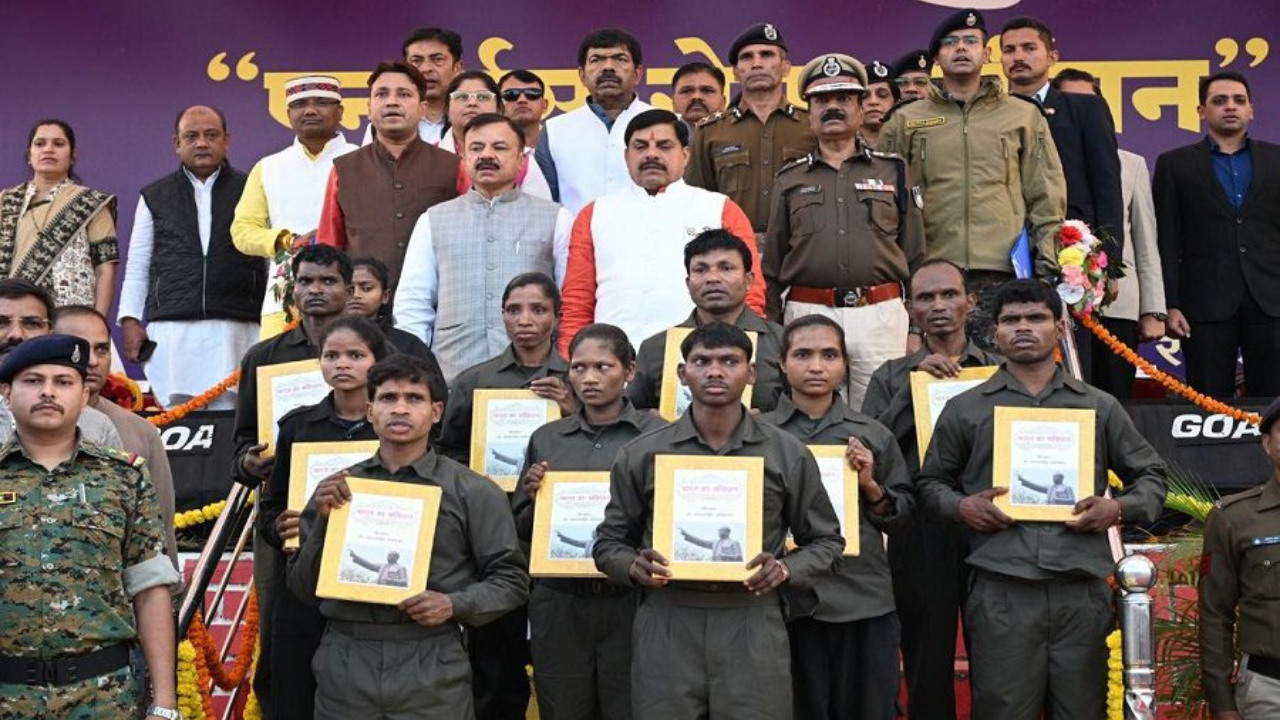

Government announces ambitious growth roadmap for ex-Naxalite regions to ensure lasting stability and prosperity.
In a historic announcement at the close of 2025, Chief Minister Mohan Yadav declared that Madhya Pradesh is now officially Naxal-free, marking a decisive end to more than four decades of Maoist insurgency in certain pockets of the state. The announcement, made in Bhopal during the state’s year-end review, represents a major turning point in the internal security landscape of central India.
For years, districts such as Balaghat, Mandla, and Dindori were considered sensitive zones affected by left-wing extremism due to their proximity to the borders of Chhattisgarh and Maharashtra. However, through a combination of sustained security operations, grassroots development programs, and community outreach efforts, the state government has now succeeded in completely dismantling Naxal influence in these areas.
“Today, we can proudly say that Madhya Pradesh has achieved a milestone that once seemed impossible. Every part of our state is peaceful, secure, and on the path of inclusive development,” said Chief Minister Mohan Yadav while addressing state officials and media representatives.
A Historic Shift from Conflict to Development
The Chief Minister emphasized that the journey from conflict to peace was not just a security achievement, but also a victory for governance and development. Over the past few years, the state government, in coordination with central security agencies, implemented a comprehensive plan combining law enforcement measures with infrastructure and welfare schemes.
Efforts were made to improve accessibility in remote tribal regions through the construction of all-weather roads, expansion of electricity networks, and digital connectivity under BharatNet. Additionally, welfare programs focusing on education, healthcare, livelihood generation, and skill development were gradually introduced to rebuild public trust and strengthen state institutions.
As a result, incidents of violence have dropped sharply since 2021, with local youth increasingly participating in government-led initiatives and vocational projects. The symbolic dismantling of Maoist hideouts and the surrender of several cadres earlier this year strengthened the government’s claim of establishing lasting peace in the region.
Special Development Package for Ex-Naxalite Districts
To reinforce this achievement, the Yadav government has announced a special development package exclusively for Balaghat, Mandla, and Dindori, focusing on speeding up infrastructure growth, education, and employment opportunities. This initiative aims not only to sustain peace but to transform these regions into models of rural transformation.
According to official sources, the new package includes provisions for:
- Construction of rural roads and bridges to enhance access to interior villages.
- Expansion of educational infrastructure, including the establishment of new Ekalavya Model Schools, skill centres, and IT-enabled classrooms.
- Special agriculture and forestry schemes encouraging sustainable livelihoods for tribal and forest-dependent communities.
- Promotion of small and medium enterprises (SMEs) through microfinance and entrepreneurship training.
- Creation of eco-tourism zones and community-based tourism projects drawing on the natural beauty and tribal heritage of the region.
Chief Minister Yadav emphasized that the government’s focus will now shift from security presence to development presence, ensuring that benefits of growth reach even the remotest communities. “Real peace is achieved when every citizen feels included in the progress story of the state. Our goal is to ensure that opportunities replace fear and that the younger generation in these areas gets access to education, jobs, and prosperity,” he stated.
Coordination Between Centre and State Agencies
The official declaration of Madhya Pradesh as Naxal-free was made possible through sustained coordination between state police, central reserve forces, and intelligence agencies. The deployment of advanced surveillance technologies, community policing, and awareness programs played a vital role in ending the extremist network’s influence.
Security officials have confirmed that no active Maoist presence now exists in the state. Routine patrolling will, however, continue for the next few months as a preventive measure. Special focus will be placed on strengthening border coordination with neighboring states like Chhattisgarh and Maharashtra, where isolated extremist activities still occur.
Empowering the People, Building the Future
The transformation of the Naxal-affected belts in Madhya Pradesh is also a story of people’s resilience and cooperation. Civil society groups, self-help organizations, and local youth have contributed significantly by participating in education drives, health campaigns, and agricultural reforms over the past few years.
The Yadav government acknowledges that community involvement will continue to be central to maintaining peace and accelerating progress. Programs promoting women’s empowerment, tribal entrepreneurship, and forest conservation will remain high on the priority list under the new package.
Experts see this development as a defining moment for Madhya Pradesh, strategically positioning it as one of the most stable and development-ready states in central India. Commenting on the announcement, political analysts noted that the state’s balanced blend of security measures and welfare initiatives could serve as a model for other states with similar challenges.
Toward a Peaceful and Progressive Madhya Pradesh
As Madhya Pradesh turns the page on four decades of insurgency, the focus is now firmly set on building a peaceful, prosperous, and self-reliant future. The government’s commitment to economic inclusion, sustainable livelihood programs, and modern infrastructure will determine how deeply this peace takes root in the coming years.
The declaration of a Naxal-free Madhya Pradesh stands not just as a political victory, but as a testament to collective determination and democratic resilience. With renewed confidence and a roadmap for growth, the state now looks forward to an era where every region — from the forests of Balaghat to the plains of Malwa — participates equally in the state’s development journey.