Thursday, June 4, 2026
Home Blog Page 263

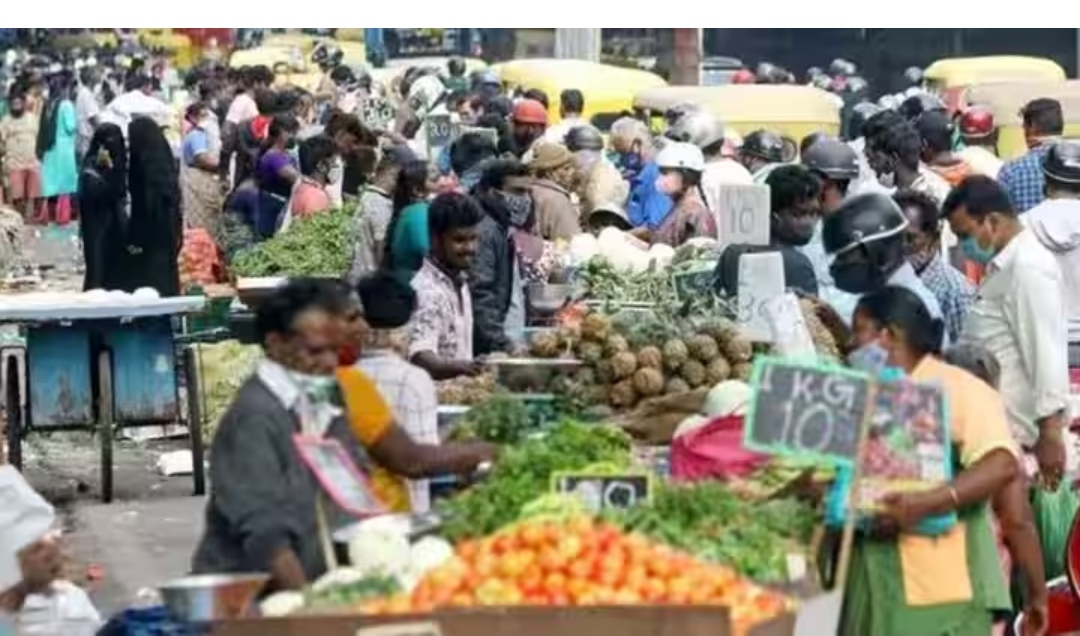
Modi- nomics ’ fails to buck the trend   fastening on GDP growth after the COVID- 19 

GDP growth after the COVID- 19 

Epidemic may show the Indian frugality in a  fairly good light, but it misses the point of  profitable  operation under the present government.   There has been  violent focus on India’s growth performance of late. First, on the occasion of the Delhi meetings of the G- 20, the government  blazoned that it was the world’s fastest growing major frugality. It was met with a challenge from an independent economist on the grounds that the government had  reckoned on the income  system to estimate GDP, and that were the expenditure  system to be used  rather the observed growth rate would be lower. 

The Finance Ministry responded that the Government of India had been  harmonious in using GDP estimated by the income  system throughout.  This is correct.  A focus that’s  defective  still, it may be noted that the  disputation had been over  profitable performance in a single quarter,  videlicet the first quarter of the current  fiscal time. Soon after this exchange, Arvind Subramanian and Josh Felman delved  whether India’s growth rate is accelerating or braking after the COVID- 19 time of 2020- 21. They concluded( in a media composition, September 14) that “ after a strong recovery there has been a significant  decaying of  energy over the last three  diggings ”. 

The former Chief Economic Adviser and hisco-author may well be right, but both the government and those challenging its narrative are  concentrated on  veritably short phases of growth. This can affect in mistaking the cycle — a temporary change — for the trend, which is the long- term tendency.  Statistical considerations  piecemeal, right now there are good reasons for looking at a slice of time longer than a many  diggings when studying  profitable growth in India. We’re edging towards the general election 2024. A major issue in this election would be the impact the  peremptory party has had in managing the frugality.

 Though only one aspect of  profitable performance, the growth of GDP, has come the main focus of attention. This shift in focus has been led by the Narendra Modi government itself. So, it should be open to an evaluation of its performance grounded on this  index.  Growth, from 1950 to the present  To ascertain the impact on the frugality of the present government, we  probe whether it has been  suitable to raise its  beginning rate of growth,  nominated the ‘ trend ’. As part of this, we study GDP growth from 1950 to the present. 

This enables us to see recent growth in relation to what has been achieved in the  history. Also, we borrow a statistical procedure that identifies changes in the  beginning rate of growth. And, what do we find?  Studying growth up to the time 2019- 20, which is thepre-COVID time, we find that the last time the growth rate increased in India was in 2000. The conclusion from this must be that the Modi government has not had success in raising the rate of growth of India’s frugality while in office.

 This doesn’t mean that the promised “ Achhe Din ” haven’t come, for there has been growth of income per capita, but this government has not been  suitable to quicken the pace at which they’ve been coming our way for decades.  The finding doesn’t surprise, for in the six times up to the COVID- 19 epidemic, the growth rate had braked  successionally in three,  incontinently upon the demonetisation of 2016. As no major exogenous shock struck the frugality in this period, it must be concluded that it’s the demonetisation that caused the slowing. 

 The reason for terminating our study at 2019- 20 was that the COVID- 19 epidemic, which broke soon after, was a shock that was external to the frugality, caused by natural factors. We want to  count  from our analysis any impact on GDP that wasn’t under the control of the government.  But what of the recovery since, for which the government takes credit? There’s a way of assessing this claim. We may  read GDP in the times after COVID- 19 by projecting forward the growth rate achieved  previous to 2019- 20, and see how  factual  issues compare to these  protrusions.  

So, we  read the GDP in 2022- 23 by extending the average periodic growth rate of6.5 achieved for the period 2000- 01 to 2019- 20. We  set up that  factual GDP in 2022- 23 is11.1  lower than  prognosticated. So, the recovery from the epidemic may well have been ‘ V- shaped ’ but till last time, GDP was yet below trend, so to speak.  The COVID- 19 time  Eventually, though  fastening on GDP growth after the epidemic may show the Indian frugality in a  fairly good light compared to other major  husbandry, it misses a  pivotal aspect of  profitable  operation during the present government’s term in office. 

This is how the frugality performed during the COVID time of 2020- 21. In that time,  utmost BRICS countries( Brazil, Russia, India, China and South Africa) and the United States contracted  lower than India did. All these countries had also  espoused a stronger macroeconomic  encouragement. The  encouragement  espoused by the Government of India  also was amazingly small.  The  compression of GDP during the epidemic in India is most affiliated to that  pontifical  turndown to stimulate the frugality when  demanded. 

It accounts for the corresponding recovery that followed in 2021- 22. In effect,  veritably high growth that time reflects there-starting of  product after the lifting of a  veritably  strict lockdown, rather than an independent  profitable response to smart policy, which is how it’s presented. 

Having left the frugality to shift for itself for  important of its  term  lately, Modinomics has  swirled to addressing growth frontally. maybe having realised that it has not had  important success in stimulating private investment, the government has, over the last two Budgets, hiked capital spending at historically high rates. The ideal of ‘  minimal government ’ seems to have been  remitted in election season.

For more information visit at https://happenrecently.com/zepto/?amp=1
Source: www.indianexpress.com

UN Security Council reform is a song in a  circle   

UN Security Council reform

Shashi Tharoor  is a third- term Member of Parliament( Congress) and former Under- Secretary General of the United Nations, former  president of the External Affairs Committee of Parliament and author of 25 books including ‘ Pax Indica ’ and( with Samir Saran) ‘ The New World complaint ’  

The problem of reforming the United Nations Security Council is akin to a  sickness presented before croakers

  — there’s agreement only on the  opinion  and not  the  tradition  further than three decades after the debate first started over abecedarian reforms at the United Nations( UN), the issue appears to have resurfaced at the ongoing General Assembly session of the world body. President Recep Tayyip Erdoğan of Türkiye was blunt “ The Security Council has  desisted  to be the  patron of world security and has come a battlefield for the political strategies of only five countries. ” Indeed the UN’s Secretary- General, António Guterres, issued a stern warning “ The world has changed. Our institutions have not. 

We can not effectively address problems as they’re if institutions don’t reflect the world as it is. rather of  working problems, they risk  getting part of the problem. ”  It couldn’t have been put more bluntly, but we’ve heard this song  ahead. Politically, it’s untenable that the five  endless members( China, France, Russia, the United Kingdom, and the United States) enjoy their position, and the  honor of a  proscription over any Council resolution or decision,  simply by virtue of having won a war 76 times agone.

 In the case of China, the word ‘ won ’ needs to be placed within  reversed commas.  I was serving at the UN when  also- Secretary General Boutros Boutros- Ghali declared that Security Council reform must be  fulfilled in time for the 50th anniversary of the world organisation in 1995. But indeed as the  critical rhetoric continues to be spoken, the organisation has missed not only the 50th anniversary of the UN, but indeed the 60th, the 70th and now the 75th.

 Left to their own  bias, member-  countries will be arguing the  graces of the case well past the UN’s centenary.  An unjust situation in terms of equity  The problem of reforming the Security Council is akin to a  sickness in which a number of croakers

 gather around a case; they all agree on the  opinion but they can not agree on the  tradition. The  opinion is clear the Security Council reflects the geopolitical realities of 1945 and not of  moment. When the UN was  innovated in 1945, the Council  comported of 11 members out of a total UN class of 51 countries; in other words, some 22 of the member  countries were on the Security Council.  

Moment, there are 193 member-  countries of the UN, and only 15 members of the Council — smaller than 8. The one change ever made to the original Duty was in 1965 when the Security Council was expanded from 11 members to 15 by adding four  further  taggednon-permanent members. So,  numerous  further countries, both in absolute  figures and as a proportion of the class, don’t feel adequately represented on the body. 

The composition of the Council also gives  overdue weightage to the balance of power of those days. Europe, for case, which accounts for  slightly 5 of the world’s population, still controls 33 of the seats in any given time( and that doesn’t count Russia, another European power).  In terms of simple considerations of equity, this situation is unjust for starters, to those countries whose  fiscal  benefactions to the UN  overweigh those of four of the five  endless members — Japan and Germany have for decades been the alternate and third largest contributors to the UN budget, while still being appertained to as ‘ adversary states ’ in the United Nations Charter( since the UN was set up by the victorious Abettors of the Second World War). 

And it denies  openings to other  countries  similar as India, which by its sheer size of population, share of the world frugality, or  benefactions in kind to the UN( through participation in peacekeeping operations, for  illustration) have helped shape the  elaboration of world affairs in the seven decades since the organisation was born.  stations by countries. 

So, the Security Council is  easily ripe for reform to bring it into the alternate quarter of the 21st century. But for every state that feels it deserves a place on the Security Council, and especially the  sprinkle of countries which believe their status in the world ought to be recognised as being in no way inferior to at least three of the being  endless members, there are several who know they won’t  profit from any reform. The small countries that make up more than half the UN’s class accept that reality and are  happy to  contend  sometimes for a two- timenon-permanent seat on the Council. But the medium- sized and large countries, which are the rivals of the prospective heirs, deeply begrudge the prospect of a select many breaking free of their current alternate- rank status in the world body. numerous are openly amped  by a spirit of competition,  literal grievance or simple covetousness. 

They’ve successfully and indefinitely baffled reform of the class of the Security Council.  Part of the problem is that the bar to amending the UN Charter has been set rather high. Any correction requires a two- thirds  maturity of the overall class, in other words 129 of the 193  countries in the General Assembly, and would further have to be ratified by two- thirds of the member  countries. Ratification is  generally a administrative procedure, so, in other words, the only ‘  tradition ’ that has any chance of  end is one that will both  convert two- thirds of the UN member-  countries to support it and not attract the opposition of any of the being  endless five — or indeed that of a  importantU.S. Senator who could block ratification in Washington.  

That has proved to be a altitudinous order indeed. India’s credentials may  feel  egregious to us, but China is none too keen on  lacing its status as the only Asian  endless member; Pakistan, which fancies itself as India’s strategic rival on the key, is unalterably opposed; and to some extent Indonesia seems to feel  lowered by the prospect of an Indian seat. In Latin America, Brazil occupies a place  similar to India’s in Asia, but Argentina and Mexico have other ideas, pointing to Portuguese- speaking Brazil’s inferior credentials in representing largely Hispanic Latin America. And while Africa, given that it accounts for 54 member-  countries, insists on two  endless seats, how is one to  arbitrate the rival credentials of the  mainland’s largest republic, Nigeria, its historically largest frugality, South Africa, and its oldest civilization, Egypt? Another offer suggests creating a alternate  order of “semi-permanent members ” to accommodate  similar  countries for, say, 10- time electable terms.

 It has  set up no takers among the  top applicants.  Continuing deadlock  So, while the debate keeps going round in circles for decades, deadlock continues in the Security Council, as  utmost vividly illustrated  lately over the Ukraine conflict, when a Permanent Member of the Security Council  raided a autonomous UN member- state and the Council proved  helpless to respond.

 Russia’s  adding  resort to the  proscription has blocked  judgments  on Ukraine, Mali, Syria and North Korea. analogous obstructionism by the West has affected  proffers to reform the  fiscal institutions established at Bretton Woods in 1944, the World Bank and the International Monetary Fund. And yet this is the only global system we’ve got that brings all countries together on a common platform. Can we go to let it fade into ineffectiveness and  impertinence?

For more information visit at https://happenrecently.com/zepto/?amp=1

Source: www.indianexpress.com

Delhi govt. to set up over 1,000 Chhath ghats across  megacity Atishi   

Delhi govt. to set up over 1,000 Chhath

The Delhi government will set up over 1,000 Chhath ghats across the  megacity, Revenue Minister Atishi said on Wednesday.   “ Chhath Puja is associated with the faith of lakhs of people. The Kejriwal government is determined to  insure that no  vexation is caused to the addicts, ” the Minister said. 

 Earlier in the day, Ms. Atishi (Delhi)held a review meeting with all the District Adjudicators and directed the  officers to start medications in advance to avoid last-  nanosecond  vexation to the addicts. She also instructed  officers to  insure cleanliness at the ghats.   The Minister directed the District Adjudicators to identify  locales for the ghats in their  separate  sections as per the addicts ’ convenience and start the construction work.   

The ghats will have essential  installations,  similar as clean water,  canopies, electricity, restrooms, and medical services.   Also, artistic programmes by the government’s Maithili- Bhojpuri Academy will be held at several ghats.  The number of Chhath ghats in the  megacity has grown from 69 in 2014 to 1,100 in 2022.   

At the same time, the budget for the  jubilee has been increased from about ₹2.5 crore in 2014 to ₹ 25 crore in 2022, according to the AAP government.

For more information visit at https://happenrecently.com/zepto/?amp=1

Source: www.indianexpress.com

Event Gyan: India’s First Online Institute for Event Management and Wedding Planning.

Event Gyan:

In a world that is full of events and celebrations, the role of event planners and managers cannot be underestimated. Recognizing the need for accessible, quality education in this field, Event Gyan has emerged as a trailblazer in the realm of online event management and wedding planning education. With a commitment to affordability, accessibility, and comprehensive training, Event Gyan is shaping the future of event management education in India.

Event Gyan proudly holds the distinction of being India’s first online event management and wedding planning institute. This pioneering institution has achieved ISO 9001:2015 certification and is registered with the Government of India as an MSME-registered institute, emphasizing its commitment to quality and legitimacy.

Founded by the visionary Jeet Kumar, Event Gyan’s mission is deeply rooted in addressing critical challenges faced by aspiring event managers. It seeks to bridge the gap between traditional event management institutes and students who harbor a passion for this field but are hindered by exorbitant fees, limited accessibility primarily in major cities, and the societal stigma associated with event management as a part-time endeavor.

Jeet Kumar’s vision is clear: to provide aspiring event managers with an opportunity to pursue their passion and obtain quality education that equips them for successful careers in event management.

Event Gyan’s approach to revolutionizing event management education is multifaceted. At its core, it employs an asset-light, online model, eliminating the financial burden of infrastructure costs. The institute offers holistic training that encompasses both the planning and execution aspects of event management. Moreover, it provides valuable on-field experience through internships or job placements.

Event Gyan boasts a diverse array of courses catering to various aspects of event management and related fields. From foundational courses such as Event Management, Wedding Planning, and Corporate Event Planning to specialized offerings like Event Production and Advertising (ATL, BTL, TTL), the institute leaves no stone unturned in equipping its students for a successful career.

The institute offers a compelling value proposition for its students. It provides affordable fees, the convenience of a one-time payment, and a lifetime access to course materials. This means that students can learn at their own pace, anytime and from the comfort of their homes. Conducting courses in Hindi ensures that a broader audience can access quality education. Furthermore, Event Gyan provides full career and business support, fostering an environment where students can thrive.

The impressive enrollment of over 1000 students underscores the trust and impact Event Gyan has on aspiring event managers. This growing community of learners is a testament to the institute’s commitment to making event management education accessible to a wider audience.

The decision to go online was not arbitrary but a well-considered response to the high fees charged by traditional institutes. Event Gyan’s online model ensures that quality education is not a privilege confined to select locations but an opportunity available to passionate individuals across India.

In summary, Event Gyan’s innovative approach to event management education sets it apart as a pioneer in the field. Through its commitment to affordability, accessibility, and comprehensive training, Event Gyan equips a new generation of event planners and managers with the knowledge and skills they need to succeed. This institute is a testament to the power of online education in democratizing opportunities and promoting the art of event management. Jeet Kumar’s vision of providing affordable and accessible event management education is becoming a reality, one student at a time.

For free guidance on Event Management & Wedding Planning anyone can reach,

YouTube: https://www.youtube.com/@EventGyan/

Website: https://eventgyan.com/

‘ Ambani pips Adani as richest Indian ’ 

Ambani pips Adani

 Mukesh Ambani has  contended ahead of Gautam Adani to come the richest Indian on a list of  flush people in the country.  

The 66- time-old  president of the diversified Reliance diligence saw his wealth grow by a borderline 2 to ₹8.08 lakh crore, while Adani’s fortune  declined by 57 to ₹4.74 lakh crore, as per the 360 ONE Wealth Hurun India Rich List 2023.  Anas Rahman Junaid,  principal experimenter at Hurun, attributed the decline in Adani’s wealth to the Hindenburg report published in January, which led to a sharp correction in the group’s stocks and consequent wealth  corrosion for the  protagonist family. 

Adani has denied all the allegations. 

 A aggregate of 1,319  individualities from 138  metropolises feature on the list which uses August 30 as the base date to assess fortunes.  Cyrus Poonawalla of vaccine maker Serum Institute of India has retained the position as the third- flush Indian, with a 36 jump in his fortune at ₹2.78 lakh crore.

For more information visit at https://happenrecently.com/zepto/?amp=1
Source: www.indianexpress.com

  ‘ India’s spacetech assiduity has ‘ downstream ’ implicit ’  

India’s spacetech assiduity

 Importance of the demand for satellite technology  operations will be decided by demand on earth, Deloitte India said in a report published with the Indian Space Association and NASSCOM on Tuesday. The report analyses the ‘ downstream ’  openings in space technology( spacetech). ‘ Downstream ’ is a reference to services like dispatches, earth imaging and navigation that satellites enable.  

It’s no longer just specialized challenges that will decide the line of satellite- enabled services by the private sector — ‘ constellations ’ of satellites are  formerly  ringing the earth, blanketing the earth with internet content in places that terrestrial networks have n’t indeed reached. rather, Deloitte says, companies will be driven by people demanding and willing to pay for satellite services, like remote education or seafaring, or due to government  authorizations. 

 Despite the  rapid-fire  elaboration of satellite technologies in recent times, implicit  openings don’t show tremendous headroom in India, owing to its small share in the global spacetech  request. Satellite internet for remote areas —  in far the most talked about  operation in recent times — represents a  request value of$ 263 million in the coming five times, as per the report.  

Other  operations like ecological monitoring, surveying and logistics tracking infrequently exceed$ 1 billion in  request  pledge. specially, a much aged technology — DTH satellite television has a  request  eventuality of$12.69 billion, Deloitte estimated in its report.

For more information visit at https://happenrecently.com/zepto/?amp=1
Source: www.indianexpress.com

Hurun Rich List 2023 Richest Indian- origin business  directors revealed  

 Arista Networks CEO Jayashree Ullal, with net worth of ₹ 20,800 crore, is the  flush Indian- origin business head.   

Hurun Rich List 2023 :-

Hurun India’s Rich List 2023, which was released on Tuesday, reveals that there are as  numerous as 259 billionaires( 221 in 2022) in the country, with the top two being Mukesh Ambani and Gautam Adani, independently. The list also identifies Indian- origin professional  directors business heads who have an  emotional net worth.  

 Which Indian- origin  director,  thus, has the loftiest net worth? Is it Google’s Sundar Pichai, Microsoft’s Satya Nadella, or someone differently? 

According to Hurun Rich List 2023–

  1.) Jayashree Ullal( CEO, Arista Networks) Her total wealth stands at ₹ 20,800 crore. Born in London and raised in Delhi, Ullal has been with the American computer networking  establishment – she also serves as its chairman – since 2008. She’s also on the board of directors of Snowflake, a  pall calculating company that went public in September 2020.     

 2.) Thomas Kurian( CEO, Google Cloud) His net worth is ₹ 15,800 crore. Kurian was born in Kerala and began his professional career with McKinsey & Company. He joined Oracle in 1996 and went on to come the organisation’s President.  

Source – www.hindustantimes.com

 Kurian joined Google Cloud in 2019.  

 3.) Ajay Banga( President, World Bank) A recent  nominee, Banga’s overall fortune is worth ₹ 7600 crore. Before starting his professional career with Nestle, he studied at Delhi’s St Stephen’s College and IIM- Ahmedabad. Banga also worked at Mastercard, as its CEO and Administrative president.   Microsoft CEO Satya Nadella( ₹ 7500 crore) is the fourth on the list, followed by his Palo Alto counterpart Nikesh Arora( ₹ 7400 crore). Google CEO Sundar Pichai is just outside the top 5, ranked sixth with a net worth of ₹ 5400 crore. 

For further information visit at https://happenrecently.com/zepto/?amp=1
CBI to probe against NewsClick over foreign fund rules violation,  quests on 

 NewsClick editor and HR head were arrested on allegations of taking  plutocrat to spread China’s propaganda. Now, CBI’ll probe alleged FCRA violations.  

 The Central Bureau of Investigation (CBI) on Wednesday registered a case against NewsClick for alleged violation of the Foreign Contribution Regulation Act. quests are being carried out at two  locales in Delhi– the office and the  hearthstone of NewsClick author Prabir Purkayastha. The  inauguration of the CBI  inquiry into the case comes a day after a Delhi court  transferred Prabir Purkayastha and NewsClick HR head Amit Chakravarty to 10- day judicial  guardianship. The brace were arrested in a case under the UAPA for allegations that the news  gate took  plutocrat to spreadpro-China propaganda. Read| NewsClick author conspired to sabotage 2019  pates, siphoned off  finances FIR  

 On October 3, Purakayastha and Chakravarty were arrested and the NewsClick office was sealed. According to the FIR, a large  quantum of  finances to the news  gate came from China to” disrupt the sovereignty of India” and beget  souring against the country. It also  contended Purkayastha conspired with a group– People’s Alliance for Democracy and Secularism( PADS)– to sabotage the electoral process during the 2019 Lok Sabha  pates. 

  Raids were conducted by CBI at 88  locales in Delhi and seven in other  countries on October 3 on the suspects named in the FIR and those that surfaced in the analysis of data, police said. Around 300 electronic  widgets were also seized from the  services of NewsClick and the  places of the  intelligencers who were examined. Following the raids, 46  individualities, including nine  womanish  intelligencers, were questioned by the Special Cell in Delhi and NCR. 

Source www.hindustantimes.com

NewsClick issued a statement and said the proceedings initiated against the  gate are nothing but a blatant attempt to muzzle the free and independent press in India.  

 NewsClick rejected Chinese fund allegation

  ” The Newsclick has not  entered any backing or instructions from China or Chinese  realities. Further, Newsclick has  noway  committed or sought to encourage violence, secession or any illegal act in any manner whatsoever.A perusal of Newsclick’s content, which is freely available online, should be sufficient to indicate the veracity of Newsclick’s claims,” it said. 

For further information visit at https://happenrecently.com/zepto/?amp=1

Civic severance rate drops to6.6 in Q1  

 The  check reused details from 5,639 first- stage  slice units and people from 44,190 civic houses.  

For men, it  dropped from7.1 to5.9 and for women, it  dropped from9.5 to9.1, show NSSO data; the labour force participation rate in the civic areas increased from47.5 to48.8   The Periodic Labour Force Survey( PLFS), carried out by the National Sample Survey Office( NSSO), has reported that severance rate in civic areas of the country has shown a  drop during the period April- June 2023.  also, the labour force participation rate( LFPR) for persons aged 15 and  over and the worker- population  rate( WPR) have also  bettered during the period.  

This  public  check reused details from 5,639 first- stage  slice units( FSUs) and people from 44,190 civic houses.  The LFPR in civic areas increased from47.5 in April- June 2022 to48.8 in April- June 2023. While it  floated around73.5 for men during this period, for women, the LFPR increased from20.9 to23.2 during this period, the Ministry of Statistics and Programme perpetration said in a release then on Monday.  

The WPR in civic areas increased from43.9 in April- June 2022 to45.5 for persons aged 15 and  over. For men, it increased from68.3 to69.2 and for women, it increased from18.9 to21.1 during this period.  dwindling trend  The PLFS claimed a  dwindling trend in severance rate( UR) for persons aged 15 and  over.  

“ UR in civic areas  dropped from7.6 in April- June 2022 to6.6 in April- June 2023 for persons of age 15 times and  over, ” the PLFS report said.  

For men, it  dropped from7.1 to5.9 during this period and for women, it  dropped from9.5 to9.1.  crucial  pointers  The Centre also claimed  enhancement in  crucial labour  request  pointers in civic areas compared with those inpre-pandemic period( April- June 2018 to October – December 2019).  The LFPR ranged from46.2 to47.8 during thepre-pandemic period and in the  rearmost report it was48.8.  

The WPR was between41.8 and44.1 before the epidemic and now it’s45.5. 

 The severance rate ranged between7.8 and9.7 during thepre-pandemic period and at the  rearmost  check it was6.6, which, according to the Centre, is lower than the severance rates observed in the  diggings covered in thepre-pandemic period.

For more information visit at https://happenrecently.com/zepto/?amp=1

Source: www.indianexpress.com

Neeraj: Glad I ’m  suitable to inspire  kiddies to take up the sport  

Herospeak Neeraj, right, and Tushar Goculdas, MD of Underdog Athletics, India, in Hyderabad  The reigning Olympic, World and Asian Games  pikestaff champion thanks SAI, the governments and commercial groups for promoting sports and games in the country.   Indian athletes are  intrepid now and can take on the stylish in the world as there’s a lot of  tone- belief in their capabilities, said Neeraj Chopra, the reigning Olympic, World and Asian Games  pikestaff champion. 

 “ It’s also because of the great support from the Sports Authority of India, the governments and a lot of commercial groups coming forward to promote sports a long way, ” the 25- time-old said after inaugurating the Under Armour exchange in the City then on Monday.  “ I’m actually  thankful to SAI for organising so  numerous camps in the run- up to all major events. It was a revolution of a kind, ” he added.  

Questioned whether he’d cross the 90m  hedge soon, a smiling Neeraj said he’d  surely target it but would like to take it step by step.  “ Well, I can only speak about  pikestaff and whether my achievements are going to inspire  numerous  further to take up calisthenics. 

Yes, I’m glad to say that a lot of boys and girls are showing great interest in  pikestaff after my feats, ” he added.  Hyderabad connect  “ Yes, it had been a  veritably tough  trip and interestingly the first  studies of how it would be to make it to the Olympics came then in this megacity in 2015 when I  contended in the Junior Fed Cup  match and won a gold, ” Neeraj said. What keeps you motivated? “ We all know how legends like Michael Phelps(  swoon), and Usain Bolt( calisthenics) have won multiple  orders in Olympics and World crowns.  

“ So, as competitions keep coming, we keep working hard and get  further competitive, ” Neeraj said.  “ I’m looking at a long career for sure and, at the same time, to keep winning  orders for the country, ” he added.  “ I appeal to the parents not to complain about  installations in the early days of any  youthful athlete. They’ve to be patient.  

“ The first thing they’ve to see is that the  kiddies have the zeal in them to  conjure  big and work hard towards the  thing, ” said Neeraj, who also visited Gopi Chand Badminton Academy and other sports centres in Gachibowli.

For more information visit at https://happenrecently.com/zepto/?amp=1
Source: www.indianexpress.com