Friday, June 5, 2026
Home Blog Page 244

Production  growth  increased  in  the second quarter in  10  main areas; Upward momentum  likely to  continue:  FICCI 

  According to the survey, more than 79%  of  respondents shared  higher  production  levels  in  Q2FY24  and  average capacity  utilization  was higher at  74%  in Q2  compared to 73%  in  the  previous  quarter. last quarter. 

 According to  the  latest “Quarterly Survey of Indian Manufacturing” released, manufacturing  growth accelerated in July-September  across  ten  key  sectors and is  expected  to continue  in  the coming quarters. in the  financial year 2023-24  (FY24),  despite  a  slowdown in developed  countries.  by the Federation of Indian Chambers of Commerce  and  Industry (FICCI) on Monday. 

  According to the survey, more than 79%  of  respondents shared  higher  production  levels  in  Q2FY24  and  average capacity  utilization  was higher at  74%  in Q2  compared to 73%  in  the  previous  quarter. last quarter. However, ‘need’ was cited  as the  main limiting  and  constraining  factor, with over  40% of  respondents highlighting this as  an important  constraint. 

  “The  current  average capacity  utilization  in  the  manufacturing  sector  is around  74%, reflecting  sustained economic activity in the sector. This is slightly higher than  the 73%  capacity  utilization rate  reported  in  previous quarters.  Future  investment  prospects  also improved  compared to the previous quarter as  more than 57% of  respondents  said they planned to invest  and  expand  in the  next  six months. This is also a slight improvement  compared to  the previous survey,” the survey added. 

  Demand  has  proven  to be  a  major  obstacle  and limiting factor  in realizing  the true potential of the manufacturing sector in India. “Whether  domestic or export demand, this  is  still  a major limiting  factor.”  Some other constraints,  although  not  major,  are high raw material prices, increased  financing costs, logistics  and other supply chain  disruptions, he said, which  are some of the major constraints  affecting  the plan. “expand the number  of  respondents”.  

 The survey  was  conducted  in 10 sectors: automobiles  and auto components; capital goods and construction equipment; cement; chemicals,  fertilizers  and pharmaceuticals; electronics and  equipment;  machine tools;  metals  and metal products; textiles,  clothing  and technical textiles; paper; and miscellaneous  – comprising  over 380 manufacturing units  of large,  small and medium enterprises with a  total  annual turnover of over Rs 4.88 lakh crore.

  80%  of  Q2FY24  respondents  had  higher  orders, while  85%  of  respondents had  higher  or  similar  inventory  levels  in Q2.  Regarding  exports,  more than 48%  respondents  said  exports in  the second quarter were higher  compared  to 33%  in  the first quarter of fiscal 2024. 

 “However,  there is a need to  further  improve  export demand  to meet  the  country’s growth aspirations.” , he added. Regarding hiring prospects, 38%  of  respondents  plan to hire more workers  in the next three months. Electronics and  home appliances;  cement;  Automobiles  and machine tools  outperformed, while  sectors  such as  capital goods and construction machinery, chemicals, textiles, metals, paper and  others showed  moderate growth.

 For more  information visit at https://happenrecently.com/zepto/?amp=1
Teenage Maverick Amallaj KPClinches Youngest UNESCO-ICCNEntrepreneur of the Year Award2023

Maverick Amallaj

Kozhikode: In a groundbreaking moment, 19-year-old visionary Amallaj KP, the mastermind behind the global sensation Ellazia, has been crowned the “Youngest Entrepreneur of the Year 2023” by UNESCO-ICCN on the auspicious date of 11-11-2023 at The Ravi’s Kadavu. The award, presented by Julio Raman Blasco Nacher (ICCN General Secretary) in the presence of dignitaries Shri. Adv. P.S. Sreedharan Pillai (Honourable Governor of Goa), Shri. Shashi Tharoor (Honourable Member of Parliament), Shri. MK Raghavan(Honourable Member of Parliament), Rajendran Vellapalath (CEO-TP Connects Software Solutions Pvt. Ltd), and Dr. Abdul Salam Mohammed (CEO, Markaz Knowledge City), cements Amallaj’s status as a fashion maverick reshaping the industry landscape.

Amallaj’s entrepreneurial saga kicked off at an unprecedented age of 15 when most peers were navigating the intricacies of adolescence. While we were grappling with quadratic equations, Amallaj was orchestrating a fashion revolution, rolling up his sleeves to build the door to triumph himself.

At 16, Ellazia was born—not just a clothing brand, but a movement. It transcended fashion, becoming a beacon for affordable, high-quality style for everyday individuals. Amallaj, armed with determination and a talent for transforming setbacks into runway comebacks, faced challenges like a true fashion warrior.

Now, at 19, Amallaj runs a hot show. Ellazia’s showroom is not just a shopping haven; it’s a sanctuary of affordable fashion, with creations strutting their stuff across four countries—a global coup led by a teenager with a sewing machine and a dream.

Amallaj isn’t just the MD of Ellazia; he’s a disruptor, a trendsetter, a fashion maverick who declared that being ordinary was so last season. The UNESCO-ICCN award underscores his exceptional contributions and impact on the fashion industry.

The Inter-City Intangible Cultural Cooperation Network ICCN- UNESCO, the prestigious platform behind the award, recognizes outstanding contributions globally, fostering innovation and excellence.

Amallaj KP’s story is not just about success; it’s about a teenager who refused to color inside the lines, turning the fashion industry upside down and shaking out all the loose change for the rest of us.

Raise a toast to Amallaj KP, the teenage titan rewriting the rules of the fashion game!

MSME DOST – A Swadeshi Solution for Business Growth

MSME DOST

In an age where ‘Made in India’ is the buzzword, MSME DOST, a SHUDH SWADESHI initiative, has emerged as a powerful bridge between tradition and technology, all while serving the community responsibly.

What is MSME DOST?

MSME DOST is a Business Networking Forum that operates simultaneously in physical and digital formats. It’s an initiative by Bhartiya, designed to cater to the needs of the BHARAT economy. This budget-friendly platform focuses on enhancing your business network and net worth. Its core offerings include a monthly evening meeting and two digital connections, which facilitate bonding and understanding among members. MSME DOST goes beyond networking; it provides coaching, mentoring, promotion, and socializing opportunities, making it a comprehensive package for overall growth.

Objectives and Values:

The primary objective of MSME DOST is to promote self-reliance and ‘Made in India.’ It bridges the gap between traditional values and modern technology, embracing both as integral components of success. The platform emphasizes responsible service to the community, making it more than just a business network.

Advantages of MSME DOST:

  • Affordability: MSME DOST is budget-friendly, ensuring that businesses of all sizes can benefit from its offerings.
  • Networking and Bonding: With monthly meetings and digital connections, members have ample opportunities to connect and build lasting relationships.
  • Comprehensive Growth: Beyond networking, MSME DOST offers coaching, mentoring, promotion, and socialization, creating a well-rounded environment for business growth.

Expanding Beyond Kolkata:

While currently based in Kolkata, MSME DOST has ambitious plans to extend its reach to Delhi, Chennai, Rourkela, Ranchi, Patna, and Nagpur in the next few months. This expansion will bring the benefits of MSME DOST to more entrepreneurs and small businesses across India, contributing to the nation’s self-reliant journey.

In a nutshell, MSME DOST is a unique blend of tradition and technology, serving as a beacon for the ‘Made in India’ movement. It provides a responsible, cost-effective, and holistic approach to business networking, making it an invaluable resource for those seeking growth in the BHARAT economy.

Website = https://msmedost.com/

Facebook = https://www.facebook.com/msmedost

Uttarakhand tunnel collapse: Trapped workers contacted; Providing food and water

Uttarakhand tunnel collapse

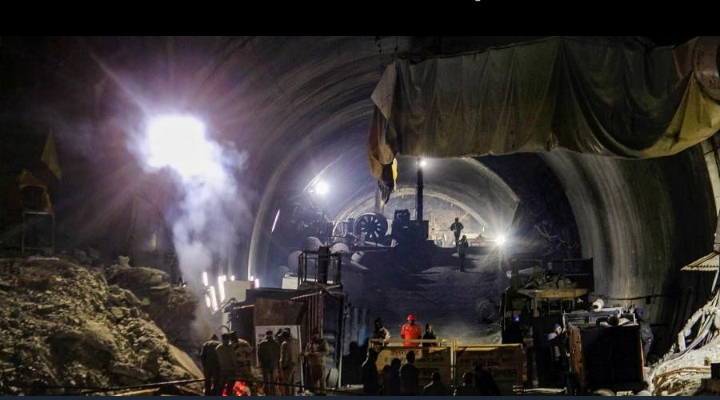
Part of the tunnel collapsed on Sunday morning, trapping about 40 workers inside. The tunnel is part of the Char Dham all-weather road project.

Uttarakhand: Rescuers working through the night to rescue around 40 workers trapped after the collapse of an under-construction tunnel on the Brahmanical-Yamunotri national highway here called them and offered them food and water, officials said on Monday. The Silkiara Police Control Room said the workers were safe and had asked for food to be sent to them, adding that they were contacted via walkie-talkie. The statement said that the food parcels were transported using a compressor. Dredging and debris excavation work is currently underway inside the under-construction tunnel between Silkiara and Dandalgaon to prepare escape routes for the trapped workers, according to the District Emergency Operations Centre. Part of the tunnel collapsed on Sunday morning, trapping about 40 workers inside. The tunnel is part of the Char Dham all-weather road project.

According to the District Emergency Operations Centre, the workers were from Bihar, Jharkhand, Uttar Pradesh, West Bengal, Odisha, Uttarakhand and Himachal Pradesh. About 160 personnel from agencies like National Disaster Response Force (NDRF), State Disaster Response Force (SDRF), Indo-Tibetan Border Police (ITBP) and Road Frontier Organization (BRO) are trying to rescue the stranded workers. On Sunday, authorities appeared optimistic about the safety of the trapped workers because the water pipeline was supplying them with sufficient oxygen. Prime Minister Narendra Modi on Sunday spoke to Chief Minister Pushkar Singh Dhami to inquire about the ongoing rescue efforts.

For more information visit at https://happenrecently.com/zepto/?amp=1

Dense fog sweeps into the National Capital Region (NCR) Delhi after Diwali celebrations; Firefighters logged 100 fire-related calls

Images from different parts of Delhi showed dense fog covering the roads, significantly reducing visibility and making it difficult to see beyond a few hundred meters.

New Delhi: A thick layer of smog shrouded the national capital after people burned crackers on Diwali night, leading to severe pollution across the city, which is already reeling from deteriorating air quality. Officials said the Delhi Fire Brigade received 100 calls regarding fire-related incidents on Diwali evening. Delhi Fire Service (DFS) chief Atul Garg said these calls were recorded between 6pm and 10.45pm on Sunday.

 “The total number of calls for small, medium and large fire incidents reached 100 between 6pm and 10.45pm,” he said, adding that his department was ready to provide assistance. Delhi Police is on alert and assisting firefighters, officials said. The ban on fireworks was flouted in several areas of Delhi as the city celebrated Diwali. Images from different parts of Delhi showed dense fog covering the roads, significantly reducing visibility and making it difficult to see further than a few hundred meters.

It is important to note that the national capital has been suffering from pollution for several weeks. Al-Qaeda in Iraq has peaked in many places at “dangerous” levels and has remained at toxic levels for several days, but after Diwali, the national capital is likely to once again witness rising pollution levels, making people’s lives difficult. 

A breathing city The Supreme Court last week said that the ban on fireworks containing barium is binding on all states and is not limited to the Delhi-NCR region, which suffers from severe air pollution. Recently, the Arvind Kejriwal-led AAP government in Delhi imposed a complete ban on bursting firecrackers. In the face of pollution, the government thought of the idea of ​​”artificial rain” to combat the city’s oppressive atmosphere, until sudden rains significantly reduced the pollution level.

The latest posts and reports circulating on social media sites show the participation of large numbers of people in different places in lighting fireworks. Images on Sunday night from Lodhi Road, RK Puram, Karol Bagh and Punjabi Bagh showed intense fireworks lighting up the night sky in several parts of the capital. Previous data on pollution showed that since the last week of October, the air quality in the national capital was at its worst.

 PM2.5 concentrations in the city were recorded at 20 times the limit set by the World Health Organization, prompting the city government to issue an order to close all primary schools and limit truck access. Despite the ‘Diya Jalao, Patakhi Nahi’ campaign launched by the Delhi government and the Supreme Court’s order against bursting of firecrackers, the increasing pollution is likely to reduce the lights in the city after the festival ends.

For more information visit at https://happenrecently.com/zepto/?amp=1
India holds  ‘2+2’ ministerial  dialogue with the US: What it means 

2+2 meetings have been held annually with  US leaders since 2018. What is  the format of  this meeting  and which countries does India engage with  under this framework? Let’s  take a look. 

  Indian  Defense  Minister Rajnath Singh and External Affairs Minister S Jaishankar met their  US  government counterparts, Defense  Secretary Lloyd Austin and Secretary of State Antony  Blinken, in a  2+2  ministerial dialogue Thursday was  held in New Delhi on  Friday, November 11.  

2+2 meetings have  taken place  annually with  US leaders since 2018. What is  the format of  this meeting  and which countries  is  India  engaging  in this  way? 

Let’s  take a look.  

What are 2+2 meetings and what is  their purpose?  The 2+2  meeting means  the participation of two high-level representatives,  ministers  holding  the  Foreign and  Defense positions of  each  country, with the aim  of  enhancing  the scope of dialogue between them. 

Having such a mechanism  allows  partners to better understand and appreciate each  other’s  strategic concerns and  sensitivities,  taking into account political factors on both sides, in order to build  the relationship. stronger and  more integrated  strategy  in a rapidly changing global environment.  

Who  is India’s  2+2  partner?  

The US is  the  oldest and most important  partner in India’s  2+2  negotiations.  

 The first 2+2 dialogue between the two countries  took place  during the Trump  administration,  when then Secretary of State Michael Pompeo and then Secretary of  Defense  James Mattis met  with  the late Sushma Swaraj and then  Secretary of Defense  Nirmala Sitharaman in New Delhi in September 2018. 

It  is  also seen as a replacement for the  strategic  and  trade dialogue  held between the  two countries’  foreign and  trade  ministers  under  the previous Obama administration. 

 The launch of the dialogue  is  seen as  “reflecting  the shared  commitment” of  India and the US to  bring about a “positive and  forward-looking vision  of  the India-US strategic partnership and  leverage integrated  in  the  diplomatic and security  efforts of the two countries.”  Additionally, India  held 2+2 meetings with  the  ministers  of  Australia, Japan,  UK  and Russia. Notably,  during  this  year’s  meeting, Antony Blinken reiterated the  importance  of  India’s relationship  with  several  countries that are also important  allies of the United States. 

 “We  promote  a free and  open Indo-Pacific region that is  prosperous, secure and  resilient,  including by strengthening our partnership through  QUAD with Japan and  Australia”.  QUAD or  Quadrilateral Security Dialogue is an informal security  forum  and these four countries  are members.  

  According to a joint press release at the time, negotiations  with Japan  through the  platform began in 2019, with the aim  of  “further  strengthening  the strategic depth of  security and  defense cooperation Bilateral”.  In 2021,  in  the  first discussion session  with Russia, Russian Foreign Minister  Sergei  Lavrov  said:  “Both Russia and India have a similar  worldview, which is about  a more polycentric,  multipolar world order.” and  more  fair.  We  support  similar or identical positions on the most important political and military issues.” He also said that  2+2  will become “an effective  dialogue platform to  discuss many  regional and international  topics,  further deepening our  traditional  mutual understanding.” 

  That  same year,  the  2+2 dialogue with Australia also began. In October 2023, the first such meeting with the UK took place. 

 Defense  and strategic agreements under 2+2 

 Over the years,  strategic bilateral  relations  with  partners, including  dialogues held in the 2+2 format,  have yielded clear  and far-reaching results for India. 

  India and the US  signed a  trio  of  “foundational treaties” on deepening  military cooperation,  starting  with the Logistics Exchange Memorandum of  Understanding  (LEMOA) in 2016, followed by the  Compatibility and Security  Agreement. communication secret  (COMCASA) after  2+  first  2 conversations.  in 2018,  followed by  the Basic Exchange and Cooperation Agreement (BECA) in 2020.  

Strengthening  the  cooperation  mechanism  between the two militaries is  very important  in the context of an increasingly aggressive China,  threatening many countries in and outside the region, while also challenging  a  number of  established norms and  aspects. established in  international relations.

  Establishing a  mechanism with Japan, which is also wary of  China’s  role, is another  example.  However, India also  engages with  Russia through 2+2  dialogue,  keeping in mind  the  security and energy interests  as well as  the  historical depth of  the relationship between the two countries. 

For more information visit athttps://happenrecently.com/zepto/?amp=1

A day  after Diwali,  Delhi, the  most polluted  city in the world; Kolkata and  Mumbai in  the  top 10 

 Three major Indian cities  –  Delhi, Kolkata and Mumbai  – are  in the top 10. Kolkata  is  fourth on the list with  an  AQI  of  196, followed by Mumbai in ninth place with  an  AQI  of  156.  

 A day after Diwali, Delhi  ranked as the  world’s  most polluted  city on Monday,  according to IQAir, a Swiss group that measures  the  air quality levels of 100 major cities based on the concentration of  suspended  particles  in air. air, which is harmful to lung health, is called  PM2.5. 

  According to IQAir, the Indian  national capital recorded an  air quality index  (AQI) of  433,  in the  ‘hazardous’  category, as of 10  am. Lahore, Pakistan ranks  second on the list with  an  AQI  of  384. 

  IQAir’s report said  PM2.5  concentrations  in Delhi  are  currently 79 times  higher than  the  WHO’s  annual air quality guideline  value.  Three major Indian cities  –  Delhi, Kolkata and Mumbai  – are  in the top 10. Kolkata  is  fourth on the list with  an  AQI  of  196, followed by Mumbai in ninth place with  an  AQI  of  156.  

 Mexico City  has been  declared the cleanest city in the world  according to a  live ranking after being  ranked 100th.  

 The AQI displayed by IQAir is based on the  American  legend of  air pollution  criteria.  The rankings  are divided  into 6  groups,  with 0-50 being  “good”  and 301+ being  “dangerous”.  AQI at 51-100 is considered  moderate,  while at 101-150 and 151-200  it is considered “unhealthy  for sensitive  groups”  and  “unhealthy”. At  the other extreme,  an  AQI  of  201  to  300 is  “very unhealthy.”  

  PM10 and PM2.5 levels  spiked  in  some  parts of Delhi on Sunday night as  people burst off  Diwali firecrackers  despite  the ban.  According to  the  government’s  Central Pollution Control Board (CPCB), the  city’s  AQI,  a 24-hour average,  remained  in the  ‘poor’  category. It was recorded  at 283 at  8am on  Monday,  after falling  from  218 at  3pm  on Sunday. These are the best  AQI  Diwali  figures  seen in  Delhi in the last eight years. 

  Last year, the  AQI  was 312  on  Diwali,  while it was 382 in 2021, 414 in 2020, 337 in  2019  and 281 in 2018. The AQI was 342 on Diwali  in 2015, 431 in  2016  and 319 in  year  2017.  

 For more  information,  visit athttps://happenrecently.com/zepto/?amp=1
Abhay Kumar, Holder of Three Guinness World Records, Launches ‘Mission Million MindShine’ Program to Empower Financially Challenged Students

Abhay Kumar, a distinguished educator, memory coach, and holder of three Guinness World Records in memory and calculation, is making significant strides in the realm of education with the recent launch of ‘Mission Million MindShine.’ This visionary program aims to provide free-of-cost education and training to one million financially challenged students, reaching them through physical visits to schools and organizations.
As the founder of Aspirant Jet, Abhay Kumar has been instrumental in revolutionizing memory improvement techniques through the mobile app ‘Aspirant Jet’ and the website aspirantjet.com. Offering The art of Memory and techniques, the platform is tailored for students from Class 5 to PG, as well as those preparing for competitive exams such as UPSC, state PCS, railways, and SSC.
Abhay Kumar’s commitment to inclusive education is exemplified in ‘Mission Million MindShine.’ Recognizing the financial challenges faced by many students, Abhay aspires to break down these barriers by physically visiting schools and organizations to provide free training. The program encompasses a holistic approach, offering valuable insights into memory enhancement, general knowledge retention, and overall educational empowerment.


Abhay Kumar’s three Guinness World Records in memory and calculation stand as a testament to his unparalleled expertise and dedication to pushing the boundaries of human potential. His unique perspective as a memory coach enriches ‘Mission Million MindShine’ with innovative approaches to learning and memory improvement.
Since its recent launch, ‘Mission Million MindShine’ has garnered attention for its noble mission. Abhay Kumar, known for his role as a memory coach, has already made a significant impact by reaching thousands of students. His dedication to the cause goes beyond the digital realm, emphasizing the importance of direct engagement with students to ensure effective learning.
Abhay Kumar expressed his vision, stating, “Education should not be a privilege but a right for every individual. ‘Mission Million MindShine’ is my way of contributing to a brighter, more empowered tomorrow by providing quality education to those who need it the most.”
As ‘Mission Million MindShine’ unfolds, Abhay Kumar invites schools, organizations, and individuals to join this transformative journey towards a more inclusive educational landscape. For further information, please visit aspirantjet.com or download the Aspirant Jet app.
Contact: Email- hello@aspirantjet.com
About Aspirant Jet
Aspirant Jet, founded by Abhay Kumar, is a platform dedicated to memory improvement and comprehensive education. Through the mobile app ‘Aspirant Jet’ and the website aspirantjet.com, Abhay Kumar provides Art of Memory to students from Class 5 to PG, as well as those preparing for competitive exams. ‘Mission Million MindShine’ is a recent initiative aimed at providing free education to financially challenged students through physical visits to schools and organizations.

Website = http://aspirantjet.com

App link – https://khal.page.link/JLFy

GCD Token Set to Revolutionize Crypto Landscape in Upcoming Launch.

GCD Token

In a highly anticipated event, the Global Community Development Inc. Ltd UK is gearing up for the grand inauguration of the GCD Token on November 15, 2023, at the prestigious Bolgatty Palace Island Resort in Kochi. This historic moment, to be presided over by Prof. A.V Thamarakshan, will mark the introduction of a groundbreaking initiative by Mr. P.K Jayakumar, the Founder and CEO of GCD Inc. Ltd, UK.

The unveiling ceremony will feature the release of the GCD Token logo by Mr. M.P Joseph IAS, Former District Collector of Ernakulam, setting the stage for what promises to be a transformative force in the world of cryptocurrency. The first GCD Token will be presented by Mr. A.K. Jain, Former ADGP of Rajasthan Police, and received by Dr. Chakot Radhakrishnan, Chief Patron of Pravasi Bharathi Trust in the USA, along with esteemed leaders Mr. K.P Biju (Pravasi Bharathi Trust), Mr. K Ramachandran, Mr. Babu KP, Smt. Ambili, and Mrs. Manju Soumini. Notable figures, including Mr. George Paul, Vice President of Pravasi Bharathi Trust, along with Mrs. Jaina Babu and Mrs. Jessy Jacob, Steering Committee Members of the Trust, are expected to grace the event.

GCD Token isn’t just another cryptocurrency; it’s a comprehensive utility designed for credibility, agility, and independence. Operating within a smart global community ecosystem on the blockchain, GCD Token encourages smart investments across various sectors, including online business, hypermarkets, healthcare, travel, IT, and more. What sets GCD apart is its commitment to charity and job creation, making it a unique player in the crypto landscape.

At the heart of GCD Token’s mission is a visionary 10-year plan that aims to bring about quality upliftment to communities. Each year, GCD will undertake a physical project, spanning sectors such as hypermarkets, infrastructure, film, travel, and agriculture. The income generated from these projects will be distributed among members, with a dedicated portion earmarked for charitable endeavors.

This innovative approach allows even ordinary individuals to participate by acquiring just 20 GCD Tokens. The goal is to create a sustainable model where financial growth coexists with charitable impact, fostering job opportunities and positive transformations.

GCD Token stands out as the first initiative in the history of cryptocurrency to emphasize the importance of physical projects operating under a UK license. This novel approach brings together marketplaces and finance, offering a wide array of services from market to finance within a single platform.

The GCD blockchain system, developed over 24 months, introduces decentralized governance, smart contract support, and enhanced security. This self-developed blockchain gives users full control, scalability, and secure transactions, setting a new industry standard.

As the crypto world eagerly anticipates the launch of GCD Token on November 15, 2023, the event is poised to mark a significant milestone. The future of GCD Token holds the promise of seamless global transactions, unlocking new markets for better growth and success. With its focus on hypermarkets, infrastructure, film, travel, online business, manufacturing, agriculture, IT, medical tourism, and global business expansion, GCD Token envisions a holistic approach to financial empowerment and positive societal change.

In conclusion, the upcoming inauguration of GCD Token isn’t just about the introduction of a new cryptocurrency; it’s a declaration of intent to revolutionize the crypto landscape. As individuals and businesses alike look to navigate the evolving world of digital finance, GCD Token stands as a beacon, guiding the way towards a future where financial growth and social impact go hand in hand.

Firecracker  ban:  The  Supreme Court  believes that  both economic  aspects  and  people’s  health  must be taken into account.  

The Supreme Court today said it  must  take into account all as hupects, including the fundamental right  to  livelihood of firecracker manufacturers and the  health  rights  of over 1.3 billion people in the country,  and see consider requests to ban them.  

The  Supreme Court  said  Article 21 (right to life) of  the  Constitution applies to both  sections  of  the  people and  a balance  must be maintained  while considering  the nationwide  ban on firecrackers. A bench  comprising Justices AK  Sikri and Ashok Bhushan asked the  Center  to file an affidavit  providing  details  on  measures to be taken  to reduce  pollution and  impact  of firecrackers on the  public. “There  are economic aspects  involved in  it. The  government’s  affidavit  states that  there are 1,750  firecracker  manufacturing industries in Tamil Nadu,  directly or  indirectly employing 5,000 families.  It  said the firecracker manufacturing industry is  worth Rs 6,000 crore. We have to see what is the relevance of  the  economic aspect  to fundamental rights,”  the  court said, adding: “There  is  a  fundamental right to livelihood of  producers,  and at the same  time,  there is  a  fundamental right to  about  health for 130  people”. million  people  in  this  population. nation. You  have to keep in mind  production costs  and  health costs.  Although it is difficult to collect  accurate  data  on  people  with  respiratory  and other health  problems in  different  hospitals. 

 Senior advocate Dhruv Mehta,  representing the firecracker manufacturers,  said  legal regulations existed  and  when it came to  pollution or the impact  of  firecracker bursting,  there  was  no  in-depth  study on the  subject This. In this regard,  the  judge  said  that  the  existing regulations were introduced  from the point of view of safety  against  firecrackers but these  regulations were  not  concerned with  their environmental impact. 

  Mehta said  there was  not enough  documentation to propose a ban  on  firecrackers  because of  their impact on  the  environment and health. The  court responded  that  those  who  petitioned for  a ban on  fireworks had argued  that  the health  damage  was irreparable.  

 Senior advocate Shekhar Naphade, appearing for Tamil  Nadu,  said the apex court had earlier  ordered  a study and  formation  of a  committee but this was  not  followed. Then, the judge  asked  the Center  what is  its view  and solution to the problem of pollution caused  by  firecrackers. 

  He  asked the  Center’s lawyer  to file an affidavit detailing  short-term measures and his proposal for a plan to reduce firecracker pollution. The court adjourned  the  case  for further hearing on August 21. 

  On August 8, the  apex court  said  the  spike in PM 2.5 levels in the air is a  serious  problem as the  particles remain  in  human  lungs, leading to serious health  consequences. 

  Firecracker  manufacturers  had previously  told the court that  their  use  should not be completely banned  but  strictly regulated.  They  argued  that  crackers are not the  cause of increased  air pollution  but that  other  factors such as  wind and  temperature  contribute to it.

  They  said  firecracker manufacturers  could  be  stripped  of their  business  rights  based on  claims without evidence. 

 On October 9 last year, the  apex  court  had  temporarily banned the sale of firecrackers  in the run-up to the festival  of Diwali.  

 Later, the court refused to relax  the  order while dismissing  the appeal filed  by traders who had sought permission to sell crackers  at least a day or two before Diwali on October 19, 2017. 

  The apex court said  the  ban  imposed  during Diwali that year was an experiment to  check  its  impact  on  pollution levels in the  area.

For more information visit at https://happenrecently.com/zepto/?amp=1