
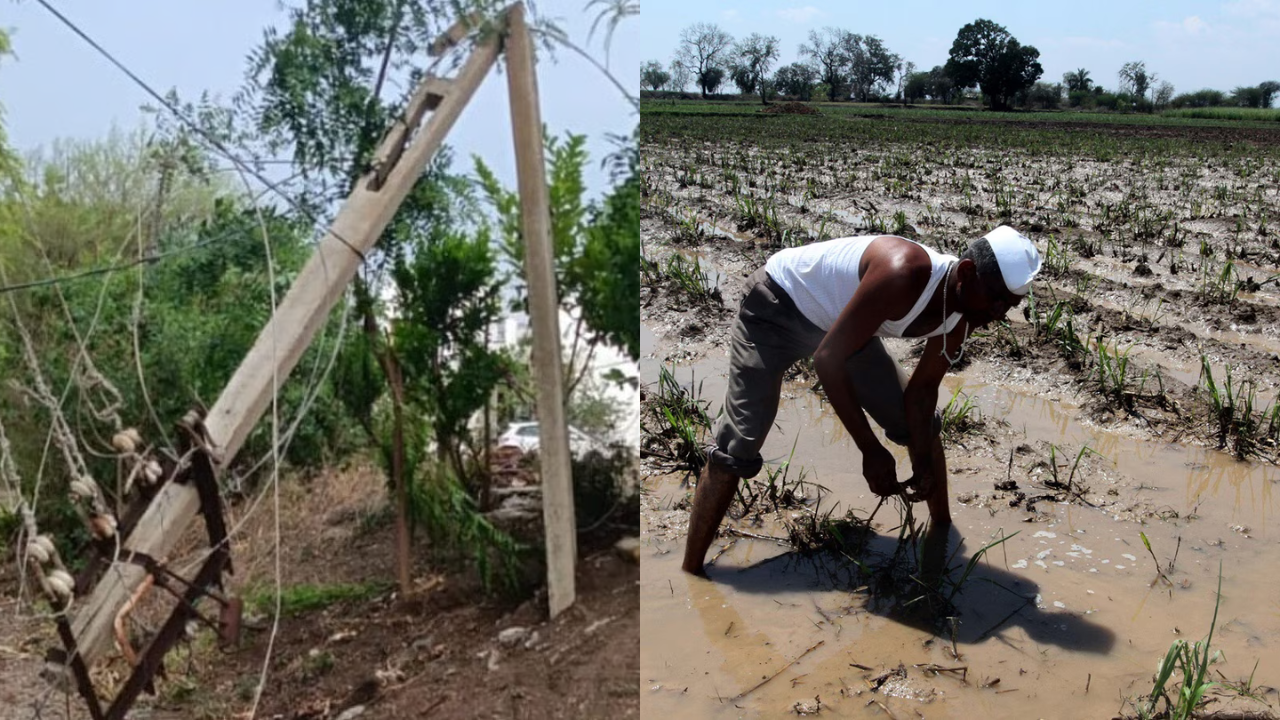

Chhatrapati Sambhajinagar – Unseasonal rainfall over the past several days has caused severe damage to standing crops across several regions of Chhatrapati Sambhajinagar district, leaving farmers in deep distress. Reports of farmer suicides have also begun to surface, highlighting the grim reality faced by rural communities as they battle the aftershocks of nature’s fury and financial hardship.
According to preliminary data from local agricultural offices, heavy rains accompanied by strong winds have flattened significant portions of kharif crops such as cotton, soybean, and tur. In several villages, standing sugarcane and onion fields have also been partially submerged, leaving farmers with little hope of recovery. Many of them had already been struggling with rising costs of seeds, fertilizers, and irrigation, and the fresh round of crop loss has pushed them deeper into debt.
Local farmers told Happen Recently that they had just begun harvesting cotton when the unseasonal rainfall struck. “Within a single day, our entire crop turned black with excess moisture and fungus. The cotton pods have fallen, and the seeds have rotted,” said a farmer from Vaijapur taluka. Others expressed similar anguish, adding that they had taken loans from cooperative societies and private lenders during the sowing season, expecting a stable yield this year after a fairly good monsoon start.
Tragically, reports have emerged of farmers taking extreme steps due to the losses. Authorities have confirmed several cases of suicide in rural areas of Chhatrapati Sambhajinagar district. Police officials said investigations are underway to determine the exact causes, but early findings indicate mounting financial pressure and loss of livelihood as major factors. Activists working in the region have urged the state government to immediately extend financial aid and mental health support to the affected families.
The Meteorological Department has noted that erratic weather patterns over the Marathwada region have become more common in recent years. While the monsoon officially withdrew in mid-October, sudden western disturbances have been bringing heavy post-monsoon showers unexpectedly. Agricultural experts warn that such conditions are likely to increase in frequency and intensity due to ongoing climate change.
District officials have begun survey work to assess the extent of the agricultural damage. The local administration has informed that revenue officials and agricultural officers are visiting affected villages to document crop loss and prepare compensation proposals. A senior district officer told Happen Recently that once the assessment report is submitted, a proposal for relief measures will be sent to the state government. “We are ensuring that the process is fast-tracked. Farmers should not have to wait months for assistance,” the official said.
Leaders of farmer organizations have demanded that the state and central governments release an immediate relief package for small and marginal farmers in the region. They also urged banks to waive interest on crop loans and delay repayment deadlines to prevent further distress. “Farmers are the backbone of our economy, yet they are repeatedly facing natural disasters with little institutional support. Without timely aid, rural Maharashtra will continue to suffer,” said one representative of a local farmer’s union.
Experts from the Vasantrao Naik Marathwada Agricultural University in Parbhani have suggested that long-term measures are needed to tackle the growing weather uncertainty. They emphasize the need for crop diversification, improved irrigation infrastructure, and better insurance coverage. “Government schemes for crop insurance are not reaching all eligible farmers. Many farmers are unaware of their benefits or face delays in claim settlements,” noted an agricultural scientist.
Meanwhile, the human toll continues to rise. Families of the deceased farmers told this publication that repeated crop failures and relentless debts had left them hopeless. Several widows and dependents are now left with loans to repay and no source of income. Social workers and non-governmental organizations in the district have begun mobilizing relief efforts, collecting funds, and providing psychological support to affected households.
In urban areas like Chhatrapati Sambhajinagar city, residents and local groups have organized food drives and donation campaigns. Religious institutions, student groups, and small business owners are also lending support. Volunteers say these small community-driven steps can provide temporary relief, but larger policy support will be needed to stabilize the situation.
Economists warn that widespread crop losses can have ripple effects on the local economy. Lower yields could impact cotton-related industries, food processing units, and allied rural employment sectors. The regional agriculture-based economy of Marathwada may further weaken, leading to migration from villages toward cities in search of daily wages.
As the state government assesses the scale of the disaster, observers are urging proactive governance. Timely disbursal of compensation, debt restructuring, and better crop insurance implementation are being cited as immediate priorities. Many also suggest setting up a dedicated crisis cell for climate-induced agricultural emergencies to coordinate between departments.
For now, hope rests on a return to stable weather and concrete action from policymakers. With the Rabi season approaching, farmers are eager to sow wheat, gram, and other crops, but uncertainty over rainfall, soil conditions, and financial availability remains high. Unless intervention reaches them quickly, another cycle of despair could unfold.
The ongoing crisis in Chhatrapati Sambhajinagar serves as yet another reminder of the vulnerability of India’s farmers amid changing climate conditions. Beyond immediate relief, this situation calls for long-term planning that strengthens farm resilience and ensures that the food producers of the nation are not left helpless in times of natural adversity.