
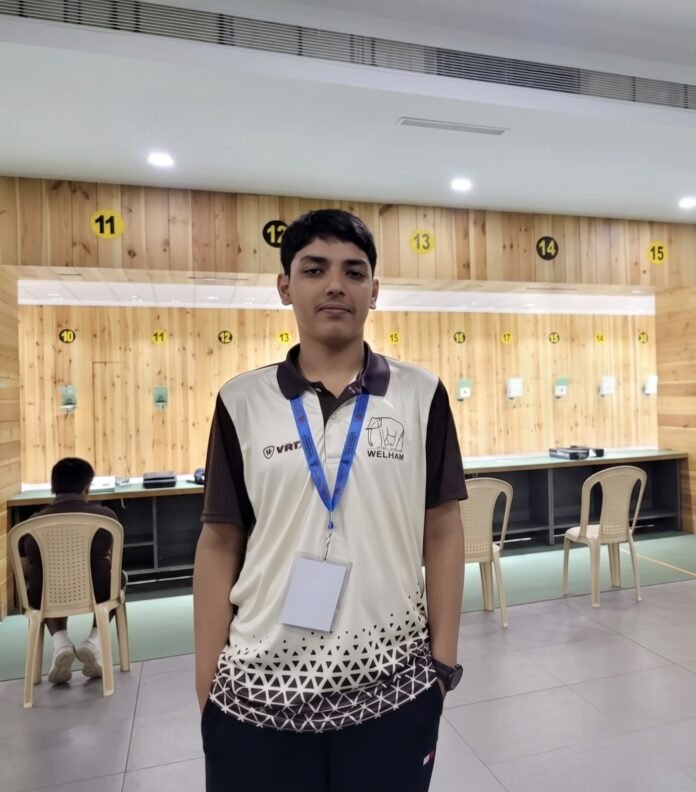
FEATURE STORY | Youth in Research & Innovation
KOTA, RAJASTHAN — In a town where waking hours are rigorously calibrated around mock exam percentiles and mechanics formulas, Vinayak Raj operates with a noticeably different rhythm. While preparing for competitive engineering entrance exams, the Grade 12 student has simultaneously authored published policy research on global carbon markets, directed simulated multilateral committees, and trained on national shooting ranges.
Originally from Bodh Gaya, Bihar, Raj’s path combines the discipline of an elite residential schooling background with the intellectual independence of an active young researcher.
The Dehradun Crucible: Welham Boys’ School
The roots of Raj’s multidisciplinary approach trace back to his middle-school years (Grades 8 to 10) at Welham Boys’ School in Dehradun, Uttarakhand. In an institution known for cultivating leadership and debate, Raj developed an early fascination with institutional history and defense strategy.
His academic commitment was recognized when he was awarded the Certificate of Commendable Contribution at the Welham Boys’ School Military History Seminar for his research on modern strategic defense frameworks. Concurrently, he joined the school’s competitive marksmanship squad, mastering the 10-metre air rifle discipline on campus.
His athletic training culminated in qualification for the XVII All India IPSC Boys Shooting Championship, hosted by Rajkumar College in Raipur. For Raj, marksmanship became far more than an extracurricular accolade:
“Target shooting forces complete internal stillness. The cardiovascular pacing, breath regulation, and neuromuscular control you learn on the firing line directly translate into how you handle high-pressure academic deadlines.”
Dissecting the Global Carbon Economy
Rather than limiting his academic writing to high school essays, Raj directed his energy toward international environmental governance. His foundational white paper, titled “Global Emissions and Carbon Offsetting: Examining Conservational Approaches and Regulatory Gaps,” was featured and published through the Model G20 platform.
The paper provides an unsparing analysis of contemporary voluntary and statutory carbon accounting mechanisms:
- The Additionality Fallacy: Critiquing how commercial offset credits are regularly issued for forestry and renewable projects that would have been financially viable regardless of carbon subsidies.
- Permanence and Reversal Vulnerabilities: Documenting how climate disruptions, including forest fires, pests, and illegal logging, undermine the long-term reliability of biological carbon sinks.
- Cross-Border Regulatory Fragmentation: Identifying loopholes between unregulated Voluntary Carbon Markets (VCMs) and Compliance Carbon Markets (CCMs), while proposing transparent digital ledgers aligned with Article 6 of the Paris Agreement.
- Equitable Stewardship Models: Proposing structural reforms that direct revenues directly to indigenous stewards and agricultural communities rather than speculative intermediaries.
Raj’s analytical writing extends beyond climate policy into published essays covering Indo-Pacific naval logistics, West Asian energy diplomacy, observational astrophysics, and behavioral criminology.
Multilateral Leadership and Grassroots Classrooms
Raj’s engagement with policy also translates into real-world conference leadership:
- WELMUN 2024: Appointed Rapporteur of the United Nations Economic and Social Council (ECOSOC), managing committee proceedings and drafting formal council documentation.
- OxfordMUN: Represented Saudi Arabia during negotiations addressing COP 28 outcomes, tackling hydrocarbon diversification and clean energy financing.
- Regional Circuits: Participated in debates at Daly College MUN (DCMUN ’24) and prior sessions of WELMUN.
Yet alongside elite diplomatic conferences, Raj has prioritized grassroots education. In Rajasthan, he has volunteered to conduct digital literacy workshops in state-run government schools, introducing underprivileged pupils to computer systems, digital tools, and technical career paths. He has also delivered instructional lectures for the Science Department in Kota, explaining the practical intersection of coding logic with physics and applied mathematics, while engaging in community welfare through Junior Chamber International (JCI).
Technical Horizons
Proficient in C, C++, Java, and Python, Raj has developed practical software experience through student internships at tech startups, including Nivaan and VJ Nucleus, observing real-world engineering sprints, version control, and codebase management.
Looking ahead, Raj intends to pursue an undergraduate degree in Computer Science at an internationally recognized university, focusing on artificial intelligence, algorithmic modeling, and data-driven sustainability frameworks.
His outlook is captured in his personal motto: “Learning with curiosity, thinking beyond boundaries, and using knowledge to build a better tomorrow.”