

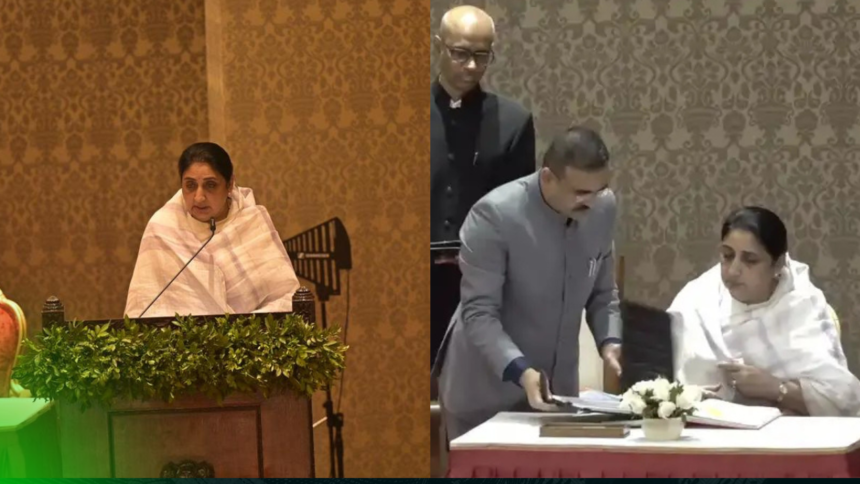
A new chapter unfolds in Maharashtra politics as Sunetra Pawar takes oath, blending legacy with women’s empowerment.
In a historic political development for Maharashtra, Sunetra Ajit Pawar has been sworn in as the first woman Deputy Chief Minister of the state. Her appointment marks a proud moment not only for the Pawar family but also for millions of women across Maharashtra who see this as a powerful symbol of empowerment, leadership, and political inclusion.
This elevation of Sunetra Pawar signals a significant chapter in the state’s evolving political landscape—one that reflects both continuity of legacy and a strong stride toward gender balance in high office.
A Legacy of Service and Leadership
Sunetra Pawar, the wife of Ajit Pawar, Deputy Chief Minister and senior Nationalist Congress Party (NCP) leader, has been an influential presence in Maharashtra’s sociopolitical scene for years, though largely working behind the scenes. Her official entry into the top administrative circle was long anticipated, given her contributions to public welfare, women’s empowerment, and rural development in western Maharashtra.
Born in a family rooted in cultural and social awareness, Sunetra Pawar has been recognized for her composed persona, philanthropic outlook, and dedication to grassroots initiatives. She co-founded and actively led several programs under the Sharad Pawar Rural Development Foundation, focusing on issues such as water conservation, education for girls, and sustainable agriculture.
From Public Service to Public Office
While political observers have followed the Pawar family’s moves closely, Sunetra Pawar’s transition from social service to active politics gained traction after the 2019 assembly elections. At that time, speculation had suggested she might enter the political arena, especially as the power dynamics within the Nationalist Congress Party were changing.
Her appointment now as Deputy CM signifies both trust and acknowledgment of her political maturity. Many insiders view it as a calculated yet meaningful expansion of the Pawar legacy, long rooted in the agricultural and political heartland of western Maharashtra.
A Milestone for Women in Politics
With this appointment, Maharashtra joins the ranks of states like Tamil Nadu, West Bengal, and Uttar Pradesh, where women have held powerful positions in government. However, in Maharashtra’s case, no woman had ever held the title of Deputy Chief Minister before Sunetra Pawar.
Leaders across party lines have welcomed the announcement, calling it a step toward creating a more inclusive political environment. Chief Minister Eknath Shinde, during the oath ceremony, said that her elevation adds “balance, dignity, and a people-first touch to the administration.”
From a policy perspective, this move is also seen as a strategic step to strengthen women’s representation in governance, encouraging young women across Maharashtra to aspire to leadership roles.
The Symbolism Behind the Appointment
Observers believe Sunetra Pawar’s new role carries both symbolic and strategic significance. Symbolically, it reflects the Pawar family’s deep roots in Maharashtra politics, continuing the political stature established by Sharad Pawar, the veteran leader and founder of the NCP.
Strategically, her inclusion in the state cabinet could appeal to diverse voter sections—urban women professionals, rural women self-help groups, and youth advocates supporting equal representation in politics. It also signals Ajit Pawar’s growing influence within the Maharashtra government after the realignment of the state’s power blocs.
Political analysts have described this move as one that combines legacy, leadership, and long-term vision—a hallmark of Pawar family politics. By stepping into an executive role, Sunetra Pawar ensures that women are no longer limited to supporting roles but are active decision-makers shaping Maharashtra’s progress.
Public Image and Popular Connect
Those who have interacted with Sunetra Pawar describe her as soft-spoken yet decisive, pragmatic yet compassionate. Over the years, she has built a strong presence in public welfare spaces, especially in education, healthcare, and rural women empowerment.
Her initiatives in the Baramati region include programs encouraging girls’ education, maternal health awareness, and entrepreneurship training for women. These efforts gained widespread appreciation, elevating her reputation as a leader who understands the grassroots realities of Maharashtra.
In the political landscape often dominated by male voices, her image offers refreshing authenticity. She is often seen visiting villages without fanfare—an approach that resonates deeply with voters who value humility and accessibility in leaders.
A Reflection of Changing Times
The rise of Sunetra Pawar as Maharashtra’s first woman Deputy Chief Minister is part of a broader wave of transformation in Indian politics. Women leaders are no longer confined to symbolic or token roles; they are emerging as key power centers capable of steering governance agendas and influencing national narratives.
Her appointment aligns with India’s push for 50% representation of women in local governance, reinforcing the fact that inclusivity at the top levels can inspire participation across the system.
Social commentators point out that her leadership could bring a more empathetic governance model—one that emphasizes family welfare, rural development, and sustainable community programs, areas often linked to women’s leadership perspectives globally.
Political Reactions and Public Response
Following the announcement, tributes and congratulations poured in from across the political spectrum. Members of both the ruling and opposition parties lauded the decision, calling it historic and progressive.
In her first statement as Deputy CM, Sunetra Pawar expressed gratitude for the faith placed in her by the party leadership and the people of Maharashtra. She reaffirmed her commitment to serving every section of society, especially women, farmers, and youth.
Social media platforms, too, witnessed a surge of celebratory messages. Many users praised her quiet strength and years of social service, while others highlighted that this marks the beginning of a new chapter for women leaders in Maharashtra politics.
The Road Ahead
As Sunetra Pawar assumes office, she carries both expectation and responsibility on her shoulders. Citizens across Maharashtra will look to her to deliver real change—improved welfare policies, effective administrative reforms, and a governance model that blends compassion with pragmatism.
Her leadership will be closely watched, particularly in sectors like rural development, women’s welfare, and education, where she already has deep experience. If she can translate her social initiatives into impactful government policies, she may redefine what it means to lead as a woman in Maharashtra politics.
For now, her rise stands as a testament to perseverance, vision, and the power of inclusion. Maharashtra has witnessed many firsts, but the day Sunetra Pawar took oath as the state’s first-ever woman Deputy Chief Minister will remain etched in history as a significant step forward for both the state and for women’s leadership in India.