


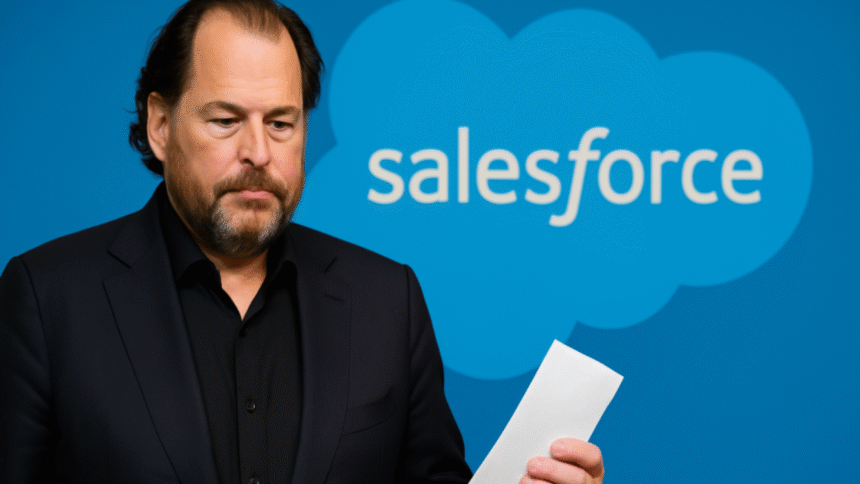
Salesforce CEO Marc Benioff Defends 4,000 Job Cuts, Says AI is Driving the “Most Exciting Months” of His Career
Artificial Intelligence is once again proving to be both a disruptive and transformative force in the global technology industry. Salesforce, the American cloud software giant, has announced a significant reduction in its customer support workforce, cutting nearly 4,000 jobs as the company increasingly integrates AI-powered solutions into its operations.
In a candid conversation on the Logan Bartlett Podcast, Salesforce CEO Marc Benioff confirmed that the company’s customer support team had been reduced from 9,000 employees to just 5,000. According to Benioff, this “rebalance” was driven by the rapid progress of artificial intelligence, which has enabled Salesforce to automate tasks traditionally handled by human staff.
“I was able to rebalance my headcount on my support. I reduced it from 9,000 heads to about 5,000 because I needed fewer heads,” Benioff explained during the podcast.
The announcement marks one of the most significant AI-driven workforce adjustments in the enterprise technology sector, highlighting how swiftly corporate strategies are shifting in response to emerging capabilities.
A Swift Turn from Previous Commitments
What makes this decision especially notable is its contrast with Benioff’s remarks just two months earlier. In July, speaking to Fortune, he emphasized that AI was intended to augment—not replace—human workers. At the time, Benioff stressed that “the humans are not going away,” dismissing widespread concerns about AI-driven job losses. He pointed to AI’s accuracy limitations, insisting that human oversight was necessary because “AIs can’t fact check.”
Back then, Benioff even contradicted AI leaders such as Anthropic’s Dario Amodei, who had predicted sweeping white-collar displacement. Yet, the latest cuts suggest that the pace of AI adoption has outstripped even Salesforce’s own projections, forcing a strategic realignment.
AI Takes Over Sales and Support
Salesforce’s use of AI is not limited to customer support. The company has also extended automation into sales operations, addressing one of its long-standing challenges—a backlog of more than 100 million uncalled sales leads accumulated over 26 years.
Benioff revealed that the issue has now been resolved with the deployment of AI-driven “agentic sales” systems. These systems are capable of contacting every individual who has previously engaged with Salesforce, dramatically accelerating the sales process and improving customer outreach.
Additionally, the company has introduced an “omnichannel supervisor” to oversee how AI agents and human employees divide responsibilities. This hybrid system ensures that tasks requiring human empathy, judgment, or creativity are escalated to staff, while routine or repetitive inquiries are handled seamlessly by AI.
Workforce Impact At the start of 2025, Salesforce employed more than 76,000 people worldwide. The 4,000 job cuts announced represent about 5% of its global workforce. While significant, the layoffs are part of a broader industry trend, as companies across sectors—from finance to healthcare—restructure their operations to incorporate AI efficiencies.
Interestingly, in his July remarks, Benioff had also indicated that Salesforce was not planning to expand its hiring for engineers, service agents, or even lawyers. Instead, the company’s hiring focus was on expanding its sales teams to help clients adopt and deploy AI-driven products. This further underscores Salesforce’s pivot toward AI-first strategies.
Benioff’s Optimism About AI
Despite the human cost of the layoffs, Benioff characterized this period as among the most dynamic and rewarding phases of his career.
“These are the most exciting months of my professional life,” he said, describing AI as a once-in-a-generation shift in how businesses operate and engage with customers.
He further emphasized that while AI is transforming roles and responsibilities, it also presents vast opportunities for innovation, efficiency, and business growth. The introduction of AI into Salesforce’s sales and support channels, according to Benioff, is already unlocking new levels of customer engagement and organizational productivity.
Broader Implications
Salesforce’s workforce reduction and aggressive adoption of AI highlight a tension playing out across industries worldwide. On one hand, AI offers undeniable benefits in terms of speed, efficiency, and scalability. On the other, it raises pressing questions about the future of work, job security, and the ethical role of corporations in balancing profit with human employment.
For Salesforce, a company that built its reputation on customer-centric solutions and pioneering cloud-based services, the transition underscores a determination to remain at the cutting edge of technological change.
Industry analysts note that while Salesforce is among the first major enterprise software providers to openly acknowledge workforce reductions due to AI, it is unlikely to be the last. As AI technologies continue to mature, similar adjustments are expected across the sector.
Looking Ahead
Benioff’s recent comments and the scale of Salesforce’s workforce changes signal that AI is no longer a supplementary tool—it is now central to the company’s operating model.
With AI-enabled systems handling millions of customer interactions, automating outreach, and reshaping support structures, Salesforce is positioning itself as a global leader in enterprise AI adoption. However, the journey also raises important questions for policymakers, industry leaders, and workers alike about how to balance innovation with inclusivity in the future of work.
As the debate around AI and employment continues, one thing is clear: Salesforce’s decision marks a pivotal moment in the corporate world’s embrace of artificial intelligence. The next few years will reveal not only the technological possibilities but also the societal consequences of this accelerated shift.