

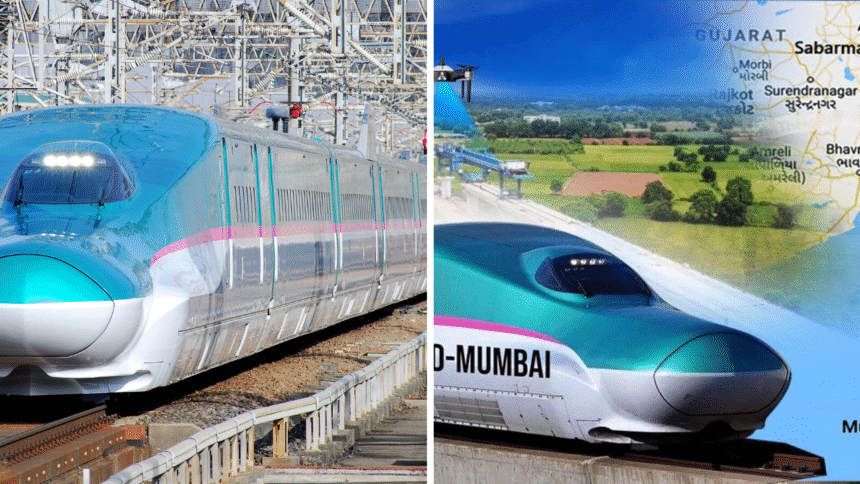
India’s most ambitious infrastructure initiative, the Mumbai-Ahmedabad High-Speed Rail (MAHSR) project, has successfully completed one of its most challenging engineering milestones—a critical tunnel segment—marking significant progress towards launching the country’s first bullet train service. Officials have confirmed that phase one of bullet train operations is on track to commence by December 2027, bringing India closer to its long-anticipated leap into high-speed rail connectivity.
The project, being executed by the National High-Speed Rail Corporation Limited (NHSRCL), is seen as a hallmark of new-age transportation that will transform mobility between Mumbai and Ahmedabad. With speeds expected to reach up to 320 km/h, the bullet train aims to cut the current travel time of seven hours to just about two hours, reshaping the way people commute and conduct business across the two states of Maharashtra and Gujarat.
A Pivotal Milestone in India’s First Bullet Train Initiative
The recently completed tunnel is not only an engineering marvel but also a symbol of the project’s momentum after years of planning, land acquisition hurdles, and technical evaluations. Spanning several kilometers, the tunnel forms a vital component of the alignment that connects Maharashtra to Gujarat, enabling seamless train operations along the high-speed corridor.
“This successful completion is a major step forward for the project. The tunnel will play a crucial role in ensuring seamless and safe passage for the upcoming bullet trains and reflects our commitment to achieving the highest standards of engineering and safety,” said an NHSRCL spokesperson.
Engineers revealed that advanced tunneling technology, including state-of-the-art Tunnel Boring Machines (TBMs) and specialized excavation methods, were deployed to counter challenges posed by the region’s complex geology. The tunnel work has been carried out under strict safety and environmental guidelines, ensuring minimal disruption to local ecosystems while adhering to global best practices.
December 2027: A Defining Moment for Indian Railways
The completion of this tunnel keeps the project aligned with its operational target of December 2027 for phase one. Once operational, passengers will experience ultra-modern facilities, enhanced comfort, and drastically reduced travel time. The first phase is expected to add significant momentum to India’s economic landscape by encouraging faster trade, smoother business connectivity, and tourism growth.
Government officials have emphasized that the MAHSR project is more than just a transport initiative—it is a transformative step toward achieving India’s vision of modern infrastructure. With support from Japan, which has provided financial assistance and technological backing through its Shinkansen expertise, the project represents a global partnership bringing world-class rail technology to Indian soil.
Economic and Social Transformation Ahead
The Mumbai-Ahmedabad bullet train is projected to create thousands of direct and indirect jobs, stimulate regional development, and boost the real-estate and hospitality sectors along its route. Additionally, the project has a strong emphasis on Make in India, with significant components being sourced and manufactured domestically.
Experts foresee that the bullet train will not only create economic opportunities but also bring profound social impact. The reduced travel time is expected to motivate more people to work in major economic hubs while living in nearby towns, balancing urban-rural development and reducing pressure on metropolitan infrastructure.
The project will also enhance India’s standing in global infrastructure rankings, reflecting the country’s aspirations to integrate high-speed, sustainable transport into its urban fabric.
Overcoming Challenges and Building the Future
The journey of the MAHSR project has not been without challenges. From land acquisition to environmental clearances and cost escalations, the futuristic venture has faced its share of obstacles. However, consistent cooperation between central and state governments, coupled with international collaboration, has ensured steady progress.
Industry analysts observe that keeping construction on schedule will be critical over the next two years, especially as more viaducts, stations, and depot facilities are completed. The decisive tunnel completion is widely seen as a confidence-boosting moment for contractors, policymakers, and stakeholders alike.
Looking Forward
As India inches toward its inaugural bullet train service, the excitement is palpable. December 2027 will not just mark the launch of a new train but the arrival of a new era in transport. The Mumbai-Ahmedabad corridor is expected to serve as a blueprint for future high-speed rail projects across the country, including proposed lines connecting Delhi, Varanasi, and Bengaluru.
With the tunnel milestone now achieved, the NHSRCL and its partners are preparing for the next challenging stages, including station construction, track laying, and trial runs. Each phase will bring the nation closer to experiencing its first true high-speed rail journey.
The successful launch of the bullet train will symbolize more than just modern infrastructure—it will stand as a testament to India’s determination to embrace innovation, foster sustainable growth, and offer citizens world-class mobility.
As commuters, businesses, and policymakers count down to December 2027, the dream of experiencing the bullet train is now closer to reality than ever before.