



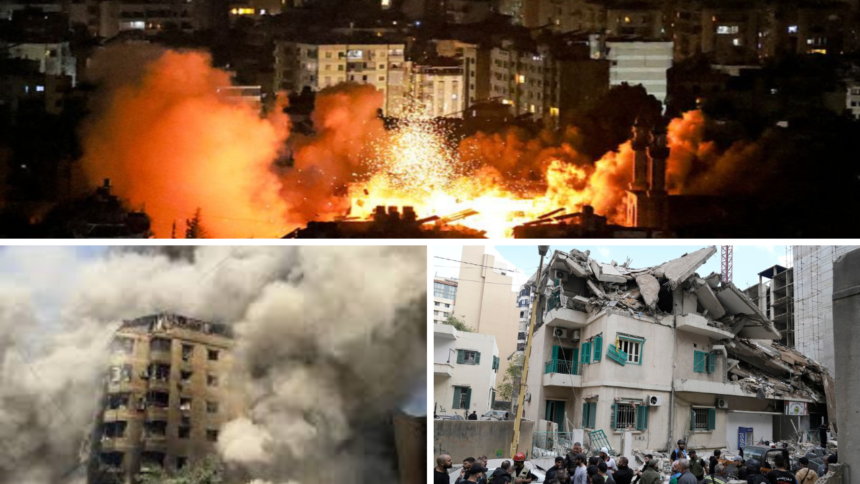
A wave of Israeli airstrikes struck residential buildings across southern Beirut on Thursday, triggering mass evacuations and widespread panic as residents were ordered to flee their homes just hours before the Muslim festival of Eid al-Adha. The attacks mark a significant escalation in tensions, raising fears of a broader regional conflict.
The targeted air raids, which began in the early hours, focused on densely populated civilian areas in Beirut’s southern suburbs, traditionally known as Hezbollah strongholds. Despite prior warnings and forced evacuation orders issued to residents, many families were caught off guard, scrambling to escape the bombardments amidst the looming holiday preparations.
Eyewitnesses reported multiple strikes that reduced residential buildings to rubble, setting off fires and causing widespread damage to civilian infrastructure. The Lebanese Civil Defense teams worked tirelessly to rescue those trapped under debris, while ambulances transported the injured to nearby hospitals. As of now, the official number of casualties remains unconfirmed, but local health authorities have warned of “significant civilian injuries” and potential fatalities.
Forced Evacuations on Eid Eve
The Israeli military had issued an evacuation order late Wednesday evening, instructing residents of several southern Beirut neighborhoods to vacate their homes immediately. The announcement came just as families were preparing for the Eid al-Adha festivities, a period traditionally associated with family gatherings, prayer, and acts of charity.
Many residents, however, decried the impossibility of such a sudden evacuation, citing the lack of safe corridors, transportation, and shelter. “Where are we supposed to go? We’ve lived here our whole lives,” lamented Fatima al-Husseini, a 62-year-old grandmother from the Bourj al-Barajneh district. “They are turning our Eid into mourning.”
Humanitarian Crisis Unfolding
Lebanese authorities, including the Ministry of Health and the Lebanese Red Cross, have warned of an impending humanitarian crisis as thousands of families are now displaced with limited access to shelter, food, and medical care. Makeshift shelters have been set up in school buildings, mosques, and community centers, but overcrowding and lack of resources have exacerbated the dire conditions.
The United Nations Interim Force in Lebanon (UNIFIL) has expressed “deep concern” over the escalation, urging all parties to exercise maximum restraint and prioritize the protection of civilians. “The timing of these attacks, on the eve of a sacred holiday, is deeply troubling,” said UNIFIL spokesperson Andrea Tenenti. “All sides must adhere to international humanitarian law.”
Israeli Defense Forces’ Statement
The Israeli Defense Forces (IDF) claimed that the airstrikes were aimed at “strategic military infrastructure” linked to Hezbollah, alleging that the targeted buildings were being used for planning and executing cross-border attacks. In a statement, the IDF emphasized that it had issued prior evacuation notices to minimize civilian casualties, though it acknowledged the complexity of operating in urban areas.
“We are committed to defending Israel’s northern border and will take all necessary actions to neutralize threats posed by Hezbollah,” the IDF spokesperson said. “Unfortunately, Hezbollah continues to embed its military assets within civilian neighborhoods, placing innocent lives at risk.”
Lebanese Government Condemns “Blatant Aggression”
Lebanese Prime Minister Najib Mikati condemned the airstrikes as a “blatant act of aggression” and a violation of Lebanon’s sovereignty. He called on the international community, particularly the United Nations Security Council, to intervene and hold Israel accountable for its actions.
“This is not self-defense; this is a calculated assault on the Lebanese people,” Mikati said during an emergency press briefing. “Targeting civilian areas on the eve of Eid al-Adha is a cruel reminder of the impunity with which Israel continues to act, while the world watches in silence.”
Hezbollah, in a statement, vowed to respond to the attacks at a time and place of its choosing, asserting that Israel’s actions would not go unanswered. The group also urged Lebanese citizens to stand in unity and resilience.
International Reactions
The airstrikes have drawn sharp criticism from several countries in the region, including Iran, Syria, and Turkey, all condemning the attacks as an “unacceptable escalation.” Human rights organizations such as Amnesty International and Human Rights Watch have also raised alarms, calling for an immediate independent investigation into potential violations of international law.
Meanwhile, Western governments have expressed concern over the rising tensions but have largely reiterated calls for de-escalation without explicitly condemning Israel’s actions.
A Festival Overshadowed by Fear
For many Lebanese families, what should have been a day of joy and celebration has turned into a night of terror and uncertainty. In the streets of southern Beirut, Eid prayers have been replaced with rescue operations, and the scent of traditional Eid feasts has been replaced by smoke and ash.
“We were preparing to distribute meat to the poor for Eid, but now we are struggling to find bread for our own children,” said Hadi Nasrallah, a local community worker.
As the situation remains volatile, Lebanon stands on the brink of another humanitarian catastrophe, with international observers warning that the coming days will be critical in determining whether this latest flare-up will spiral into a larger conflict.


