
Rising toll, compensation disputes fuel government-Congress clash; High Court slams negligence in India’s cleanest city
The contaminated water tragedy in Indore’s Bhagirathpura has escalated with the death toll reaching 21, sparking fierce political clashes between the state government and Congress. Congress leaders have labeled these preventable deaths as “government murder,” demanding accountability, higher compensation, and resignations amid rising public outrage.
Incident Background
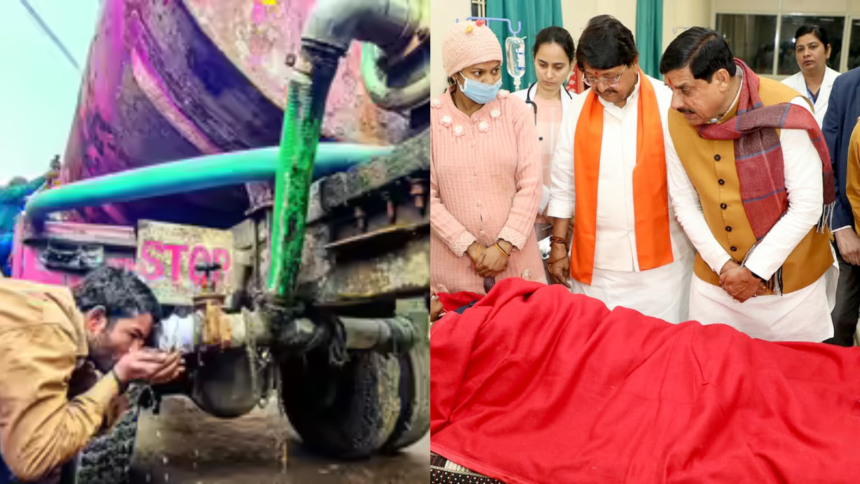
Bhagirathpura, a bustling locality in India’s cleanest city Indore, turned into a nightmare starting late December 2025 when residents began reporting foul-smelling, discolored water from Narmada pipelines mixed with sewage. This led to widespread outbreaks of vomiting, diarrhea, kidney failure, and even rare conditions like Guillain-Barré Syndrome (GBS). Lab tests confirmed sewage contamination, affecting over 3,200 people, with more than 200 hospitalized and several on ventilators.
Among the victims are vulnerable groups like a six-month-old infant Avyan Sahu, elderly women such as Harkunwar Bai (70), and retired cop Om Prakash Sharma. Families report complaining about leaks for two years, but officials ignored them. As of January 12, 2026, fresh cases continue, with hospitals overwhelmed despite free treatment pledges.
Government Response and Compensation
Madhya Pradesh Chief Minister Mohan Yadav announced Rs 2 lakh compensation per family, disbursed to 18 families so far, even as disputes rage over the exact toll—official figures lag behind local reports of 20-21 deaths. Actions include suspending three engineers, dismissing one zonal officer, and forming a three-member probe panel. Tanker supplies, dedicated medical wards, and pipeline repairs (3,000 km network) are underway.
The Madhya Pradesh High Court slammed authorities, questioning why Indore—eight-time Swachh Survekshan winner—is treated like a “grazing ground” with new IAS officers shuffled in. It ordered top treatment for victims. Urban Development Minister Kailash Vijayvargiya, whose constituency includes the area, faces heat for reportedly dismissing media queries as “fokat” (pointless).
Congress’s Fierce Backlash
Congress has turned the crisis into a major political flashpoint. MP Congress chief Jitu Patwari led a “Nyay Yatra” (Justice March) with leaders like Digvijaya Singh and Umang Singhar, protesting outside the municipal corporation. They demand Rs 1 crore compensation, criminal cases against officials, Vijayvargiya’s resignation, and a Supreme Court-monitored probe.
Pawan Khera accused the BJP of “criminal betrayal” under Jal Jeevan Mission and Swachh Bharat, calling it a failure despite Rs 2,450 crore allocated for clean water in Indore. Singhar alleged negligence amounting to murder, with Youth Congress staging symbolic protests using bells (“ghanta”). Over 21 activists were detained briefly. Patwari highlighted 24 years of BJP municipal rule yielding “not even one glass of clean water.”
Local Anger and Fear
Residents of Bhagirathpura are furious and scared. Mothers like Avyan’s recount mixing poisoned water in milk, while elders lament ignored complaints. “Indore is clean on paper, but our taps spew poison,” said one family member near MY Hospital. Social media erupts with #BhagirathpuraWaterTragedy, questioning civic pride amid GBS cases needing costly Rs 10-15 lakh IVIG treatments.
The crisis exposes systemic issues: untested quarterly water quality, incomplete infrastructure, and sewage leaks. Tanker dependency breeds distrust, with fears of spread to adjacent areas.
Political Tensions and Way Forward
Tensions peak as BJP defends probes while Congress vows sustained agitation. Vijayvargiya’s reported RSS office meetings with officials fueled conspiracy claims. This could impact local polls, highlighting urban governance failures despite flagship schemes.
Madhya Pradesh needs urgent water audits, strict monitoring, and accountability to prevent repeats. Families await justice beyond compensation—the real cost is irreplaceable lives in a preventable tragedy