


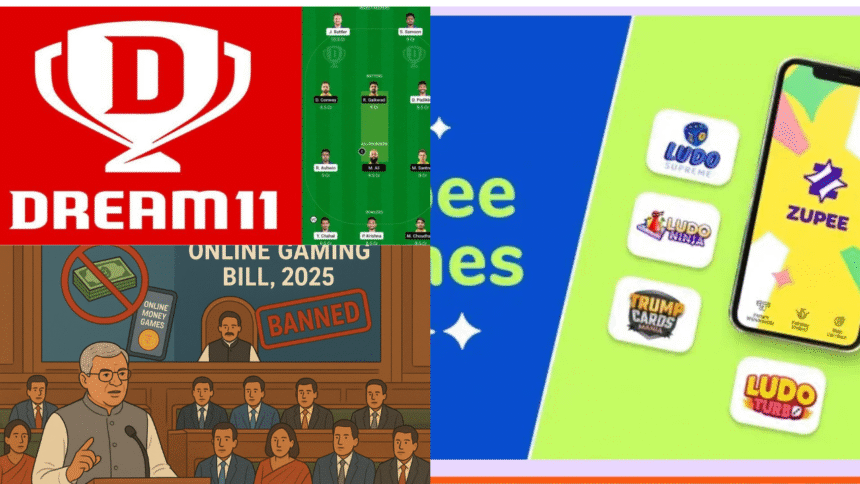
In a landmark development for India’s digital gaming and sports-tech ecosystem, two of the country’s largest online real-money gaming platforms, Dream11 and Zupee, have announced that they will discontinue their money-based gaming services. The decision comes in the wake of the Rajya Sabha’s passage of the Online Gaming Bill, 2025, a legislation that fundamentally reshapes the regulatory environment for the gaming industry in India.
According to multiple media reports, the legislation—now awaiting the assent of President Droupadi Murmu—prohibits the advertising, promotion, and endorsement of online real-money gaming platforms. It further restricts banks and non-banking financial companies (NBFCs) from facilitating transactions linked to money-based games, effectively curtailing the financial backbone of the industry.
Dream11’s Transition Strategy
Dream Sports, the parent company of Dream11, has reportedly briefed its employees about the transition plan. As per NDTV Profit, the company is preparing to pivot its focus toward its other verticals that have been steadily gaining traction in the sports-tech and content space. These include:
- FanCode – a digital sports content and streaming platform.
- DreamSetGo – a sports travel and experiences business.
- Dream Game Studios – focused on creating immersive sports-themed gaming content.
- Strategic investments in Willow TV and CricBuzz, leading names in global cricket broadcasting and coverage.
A company spokesperson emphasized that while real-money gaming was a major driver of Dream Sports’ success, the organization has always envisioned itself as a holistic sports ecosystem player. “Our mission is to make sports better and more accessible to fans in every possible way. The new law necessitates a change in operations, but it also opens opportunities to strengthen our other verticals,” the spokesperson said.
Zupee Retains Free-to-Play Portfolio
Zupee, one of India’s fastest-growing online gaming platforms, has also confirmed that it will wind down its paid gaming segment in full compliance with the new law. However, the company clarified that its popular free-to-play titles—including Ludo Supreme, Ludo Turbo, Snakes & Ladders, and Trump Card Mania—will continue to remain operational and accessible to millions of casual players across the country.
In a statement, Zupee’s leadership team acknowledged the importance of adapting to the evolving regulatory framework while ensuring uninterrupted entertainment for users. “We respect the decision of the Parliament and will fully comply with the provisions of the Online Gaming Bill. At the same time, our focus will be on nurturing India’s love for casual and skill-based gaming through our free-to-play offerings,” the company noted.
Industry Impact and Wider Implications
The passage of the Online Gaming Bill 2025 represents one of the most significant regulatory interventions in India’s digital economy in recent years. By banning advertisements and endorsements of real-money gaming and preventing financial institutions from facilitating such transactions, the law effectively dismantles the foundation on which several gaming platforms were built.
Experts believe this move will have far-reaching consequences:
- Industry Consolidation: With real-money operations curtailed, companies may consolidate around non-monetary models such as free-to-play games, esports, fantasy sports with non-cash rewards, and digital sports content.
- Job Transitions: Thousands of employees in the gaming sector could face role changes, though companies like Dream Sports are already working on redeployment strategies.
- Investor Sentiment: Venture capital and private equity funds that heavily backed real-money gaming may reevaluate their India strategies. At the same time, ancillary verticals such as sports media, esports, and content platforms could see renewed interest.
- Consumer Shift: Millions of players accustomed to real-money fantasy sports and card games will now be redirected to free-to-play or alternative entertainment platforms.
Government’s Stance
Supporters of the Online Gaming Bill 2025 argue that the legislation is aimed at curbing gambling-like practices, preventing financial exploitation, and ensuring consumer protection in a fast-growing but largely unregulated sector. By drawing a clear line between free-to-play entertainment and money-based gaming, the government has sought to strike a balance between innovation and social responsibility.
However, critics warn that the abrupt changes may drive some players toward offshore or unregulated platforms, raising concerns about illegal betting and the loss of domestic revenue. Policymakers have countered these arguments by underlining the need for a safer and more transparent digital ecosystem.
Dream11 and Zupee
While Dream11 and Zupee’s announcements mark the end of a significant chapter in India’s real-money gaming industry, they also highlight the adaptability of leading companies in the face of regulatory disruption. Dream11’s pivot toward sports content, experiences, and technology, coupled with Zupee’s commitment to free-to-play casual gaming, signals a reshaping of India’s gaming landscape rather than its decline.
Industry watchers predict that innovation in esports, AR/VR-based sports engagement, and casual gaming could define the next phase of growth. With India’s massive youth population and growing internet penetration, the appetite for digital sports and gaming experiences remains strong—albeit under a new legal framework.
The Online Gaming Bill 2025 represents a turning point for India’s gaming industry. For companies like Dream11 and Zupee, the legislation necessitates a strategic pivot, but it also provides an opportunity to reinvent and diversify. As the bill awaits Presidential assent, industry stakeholders, investors, and millions of users will closely watch how India’s digital gaming ecosystem evolves in this new era.