

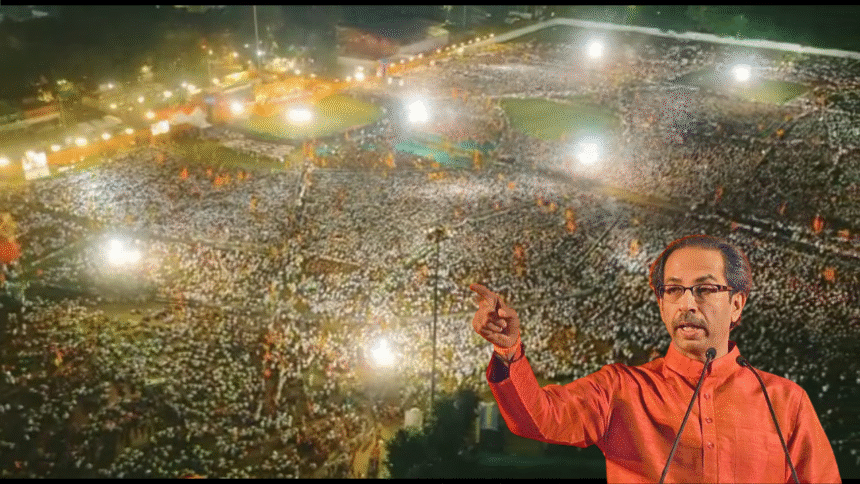
The political landscape of Maharashtra once again turned its focus on the grand Dasara Melava rallies, one of the most awaited annual events on the state’s political calendar. This year’s gatherings brought renewed attention as former Chief Minister Uddhav Thackeray and both Shiv Sena factions held parallel events at iconic locations, most notably at Shivaji Park, reinforcing the symbolic significance of the day. The tradition of the Dasara rally has long been associated with Shiv Sena’s strength and unity, dating back to Bal Thackeray’s speeches that set the political tone for the party every year. But with the split that shook Maharashtra politics in 2022, these rallies now symbolize not just tradition but also the fierce battle for ideological and political supremacy.
Historical Significance of Dasara Melava
The Dasara Melava has been a central point for Shiv Sena politics since the party’s inception. Traditionally organized at Shivaji Park in Mumbai, the gathering was used by Bal Thackeray to outline the party’s agenda and galvanize its supporters. Over the decades, the rally evolved into a larger-than-life event, drawing lakhs of attendees and serving as a platform for key announcements and strategies. Post-split, the rallies have acquired even greater importance as citizens, party workers, and observers look to decode policies, alliances, and electoral strategies from the speeches delivered.
Uddhav Thackeray’s Shivaji Park Address
Uddhav Thackeray, leading the Shiv Sena (Uddhav Balasaheb Thackeray) faction, continued his family’s legacy by addressing supporters at Shivaji Park. The venue, steeped in Shiv Sena’s legacy and political nostalgia, was flooded with saffron flags, slogans, and large crowds of enthusiastic karyakartas who saw Uddhav’s address as a reaffirmation of his leadership. His speech highlighted the political challenges of Maharashtra, critiqued the ruling alliance, and positioned his party as a protector of regional identity and democratic principles. Uddhav Thackeray underscored issues like farmers’ distress, unemployment, and governance concerns in the state. He also attempted to build momentum for upcoming local and national elections, emphasizing unity within his faction while reminding party workers of the original Shiv Sena values founded by Bal Thackeray.
Parallel Rally by the Eknath Shinde Faction
On the other hand, the Shiv Sena led by Eknath Shinde, currently aligned with the NDA, also organized its own Dasara Melava at an equally significant venue with massive participation. Shinde’s rally focused on projecting the faction as the “true heirs of Balasaheb’s Hindutva ideology”, stressing developmental politics coupled with ideological firmness. The Shinde group used the occasion to highlight government schemes, infrastructure projects, and welfare initiatives brought under their leadership, seeking to position themselves as not only ideologically strong but also administratively effective. The rallies reflected the deep-rooted competition between both factions, with both camps attempting to claim the legacy of Bal Thackeray while addressing their respective supporter bases.
The Battle for Symbolism and Legacy
The Dasara rallies this year clearly underlined the struggle for symbolism that continues to dominate Maharashtra politics. Shivaji Park, traditionally associated with Shiv Sena’s birth and growth, has become a matter of prestige and ownership between the two sides. While Uddhav Thackeray’s faction tries to project itself as the “original Sena,” closely tied to cultural and emotional grounds, the Shinde camp emphasizes its government support and recognition as the ruling faction. For supporters, the Dasara Melava remains more than just a rally—it embodies loyalty, tradition, and the vision of Shiv Sena’s founder. This makes the parallel rallies not only political contests but also emotional battles for identity and authenticity.
Broader Political Impact
The rallies also assume particular importance with Maharashtra gearing up for key local body elections and the 2026 Lok Sabha polls looming on the horizon. These events are seen as mood indicators, giving insights into ground-level sentiment and mass mobilization strength. Both factions put their organizational capabilities on display through turnout, event management, and enthusiasm generated around speeches. The rallies draw national attention as well, since Maharashtra remains a pivotal state in India’s political arithmetic. Alignments and rivalries formed here often shape broader coalitions and parliamentary outcomes.
Security, Crowd Management, and Enthusiasm
Given the mammoth scale and political sensitivity of the rallies, security arrangements were extremely tight at Shivaji Park and other rally venues. Mumbai Police ensured crowd control measures, with CCTV monitoring, traffic diversions, and emergency response teams deployed. Despite heavy arrangements, the enthusiasm of cadres remained high, with slogans, banners, and cultural programs adding energy to the events. Spectators noted that even decades after its inception, the Dasara Melava continues to maintain its magnetic pull over Shiv Sena workers and supporters.
Looking Ahead
As both Uddhav Thackeray and Eknath Shinde vie for the loyalty of Shiv Sena voters, the Dasara Melava rallies highlighted the intensity of Maharashtra’s political battles. The symbolic significance of Shivaji Park, coupled with powerful addresses from leaders, set the stage for an unfolding chapter in state politics. Observers believe these rallies are not just about current issues but also about shaping future narratives in Maharashtra’s politics. With elections near, each word delivered at these rallies will echo in campaign trails and public debates in the months to come.
The 2025 Dasara Melava rallies thus reinforced Shiv Sena’s legacy while underlining the evolving realities of Maharashtra’s political battleground. Both factions may differ in strategies and alliances, but the passion of their cadres proves that the Sena spirit remains alive, ensuring that the Dasara rally will continue to be a centerpiece of Maharashtra politics for years.