


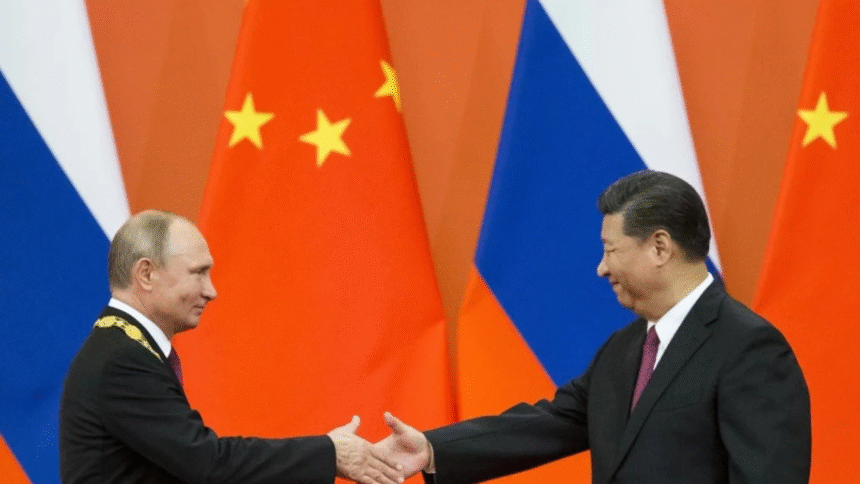
Chinese President Xi Jinping has reaffirmed the strength and resilience of the China-Russia relationship, describing it as the “most stable” partnership in today’s turbulent and uncertain global environment. His remarks come at a time of shifting geopolitical dynamics, underscoring the importance of Beijing-Moscow ties in shaping the future of international politics, trade, and security.
A Partnership Anchored in Stability During a high-level meeting between senior officials of both nations, President Xi highlighted the unique stability that characterizes China-Russia ties, despite global challenges ranging from economic slowdowns to rising geopolitical tensions. “In a world defined by turbulence and unpredictability, China and Russia stand together as partners committed to mutual respect, equality, and long-term stability,” Xi stated.
The Chinese leader emphasized that the relationship has transcended traditional alliances and is now built upon a foundation of shared strategic interests, pragmatic cooperation, and strong people-to-people exchanges. “Our partnership has withstood the test of time, international pressure, and regional complexities. It is a model for major-country relations,” he added.
Strengthening Economic Cooperation
Economic cooperation remains a key pillar of China-Russia ties. Bilateral trade between the two nations reached record levels in 2024, surpassing $240 billion, fueled largely by energy cooperation, agricultural exports, and the use of local currencies in cross-border settlements.
China has become the largest importer of Russian energy resources, particularly natural gas and crude oil, as Moscow reorients its trade in response to Western sanctions. President Xi reiterated that such cooperation is not merely transactional but strategic, as it ensures long-term energy security for China and stable export markets for Russia.
Furthermore, joint projects in infrastructure, technology, and logistics continue to expand under initiatives like the Belt and Road Initiative (BRI) and the Eurasian Economic Union (EAEU). Both governments have expressed confidence that bilateral trade could surpass $300 billion annually by 2030 if current growth trends continue.
Political and Security Alignment
The political alignment between China and Russia has grown closer in recent years, with both nations frequently coordinating their positions in international organizations such as the United Nations, BRICS, and the Shanghai Cooperation Organization (SCO).
President Xi noted that the partnership plays a crucial role in safeguarding global peace and promoting multipolarity, countering the dominance of any single power in world affairs. “China and Russia stand for fairness, justice, and the principle that all nations—regardless of size or power—deserve equal treatment in the international system,” Xi stressed.
Military cooperation also continues to deepen, with regular joint exercises conducted across land, sea, and air domains. These drills are seen as a demonstration of both nations’ commitment to regional security and strategic coordination.
Navigating Global Challenges Together
Xi Jinping acknowledged that the international order is facing unprecedented challenges: economic uncertainty, regional conflicts, climate change, and technological competition. Against this backdrop, he emphasized that China-Russia relations offer a stabilizing force.
“The strength of our partnership lies in its predictability and resilience. Unlike alliances driven by short-term interests, our ties are based on mutual understanding and long-term vision. We complement rather than compete, and this allows us to chart a stable course amid turbulence,” Xi remarked.
Both nations are also working closely on global governance reforms, advocating for stronger representation of developing countries in international financial institutions and pushing for reforms that reflect the realities of a multipolar world.
Cultural and People-to-People
Exchanges Beyond economics and politics, cultural exchanges are seen as a growing dimension of bilateral ties. Educational programs, tourism, and joint research initiatives have expanded steadily, with more Chinese students studying in Russian universities and vice versa.
In 2025, both nations are also celebrating the “China-Russia Year of Culture and Arts,” featuring exhibitions, film festivals, and academic symposiums aimed at deepening mutual understanding and fostering goodwill between their peoples.
Global Implications of Stable Ties
Analysts note that the strong and stable China-Russia relationship carries significant implications for global geopolitics. In an era where many alliances are tested by economic strain and political disagreements, the consistency of Beijing-Moscow ties offers a counter-narrative.
For emerging economies, the relationship demonstrates the possibility of strategic partnerships independent of Western-led frameworks. For global governance, it represents a push toward multipolarity, where no single nation dominates international decision-making.
However, some Western policymakers view the deepening partnership with caution, warning that closer coordination between China and Russia could challenge existing global power structures. Despite this, Beijing and Moscow maintain that their cooperation is not directed against any third country but is instead rooted in the principles of mutual benefit and peaceful coexistence.
President Xi’s remarks
President Xi’s remarks underscore China’s commitment to sustaining its partnership with Russia as a cornerstone of its foreign policy. Both nations have pledged to continue enhancing cooperation in trade, energy, defense, and diplomacy, while also expanding cultural and humanitarian exchanges.
“China and Russia will continue to walk side by side,” Xi concluded, “contributing to the stability of our region and the world at large.”
As the world continues to grapple with uncertainty, the enduring stability of China-Russia relations serves as a reminder that strategic partnerships, when based on equality and mutual respect, can act as a powerful force for peace and balance in the global order.