


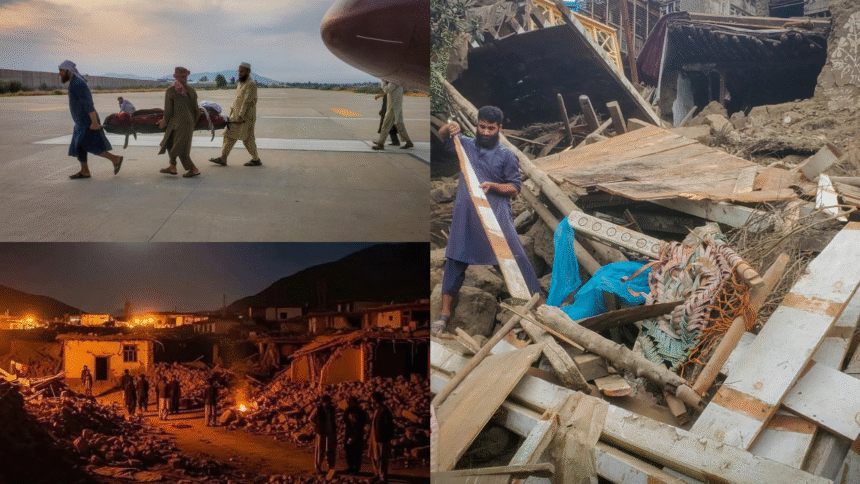
A powerful earthquake measuring 6.0 on the Richter scale has struck Afghanistan’s mountainous eastern region, leaving behind a trail of destruction, widespread casualties, and urgent appeals for international aid.
The quake hit late on Sunday at 23:47 local time (19:17 GMT) with its epicentre located 27 km (17 miles) from Jalalabad, the country’s fifth-largest city in Nangarhar province. Striking at a shallow depth of just 8 km, the tremor was felt strongly in Kabul, some 140 km away, as well as across the border in Pakistan. Initial reports suggest that more than 600 lives may have been lost, although authorities caution that the final toll could be much higher as rescue efforts continue.
Massive Casualties and Widespread Destruction
According to the Taliban’s Interior Ministry, hundreds of homes have been flattened in Nangarhar and neighboring Kunar province, with dozens of villages reportedly buried under rubble. “The extent of the devastation is still unknown, but what we are seeing already is a catastrophe,” one government official confirmed.
The quake’s impact has been compounded by a series of strong aftershocks, which have triggered additional collapses and landslides in already unstable mountain terrain. With road networks severely damaged, the only access to the epicentre is through air evacuations by helicopter, further delaying relief to remote communities.
“The road to the epicenter has been blocked by a massive landslide,”. “Helicopters are being deployed, but the need for urgent medical evacuation and supplies is far greater than what can currently be provided.”
International Aid Requested Amid Humanitarian Crisis
The Afghan government has urgently requested international humanitarian support, with UN agencies and aid organizations mobilizing to deliver emergency assistance. UNICEF confirmed that hundreds of homes may have been destroyed and warned that children are among the worst affected.
“This is a deeply tragic moment for Afghanistan,” said Salam Al Janabi, UNICEF. “Our teams are on the ground, but reaching the worst-hit areas is extremely difficult due to terrain and infrastructure damage.”
The disaster comes just days after flash flooding and landslides struck the region, killing at least five people and damaging vital transport routes between Afghanistan and Pakistan. This double blow has further weakened an already fragile response system.
Challenges in Gathering Accurate Information
The true scale of the tragedy remains unclear due to limited communications in rural areas and the ongoing difficulties of independent verification. Since the Taliban’s return to power in August 2021, international journalists and many NGOs have reduced their presence in Afghanistan, leaving fewer resources to monitor crises on the ground.
Previous earthquakes in Afghanistan have shown that death tolls often rise sharply in the days following the disaster, once aid workers and officials manage to access the hardest-hit areas.
Economic Collapse Compounds the Disaster
The earthquake strikes Afghanistan at a time of severe economic distress. Following the Taliban’s takeover, foreign funding—previously 80% of the national budget—was cut off. This collapse has left public services, including healthcare, in disarray.
Jalalabad’s main hospital, the closest major facility to the quake’s epicentre, is already overwhelmed. It is struggling to cope not only with earthquake victims but also with the ongoing influx of Afghans deported from Pakistan. Medical staff report severe shortages of beds, supplies, and medicine.
International sanctions continue to restrict financial aid flows, although humanitarian exemptions exist. Afghanistan’s foreign-held assets remain frozen, and the suspension of USAID programs earlier this year has further reduced emergency capacity.
Afghanistan’s High Vulnerability to Earthquakes
Geologically, Afghanistan sits at the convergence of the Indian and Eurasian tectonic plates, making it highly prone to destructive seismic activity.
In 2023, quakes in Herat province claimed over 1,000 lives, while in 2022, a tremor in Paktika province killed more than 1,000 people. Afghanistan’s vulnerability is magnified by shallow quake depths and poor construction standards, with many homes built from mud brick, timber, or weak concrete, none of which withstand seismic shocks.
Landslides triggered by quakes often exacerbate destruction, flattening entire villages and blocking rivers, which can lead to flooding.
Global Response Needed
The Afghan authorities have pledged to coordinate relief efforts but admit that resources are stretched to the limit. International humanitarian organizations, including the UN and the Red Crescent, are preparing to deliver emergency tents, food supplies, and medical kits.
Observers warn that without immediate assistance, the disaster could escalate into a long-term humanitarian crisis, adding to the plight of over 23 million Afghans already dependent on aid.
“Afghanistan is facing a disaster within a disaster,” said a senior humanitarian official. “This earthquake has struck at the heart of a country already grappling with economic collapse, sanctions, and chronic instability. International solidarity is essential right now.”
As search-and-rescue operations continue, authorities caution that the death toll will likely rise significantly in the coming days. Aftershocks remain a constant danger, further threatening survivors and relief workers alike.
Global leaders and humanitarian organizations are being urged to step up emergency relief, ensure swift delivery of medical supplies, and provide long-term reconstruction assistance to a country already on the brink of crisis.
For now, the people of eastern Afghanistan face another dark chapter in a long history of tragedy—caught between natural disaster and political upheaval, struggling to survive amid overwhelming odds.