
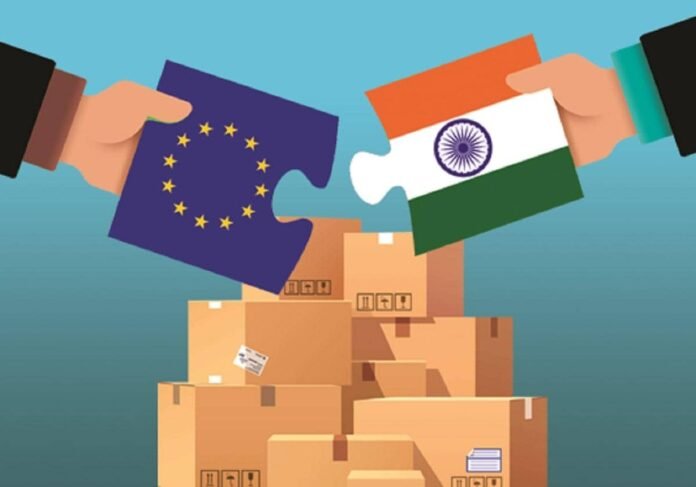
India and the European Union are likely to sign their long-awaited free trade agreement on December 16 in Brussels, during Prime Minister Narendra Modi’s visit to the Belgian capital, in a deal being described as the mother of all deals.
An official said the agreement is expected to be signed on that date, and European Union Ambassador to India Jean-Eric Paquet recently said the pact would be signed during Modi’s December visit to Brussels and would come into force next year.
The signing would close a negotiating process that has run for more than two decades and would open one of the largest trade corridors in the world for Indian exporters.
A deal two decades in the making
India and the 27-nation European Union concluded negotiations for the pact on January 27 this year, after talks spanning over two decades.
The European Commission has already submitted proposals to the Council of the European Union seeking authorisation for signing and conclusion of the agreement, along with the final legal text and tariff schedules.
The EU will eliminate tariffs on more than 90 percent of its tariff lines, while India will eliminate tariffs on 86 percent of tariff lines. When partial tariff liberalisation is also counted, the coverage rises to 99.3 percent for the EU and 96.6 percent for India.
What changes for Indian exporters
Under the free trade agreement, 93 percent of Indian shipments will enjoy duty-free access to the 27-nation bloc, giving exporters a sharper edge in one of the world’s largest consumer markets.
Indian exporters in textiles, apparel, footwear, fisheries, chemicals and pharmaceuticals are among the key beneficiaries of the improved access to European markets, according to the European Commission’s summary.
The tariff concessions are expected to strengthen the competitiveness of Indian products in Europe by cutting import duties and giving businesses a more predictable framework for cross-border trade.
What gets cheaper in India
The agreement also cuts tariffs the other way. Imports of luxury cars and wines from the European Union will become less expensive in India once the pact takes effect, with the timing depending on the product-specific commitments in the agreement’s schedules.
The scale of the pact
Once implemented, the agreement will create a combined market of around 2 billion people, linking India, the world’s fourth-largest economy, with the European Union, the world’s second-largest economic bloc.
Taken together, India and the EU account for 25 percent of global GDP and about one-third of international trade, worth around USD 11 trillion out of an estimated USD 33 trillion in global trade.
The European Union is India’s largest trading partner in goods when considered as a single economic bloc. India, in turn, ranks ninth among the EU’s goods trading partners worldwide and sixth for services.
What happens after the signing
The signing in Brussels is not the final step. Following the signing, the agreement will require approval from the European Parliament and the Council of the European Union. India will also have to complete its domestic legal procedures for ratification and implementation.
Paquet has said the agreement is expected to come into force next year, in 2027, once those approvals are complete.
For Indian businesses, December 16 now sets the clock running on the country’s largest trade deal.
Frequently Asked Questions
When will India and the EU sign the free trade agreement?
India and the European Union are likely to sign the free trade agreement on December 16, 2026, in Brussels, during Prime Minister Narendra Modi’s visit. The European Commission has submitted the final legal text and tariff schedules to the Council of the European Union for authorisation to sign.
What does the deal offer Indian exporters?
Under the agreement, 93 percent of Indian shipments will get duty-free access to the 27-nation European Union. Exporters in textiles, apparel, footwear, fisheries, chemicals and pharmaceuticals are among the key beneficiaries.
When will the agreement come into force?
After the signing, the pact needs approval from the European Parliament and the Council of the European Union, and India must complete its domestic legal procedures. The EU Ambassador to India has said it is expected to come into force in 2027.