

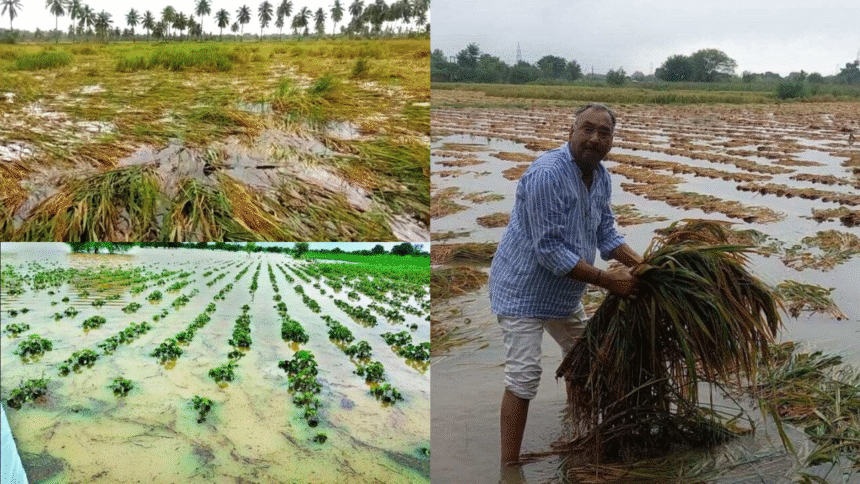
In a major setback for Indian agriculture, unseasonal and excessive rainfall over the past few weeks has led to widespread crop damage across several states. Preliminary estimates suggest that nearly 70 lakh acres of cultivated land have been affected, raising concerns for farmers, supply chains, and food security. In response, the Government of India has ordered an immediate survey of the losses to assess the scale of damage and ensure timely relief measures for affected farmers.
Extensive Crop Damage Across States
Reports indicate that states in central, western, and southern India have borne the brunt of the untimely showers. Standing crops such as paddy, soybean, cotton, pulses, maize, and groundnut have been hit hardest. In some regions, floods submerged large tracts of farmland, while in others, sudden downpours during harvesting season damaged produce ready for procurement.
According to early reviews, Madhya Pradesh, Maharashtra, Telangana, Andhra Pradesh, Karnataka, and parts of Uttar Pradesh have reported the most severe impact. Farmers in low-lying areas have been particularly vulnerable, with heavy waterlogging destroying crops in a matter of hours.
Government Moves Swiftly
Taking serious note of the crisis, the Union Agriculture Ministry has directed state agricultural departments to conduct urgent surveys. These surveys, to be carried out jointly by revenue and agriculture officials, will quantify the extent of crop loss and help determine compensation payable under state relief schemes and insurance programs.
A senior official from the ministry stated, “The government’s priority is to provide immediate support to farmers. Instructions have been issued to all states to complete surveys within days, not weeks, so that relief can be disbursed quickly.”
The Centre has also assured that sufficient funds are available under relief provisions, and that claims under the Pradhan Mantri Fasal Bima Yojana (PMFBY) would be expedited for insured farmers.
Farmers’ Concerns
For farmers, the rains have come as a huge blow, compounding the challenges already faced from fluctuating input costs and market uncertainty. Many had borrowed heavily ahead of the kharif season, and the sudden destruction of standing crops has left them staring at financial distress.
In Maharashtra’s Vidarbha region, cotton farmers have reported severe boll rot due to excess moisture. Paddy growers in eastern Uttar Pradesh and Chhattisgarh, who were close to harvesting, now fear much of their produce will go to waste. Meanwhile, soybean cultivators in Madhya Pradesh have claimed that the rains have brought down yield potential drastically.
Farmer unions, while welcoming the government’s directive for surveys, have urged for prompt ground-level action, noting that delays in compensation often worsen the distress. “We need quick verification and immediate compensation. Farmers cannot wait for months while official files move between departments,” one farmer leader said.
Possible Food Supply Concerns
The large-scale crop damage could also have wider economic implications. Agricultural experts believe that while India has robust food grain stocks, localized shortages of oilseeds, pulses, and certain vegetables might push up prices in the coming months. Cotton damage, in particular, may affect the textile supply chain, while a reduced soybean output could impact the edible oil markets.
Economists warn that the rural economy, which relies heavily on agricultural income, could face a temporary slowdown if the crisis is not addressed quickly. The government may have to increase procurement support and provide additional financial packages for vulnerable regions to stabilize the situation.
Political and Administrative Reactions
Several state chief ministers have written to the Prime Minister seeking additional relief packages and flexibility in utilizing disaster management funds. Opposition parties, meanwhile, have pressed for an urgent parliamentary discussion on crop losses and farmer relief.
In some states, district collectors have already issued advisories for farmers to record their losses and apply under crop insurance schemes. The government has also set up helplines where farmers can report damages, ensuring faster data collection and verification.
Expert Advice for Farmers
Agricultural universities have advised farmers to salvage whatever part of their crop can still be harvested. They have also suggested measures such as field drainage and drying of partially damaged crops to minimize further losses. Scientists have highlighted the need for climate-resilient agricultural planning, suggesting that unseasonal rainfall patterns could become more frequent due to climate change.
Government’s Next Steps
The Union Agriculture Ministry has indicated that after the survey reports are compiled, the Centre will release assistance under the State Disaster Response Fund (SDRF) as well as the National Disaster Response Fund (NDRF). Special relief camps and credit restructuring measures for affected farmers are also under consideration.
Meanwhile, the government has reassured citizens that overall food grain production targets for the year are unlikely to be seriously compromised. However, it has acknowledged that extensive state-level interventions are needed to prevent localized farm distress.
A Test of Resilience
This widespread crop damage comes at a time when policymakers have been emphasizing doubling farmer incomes and boosting rural growth. The current situation highlights the vulnerability of agriculture to weather extremes, while also underlining the importance of timely government intervention.
Protecting the livelihoods of millions of farmers, stabilizing food supplies, and ensuring quick compensation will remain the government’s immediate priorities in the coming weeks. Farmers’ welfare organizations, industry observers, and economists will continue to watch closely as survey reports emerge and relief measures unfold.
For the farmers affected, the hope remains that swift surveys, transparent compensation mechanisms, and supportive agricultural policies will help them recover from this devastating blow.