
Vembanad Lake, Kerala
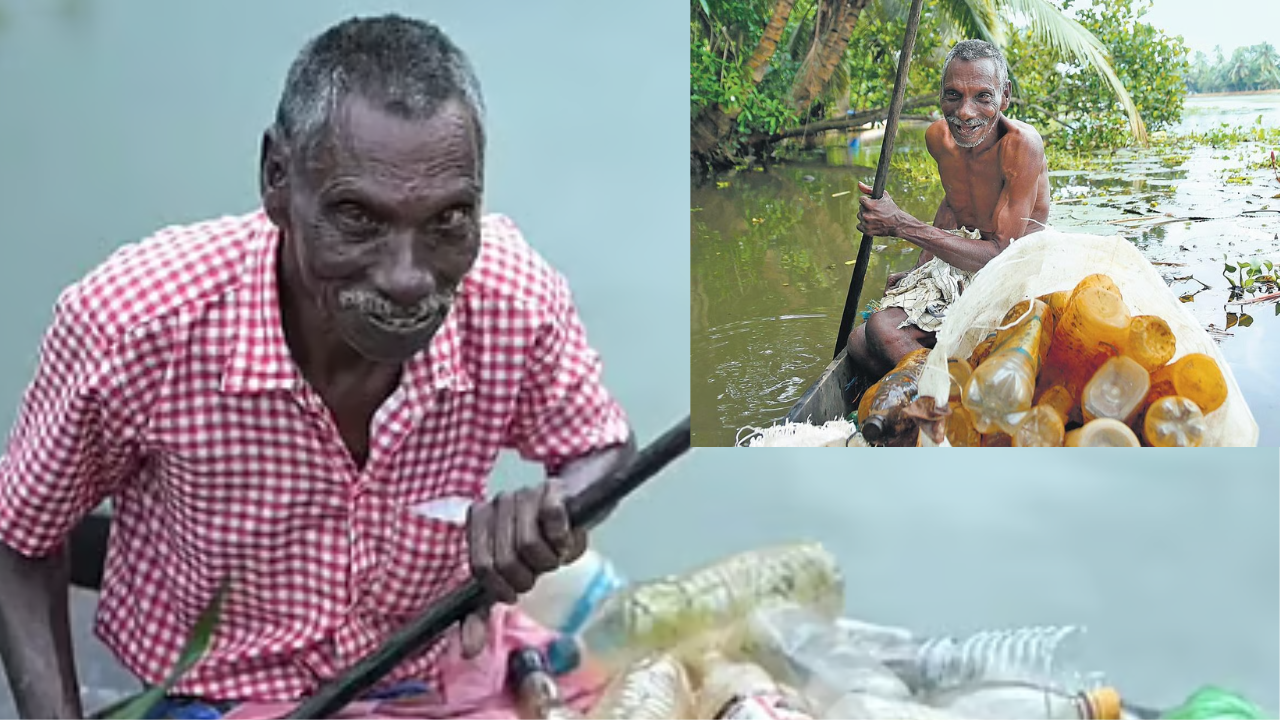
In a world driven by convenience and often blinded to the cost of environmental negligence, one man has quietly become a symbol of resilience, service, and selfless dedication. For the past six years, 69-year-old N.S. Rajappan—paralyzed below the knees—has undertaken an extraordinary mission: rowing a small boat using only his hands across the vast Vembanad Lake to collect plastic waste.
What makes Rajappan’s story so powerful isn’t just the physical effort it demands, but the unwavering spirit behind it. With no financial backing, no formal recognition, and limited mobility, Rajappan begins his day before sunrise, maneuvering a modest boat through the waters of Kerala’s longest lake, tirelessly retrieving discarded plastic bottles, bags, and debris.
“I may not be able to walk, but I can row. And I can clean,” Rajappan says with humility, his weathered hands reflecting years of labor, not for gain, but for a cleaner tomorrow.
Vembanad Lake, a UNESCO-recognized wetland and ecological hotspot, stretches across several districts of Kerala. Despite its ecological significance, the lake has suffered decades of abuse—industrial runoff, plastic pollution, sewage, and encroachment have severely impacted its biodiversity. Once brimming with fish and migratory birds, many parts of the lake are now choked with plastic and aquatic weeds.
Amid this growing environmental crisis, Rajappan’s solitary campaign stands out—not only for its environmental impact but also for its moral weight.
“He’s a Karla’s silent hero,” says Dr. Jaya Kumar, an environmentalist and professor at the Kerala University of Fisheries and Ocean Studies. “Without any government support or media spotlight, he’s doing what entire departments struggle to manage. He is living proof that one person can make a difference.”
A Life Marked by Adversity, Defined by Purpose
Rajappan lost mobility in his legs due to polio at a young age. Growing up in modest circumstances near Vaikom in Kerala’s Kottayam district, he never let his disability define his identity. Instead, he found ways to adapt. What started as occasional boat rides near his home eventually evolved into a full-fledged environmental mission when he saw plastic pollution spreading across the water he loved.
“I saw animals getting sick, fish dying, and plastics floating everywhere. I thought, if I don’t do something, who will?”
Using a simple, manually operated wooden boat, Rajappan collects between 5 to 8 kilograms of plastic waste every day. He sells the collected plastic for a meager amount to local scrap dealers—just enough to buy food and maintain his modest lifestyle.
Despite his contributions, Rajappan lives alone in a small house, surviving on basic needs and minimal earnings. His mission is not funded by any NGO or government body. It is powered purely by purpose.
A Wake-Up Call
Rajappan’s selfless efforts have drawn occasional media attention and social media buzz, with environmental advocates calling for government recognition and support. In 2022, a short video of him went viral, drawing admiration from across India and abroad. People praised his dedication and demanded authorities take note.
“It’s a wake-up call,” said actor and environmentalist Rahul Bose. “If someone who can’t walk can clean a lake daily, what excuse do the rest of us have?”
Calls for honoring Rajappan with a national award have grown louder, with many suggesting he deserves the Padma Shri or an equivalent recognition.
Beyond awards, environmental groups are urging local authorities to support Rajappan with a better boat, medical aid, and perhaps even a stipend or pension that reflects his service to society.
A Movement in the Making?
While Rajappan doesn’t consider himself an activist or leader, many young volunteers and students now look to him as an icon of environmental consciousness. Several schools and colleges near Vembanad have organized “Clean the Lake” campaigns inspired by his actions. His story has sparked discussions in local government circles about formalizing lake cleanup operations involving community participation.
“There’s a purity to what he’s doing. He doesn’t seek fame. He just wants to leave the lake better than he found it,” says Devika Nair, a student volunteer who met Rajappan during a cleanup drive in 2024.
Recognition Long Overdue
As India continues to grapple with plastic pollution and the challenges of environmental sustainability, the story of N.S. Rajappan offers both inspiration and indictment. It challenges the complacency of a system that often overlooks its most dedicated citizens while applauding token efforts elsewhere.
It is time Rajappan receives more than applause. He deserves systemic support—medical care, financial stability, and above all, the acknowledgment of a nation that benefits daily from unsung heroes like him.
A Message for All
In a society increasingly distracted by digital lives and instant gratification, Rajappan’s journey reminds us that greatness lies not in loud declarations, but in quiet, consistent action. His daily voyage across the polluted waters of Vembanad is more than an environmental act—it is a message of hope, of resilience, and of what it truly means to serve.
As he rows on, with calloused hands and an undeterred heart, N.S. Rajappan continues to clean not just a lake, but our collective conscience.