
In international politics, strength is often measured by visible indicators—military capabilities, economic power or technological superiority. Yet history repeatedly demonstrates that nations capable of exercising patience frequently achieve outcomes that military force alone cannot deliver. In today’s increasingly complex geopolitical landscape, strategic patience has emerged as one of the most valuable tools of statecraft.
Independent geopolitical researcher Tanmay Saukur believes this principle has been embedded in Indian strategic thinking for over two millennia. Through years of research into geopolitics and India’s evolving global role, he argues that one of the most overlooked lessons from Chanakya’s Arthashastra is not how to wage war, but how to avoid it while still securing national interests.
Having authored more than 30 articles and five research papers on geopolitics, Tanmay has built a reputation for analysing international affairs through an India-centric strategic lens. Tanmay has shared a paper with the CII on Smart Manufacturing and has been recognised at national and international academic forums.
According to Tanmay, modern diplomacy often rewards countries that understand when not to react.
“Patience should never be mistaken for indecision,” he says. “In geopolitics, waiting for the right opportunity can be more effective than responding immediately.”
Chanakya described this principle through the concept of Kaal—the strategic value of timing. He believed that every decision should be guided not by emotion but by circumstance, preparedness and long-term advantage. A ruler who understands timing can often achieve objectives with fewer costs and greater certainty than one who acts impulsively.
This philosophy continues to resonate in today’s international environment.
Global affairs have become increasingly unpredictable. Traditional alliances are evolving, new power centres are emerging, and economic competition has become deeply intertwined with national security. In such an environment, measured diplomacy often produces more sustainable outcomes than public confrontation.
India’s foreign policy over the past decade provides several examples of this approach. Rather than rushing into rigid alliances, India has expanded strategic partnerships across multiple regions while preserving its decision-making autonomy. It has simultaneously strengthened relations with the United States, Europe, the Middle East, ASEAN nations, Africa and the Global South, all while maintaining dialogue with countries holding differing geopolitical interests.
This ability to engage with diverse partners reflects confidence rather than hesitation.
Strategic patience has also become evident in India’s approach towards regional diplomacy. Instead of allowing temporary political tensions to permanently disrupt long-term relationships, India has consistently prioritised dialogue, economic cooperation, connectivity and developmental partnerships. Such an approach recognises that geopolitical relationships evolve over time and that today’s disagreement need not become tomorrow’s permanent divide.
Chanakya understood this reality centuries ago. His vision of diplomacy was never built on emotional responses or ideological rigidity. Instead, it was founded upon careful assessment, flexibility and an unwavering commitment to protecting long-term national interests.
Equally important is Chanakya’s understanding that influence grows gradually. Trust cannot be built overnight, nor can regional leadership be established through coercion alone. Sustainable influence is earned through consistency, credibility and the willingness to remain engaged even during periods of uncertainty.
This perspective is increasingly reflected in India’s expanding global role.
Whether through humanitarian assistance during crises, leadership on issues affecting the Global South, infrastructure partnerships with neighbouring countries, or consensus-building at multilateral forums such as the G20, India has demonstrated that diplomacy is often most effective when it combines restraint with purpose. Rather than seeking dominance, it has increasingly positioned itself as a reliable partner capable of balancing competing interests.
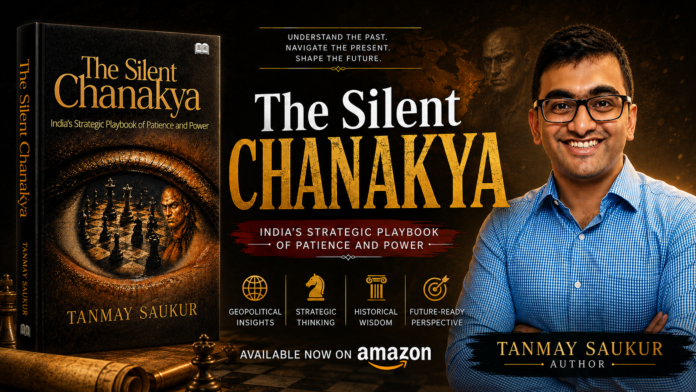
These observations form the foundation of The Silent Chanakya: India’s Strategic Playbook of Patience and Power, authored by Tanmay Saukur. The book explores how Chanakya’s strategic principles continue to illuminate India’s contemporary foreign policy through detailed case studies involving the Maldives, Afghanistan, Sri Lanka, Bhutan, Nepal, the G20 Presidency and other major geopolitical developments. It argues that India’s diplomatic conduct is best understood not merely through contemporary international relations theories, but also through the enduring wisdom of the Arthashastra, where patience, strategic restraint and calibrated engagement are recognised as powerful instruments of statecraft.
Already an Amazon No. 1 Bestseller, The Silent Chanakya offers a fresh perspective for policymakers, students, business leaders and anyone interested in understanding India’s growing influence in world affairs. By connecting ancient strategic wisdom with modern geopolitical realities, the book demonstrates that some of history’s most profound ideas remain remarkably relevant in addressing today’s global challenges.
As the world navigates an era of uncertainty, one lesson stands out with increasing clarity: enduring influence is rarely built through force alone. It is built through foresight, resilience, strategic patience and the wisdom to know when the right move is not the quickest one. That timeless lesson, articulated by Chanakya more than two thousand years ago, may well be one of India’s greatest strategic advantages in the twenty-first century.
Buy the book here: https://amzn.in/d/0cf8vtVB