
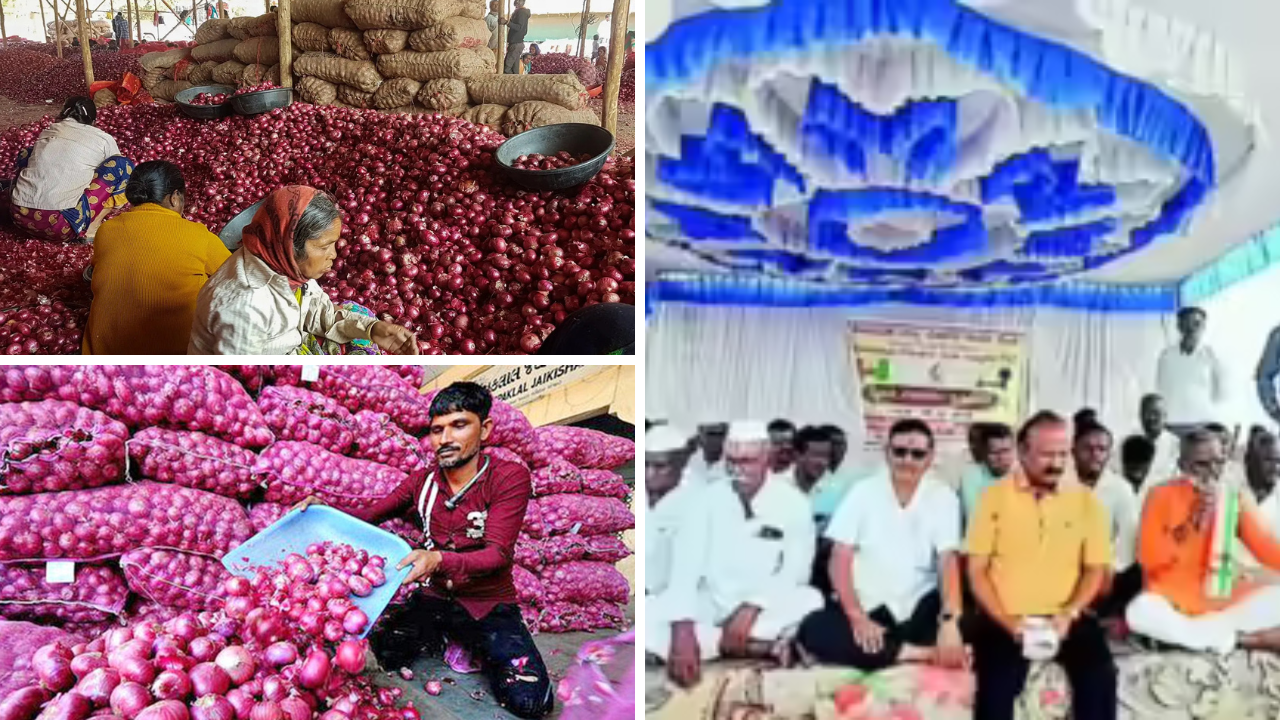
In a dramatic escalation of the ongoing agrarian unrest, onion farmers across Maharashtra have strengthened their protests against the current market conditions, demanding fair prices for their produce. On Friday, large groups of farmers intercepted trucks belonging to the National Agricultural Cooperative Marketing Federation of India (NAFED), insisting that government procurement agencies must ensure they receive remunerative rates. Farmer leaders have warned that if their demands are not met soon, they will launch a statewide Rasta Roko Andolan (road blockade agitation).
The state, one of the largest producers of onions in India and a key supplier for both domestic and export markets, has witnessed significant distress among cultivators in recent months. A glut in supply, coupled with volatile pricing and inadequate procurement measures, has left farmers struggling to cover even their basic input costs. The frustration reached its peak as trucks loaded with onions under NAFED procurement operations were stopped by agitating farmer groups outside major mandis in Nashik, Ahmednagar, and Jalgaon.
Farmers’ Key Demands
The protesting farmers are demanding that the government sets a minimum support price (MSP) for onions at a level that reflects rising costs of cultivation, storage, and transport. They emphasized that while onions are an essential commodity for households across India, farmers ironically receive less than what it costs to grow the crop. Representatives assert that the current procurement price offered by NAFED and local wholesale markets is far below expectations, discouraging farmers from continuing husbandry of this staple vegetable.
Speaking at the protest site in Lasalgaon, one of Asia’s biggest onion markets, farmer leader Suresh Patil said, “We are not asking for charity, we are asking for justice. The government agencies are buying onions at distress prices while private traders exploit our situation. If the State and Center cannot give us fair value, we will have no option but to block roads across Maharashtra.”
Why Onions Matter
Onion farming is central to Maharashtra’s agricultural economy, employing millions directly and indirectly. The Lasalgaon belt in Nashik is considered the ‘onion capital of India’. Any disruption in production or supply not only affects farmers’ livelihoods but also impacts consumers across the country. A crash in onion prices has historically led to farmer agitations, while a sudden rise in market rates often triggers political repercussions at the national level.
Currently, farmers report that they are being forced to sell onions at as low as ₹7-8 per kilogram in wholesale markets. Considering that production cost per kilogram, inclusive of seeds, fertilizers, labor, electricity, and transport, is often above ₹10, cultivators face net losses. For many, this is pushing them into mounting debt and fueling frustration that has now erupted into widespread protest.
The Role of NAFED
The National Agricultural Cooperative Marketing Federation, a central government body, has been tasked with procuring onions to stabilize prices and manage buffer stocks. However, farmers allege that procurement volumes are insufficient and offered prices are too low to meaningfully benefit cultivators. This, combined with outdated storage infrastructure, means much of the produce risks spoilage before it can reach consumers or export markets.
Officials from NAFED maintained that they are working within the guidelines set by the Union Ministry of Agriculture and are carefully balancing farmer interests with consumer welfare. However, the assurances have failed to calm tempers on the ground.
Threat of Statewide Agitation
What makes the situation critical is the farmers’ announcement of an impending Rasta Roko Andolan. Such protests, involving road blockades and the disruption of transport corridors, could severely affect supply chains, including the movement of essential goods across Maharashtra and neighboring states.
Farmer organizations have already started mobilizing support in districts like Nashik, Pune, and Aurangabad. If thousands of trucks carrying agricultural produce are stopped on highways, the disruption could escalate into a nationwide issue, leading to spikes in retail onion prices at urban centers.
Political observers note that the agitation has the potential to put pressure on both the Maharashtra state government and the Union government. With onion prices always a politically sensitive issue in India, any prolonged unrest could influence policy decisions and electoral narratives.
Government Response
State authorities have appealed for calm and assured farmers that negotiations will continue. Maharashtra’s Agriculture Minister held an emergency press briefing on Saturday, promising to review procurement rates and to raise the matter urgently with the Center. “We recognize the importance of onion farmers in keeping food markets stable. We are committed to finding a solution where cultivators are not forced into distress. Dialogue is the only way forward,” the minister stated.
Meanwhile, opposition parties have seized upon the crisis to attack the government, accusing it of neglecting farmer welfare and failing to fulfill promises made regarding MSP reforms.
Broader Implications
Beyond immediate price concerns, the crisis also reflects structural challenges in India’s agriculture sector. Farmers remain vulnerable to market volatility due to the lack of adequate storage facilities, efficient export policy frameworks, and transparent procurement systems. Without major reforms, experts warn that similar unrests will continue to flare up whenever supply-demand gaps emerge.
Many agricultural economists argue for a stronger MSP regime along with investments in cold storages, digitalized procurement, and farmer cooperatives. Such systemic changes, they believe, would not only safeguard farmer interests but also stabilize consumer prices.
The Road Ahead
As protests intensify, the coming week will be crucial in determining whether the standoff finds a resolution or escalates into widespread disruptions. If the government raises procurement prices to meet farmer expectations, tensions may soften. If not, Maharashtra could be the starting point for yet another nationwide agrarian movement.
For now, the voices from Nashik’s onion markets echo a singular message: farmers want justice, and they are prepared to take their fight to the streets if their demands are not heard.