
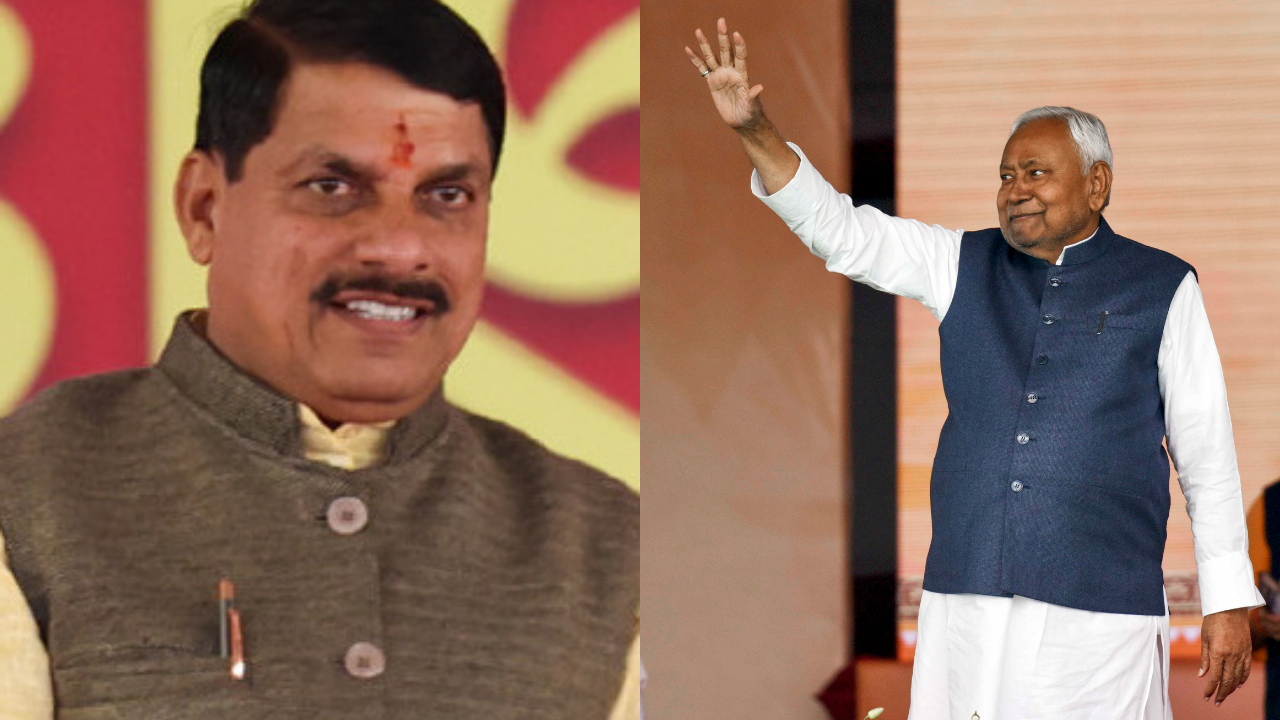

Madhya Pradesh Chief Minister Mohan Yadav is once again making political headlines as he prepares to attend the oath-taking ceremony of Bihar’s Chief Minister Nitish Kumar. The event, marking Nitish Kumar’s 10th term as Chief Minister, is gaining national attention, and the presence of Mohan Yadav at the ceremony underscores a larger message of political engagement and alliance-building within India’s shifting political landscape.
The ceremony, expected to be attended by several political heavyweights, reflects Bihar’s political continuity under Nitish Kumar’s leadership, while also providing a stage for broader discussions among leaders from different states. Mohan Yadav’s attendance emphasizes Madhya Pradesh’s growing presence in national political circles and his own emergence as a significant leader within the Bharatiya Janata Party (BJP).
Strengthening Political Ties Across States
Mohan Yadav’s participation in the event is being interpreted as more than a simple gesture of respect or protocol. Political analysts view it as part of a broader strategy to strengthen inter-state relations within the party and reinforce coordination among the BJP-led governments across India. His attendance signals Madhya Pradesh’s active role in national dialogue and decision-making processes, especially in the run-up to key political events and elections.
Leaders from various states, particularly from BJP-ruled regions, are likely to utilize the occasion to discuss future strategies, governance models, and policy collaborations. Madhya Pradesh’s success in implementing several flagship central schemes, infrastructure upgrades, and development initiatives under Mohan Yadav’s leadership has positioned the state as an example of efficient governance. Many observers see this as a reason his presence at major political gatherings carries increasing significance.
Nitish Kumar’s Landmark 10th Oath-Taking Ceremony
Nitish Kumar’s 10th term as Bihar’s Chief Minister is historic, further cementing his reputation as one of India’s longest-serving state leaders. Known for his coalition politics, administrative reforms, and efforts to balance social and economic priorities, Nitish’s return to office reflects both continuity and resilience in Bihar’s political environment.
For the BJP and its national allies, such a milestone provides an important opportunity to demonstrate internal stability and regional cooperation. The presence of influential leaders like Mohan Yadav underscores unity within the party framework and signals the central leadership’s confidence in the administrative abilities of its key Chief Ministers.
Mohan Yadav’s Rising Role in the BJP’s National Landscape
Since assuming office as the Chief Minister of Madhya Pradesh, Mohan Yadav has maintained a steady focus on governance, infrastructure development, and youth empowerment. His governance style has often been described as practical and people-centric, focusing on long-term state growth through both urban modernization and rural empowerment.
Attending significant political ceremonies such as this one not only enhances his visibility at the national stage but also strengthens inter-state collaboration on key issues like education, digitalization, and investment promotion. Political experts suggest that Yadav’s growing influence within the BJP could translate into a greater role in shaping national-level policies that affect states like Madhya Pradesh and beyond.
Symbolism and Political Messaging
The presence of Chief Ministers from multiple states at the event also carries symbolism. It reflects the idea of cooperative federalism—leaders working together to build a shared political vision while maintaining regional diversity. For Mohan Yadav, being part of Nitish Kumar’s historic moment offers an opportunity to showcase Madhya Pradesh’s political harmony with other states while reinforcing the principles of unity and development under the party’s broader ideology.
Such interactions often extend beyond ceremonial participation. Behind the scenes, these events serve as informal platforms for exchanging ideas, sharing governance strategies, and discussing upcoming challenges such as employment generation, economic revival, and welfare delivery. The networks formed during such gatherings can influence future collaboration across sectors like agriculture, education, and industrial growth.
What This Means for Madhya Pradesh
For Madhya Pradesh, the Chief Minister’s engagement in national political events helps raise the state’s profile in inter-state and central-level discussions. It positions Madhya Pradesh as an active contributor to India’s overall progress rather than a spectator. Mohan Yadav’s leadership approach—rooted in regional tradition but open to innovation—fits well within the broader aim of expanding the state’s influence beyond its borders.
The event also offers an opportunity to attract new investments and partnerships. Bihar and Madhya Pradesh share cultural and social similarities, and both states are working on strengthening infrastructure, transport connectivity, and industrial corridors. Future collaborations spurred by such political interactions could translate into developmental benefits for both regions.
National Significance and Broader Impact
Beyond state politics, Mohan Yadav’s attendance at Nitish Kumar’s 10th oath-taking ceremony highlights the BJP’s emphasis on maintaining strong communication and coordination between its regional leaders. In an era where public perception and political partnerships matter more than ever, the symbolic presence of state leaders hints at unity and continuity within the organization’s national framework.
As political observers await the proceedings in Patna, all eyes will be on how key leaders interact and what messages emerge from this landmark event. The coming together of experienced leaders like Nitish Kumar and rising figures such as Mohan Yadav presents a picture of political coherence, stability, and shared commitment toward national growth.
Conclusion
Mohan Yadav’s attendance at the oath-taking ceremony goes beyond mere formality. It represents a convergence of political respect, inter-state cooperation, and strategic outreach. For Madhya Pradesh, it marks another step in projecting its leadership at a national level, while for India’s political scene, it reaffirms the importance of unity and collaboration among leaders steering the country’s development.
As Bihar marks Nitish Kumar’s 10th term, the presence of leaders like Mohan Yadav sets the tone for a renewed era of partnership-driven governance in India—where state leaders come together to shape not just their regions, but the nation’s future direction.