
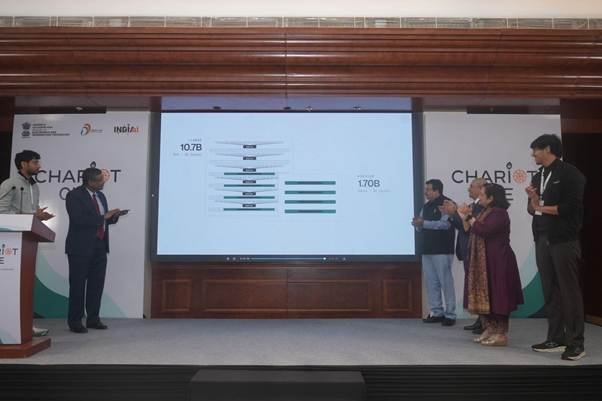
India has launched Chariot-1, a home-grown suite of foundation AI models built from scratch in the country under the IndiaAI Mission. S. Krishnan, Secretary in the Ministry of Electronics and Information Technology (MeitY), inaugurated the launch at Bharat Mandapam in New Delhi on Wednesday.
The models were developed by Chariot Artificial Intelligence Pvt. Ltd., one of the first four teams selected under the IndiaAI Mission to build sovereign foundation models.
The Chariot-1 suite has two parts: the Chariot-1 Large Language Model (LLM) and the Chariot-1 Text-to-Speech (TTS) model. Both were pre-trained from scratch in India, and the launch adds a second Indian foundation model effort to the public stage after Sarvam AI’s recent releases.
An 11-billion-parameter model in three sizes
The Chariot-1 LLM is an 11-billion-parameter mixture-of-experts model, with 4 billion active parameters per token. It is available in three model sizes, 10.7 billion, 1.7 billion and 745 million parameters, to suit different computing needs and deployment settings.
That range matters because the same model family is meant to run everywhere from data centres to laptops, smartphones and edge devices.
The speech model, Chariot-1 TTS, generates speech in English and 10 Indian languages: Hindi, Bengali, Marathi, Tamil, Telugu, Kannada, Malayalam, Gujarati, Punjabi and Odia. It is designed to understand context and decide how numbers, dates, currencies, units, web addresses and abbreviations should be spoken aloud, a common stumbling block for speech systems in real-world use.
On the Async TTS Pronunciation Benchmark, the model recorded over 97 per cent verbalisation accuracy across 1,029 real-world sentences and 2,251 instances of non-standard text in 42 categories.
Three research ideas behind the models
The launch showcased three research innovations developed by the Chariot team and built into the training of the models.
The first is IndicShift, an open-source method that introduces a shared alphabet for Indian scripts. It covers 1,012 characters across 12 Indian scripts through 350 letters, letting models use the similarities between languages instead of treating each script separately. The approach uses up to 2.5 times fewer tokens on Indian text than OpenAI’s GPT tokeniser.
The second is Nested Training, which trains the three model sizes at once, as described above.
The third is Mixture of Vocabularies, which splits the model’s vocabulary into 11 groups and scores only the relevant group at a time. That cuts the number of vocabulary entries scored per word by 5.7 times and delivers a 38 per cent improvement in training speed on the same GPUs.
One model for text, speech and listening
Parth Sarthi, Co-Founder of Chariot One, said the model combines text generation, text-to-speech and automatic speech recognition in a single architecture, so developers do not need separate specialised models for each job.
“So, that is what makes Chariot One special: it is one model, a backbone that powers all these different applications,” Sarthi said.
Krishnan congratulated the Chariot team, describing the launch as a significant achievement for India’s technology ecosystem. He noted that the IndiaAI Mission was designed to nurture and support such talent, and appreciated the contribution of the two Stanford graduates who returned to India to build advanced AI technology.
The event also featured a fireside conversation between Vishal Dhupar, Managing Director, South Asia, at NVIDIA, and Suvrat Bhooshan, Co-Founder of Chariot.
What it means for the IndiaAI Mission
The launch is part of the Centre’s wider effort under the IndiaAI Mission to support teams building AI models and technologies within the country, with a focus on reducing dependence on externally developed technology. Krishnan also said on the sidelines that the government’s upcoming AI regulation papers are in the final stages and will be released shortly. “It’s in the final stages. We’ll bring it out shortly,” he said, adding that the Chariot-1 launch has vindicated the IndiaAI Mission’s faith in young Indian talent to develop first-rate AI models.
The key numbers to watch:
– 11 billion: parameters in the Chariot-1 LLM, with 4 billion active per token – 3: model sizes, 10.7 billion, 1.7 billion and 745 million parameters – 11: languages covered, English and 10 Indian languages – 97 per cent: verbalisation accuracy on the Async TTS Pronunciation Benchmark – 2.5 times: fewer tokens on Indian text with IndicShift, versus OpenAI’s GPT tokeniser – 62 per cent: faster training with Nested Training
If the models find real users in Indian languages, the launch will count as the IndiaAI Mission’s clearest result so far. The test now is adoption: whether developers and government services pick up a home-grown model that speaks their users’ languages.
Frequently Asked Questions
What is Chariot-1?
Chariot-1 is a suite of sovereign AI foundation models built from scratch in India by Chariot Artificial Intelligence Pvt. Ltd. under the IndiaAI Mission. It includes a large language model and a text-to-speech model.
Which languages does Chariot-1 support?
The models work in English and 10 Indian languages: Hindi, Bengali, Marathi, Tamil, Telugu, Kannada, Malayalam, Gujarati, Punjabi and Odia.
How big is the Chariot-1 language model?
The Chariot-1 LLM is an 11-billion-parameter mixture-of-experts model with 4 billion active parameters per token. It comes in three sizes: 10.7 billion, 1.7 billion and 745 million parameters.

