
The legislative assembly has received the CAG report on the performance audit of the previous BRS government’s flagship project.
The Comptroller and Auditor General (CAG) has released a scathing report on Telangana’s Kaleshwaram project, stating that it was not financially feasible from the start and highlighting significant cost overruns, potential undue advantages for contractors, and inadequate planning.
The CAG report suggests that the cost of the Kaleshwaram Project, which was initially estimated at Rs 81,911 crore according to the Central Water Commission (CWC), is now expected to exceed Rs 1.47 lakh crore.
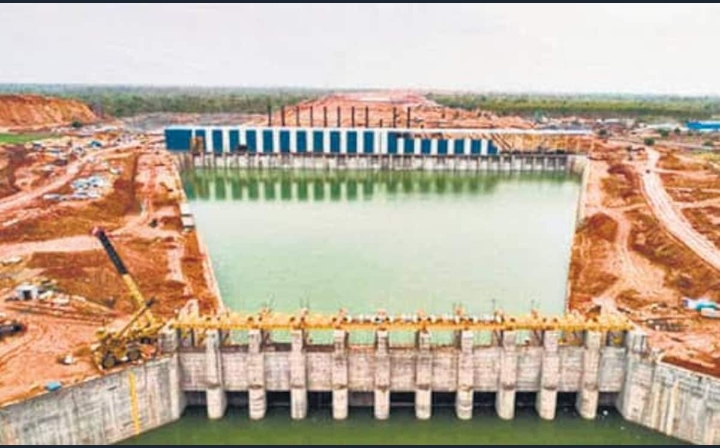
This report was presented in the legislative assembly, shedding light on the performance audit of the previous BRS government’s flagship project. The controversial Kaleshwaram project has faced further scrutiny after some piers of the Medigadda barrage “sank” last year.
The Medigadda barrage was found to be severely damaged by the National Dam Safety Authority (NDSA), making it non-functional unless it undergoes extensive renovations.
This damage is believed to be one of the main factors contributing to the defeat of BRS in the recent assembly elections. The Kaleshwaram Project is an offshoot of the PCSS Project, which was originally formulated by the former undivided state of Andhra Pradesh.
The executive summary of the CAG report highlights that the Telangana government has not provided administrative approval for the entire project, instead issuing separate approvals totaling to 73, with a combined cost of Rs 1,10,248.48 crore. Additionally, there is no clarity about the funding pattern for the project, as there are no government orders in this regard.
As of March 2022, out of the total expenditure of Rs 86,788.06 crore on the project, Rs 55,807.86 crore (64.3 percent) was financed through off-budget borrowings raised by KIPCL.
The proposal for the DPR included the extraction of water from river Godavari at a rate of two TMC per day. However, the pumping capacity was later increased to three TMC per day, which incurred an additional cost of Rs 28,151 crore.
As a result of re-engineering the PCSS Project and making changes to the project works, certain parts of the already executed works became unnecessary, leading to a loss of Rs 767.78 crore.
As of March 2022, only 12 out of the 56 project works were completed, 40 were ongoing, and four had not even begun. Furthermore, the report stated that the identification of lands required for the distributary network and other purposes is still incomplete.
For more information visit at www.happenrecently.com