
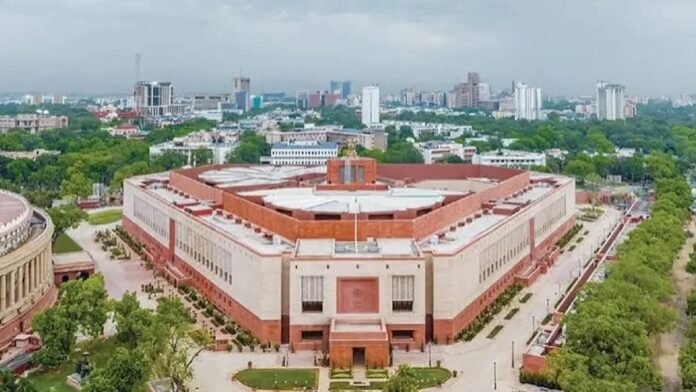
Parliament will reconvene from November 30, Union Minister of Parliamentary Affairs Kiren Rijiju announced on Thursday, 26 November, setting the stage for a short sitting dominated by speculation over the Delimitation Bill and women’s reservation ahead of the 2029 Lok Sabha elections. The Lok Sabha will meet on Monday, 30 November, and the Rajya Sabha on Wednesday, 2 December, to transact essential government business.
Rijiju said the government has written to Lok Sabha Speaker Om Birla and Rajya Sabha Chairman C P Radhakrishnan, and that there will be no Question Hour, Zero Hour or Private Members’ business during the sittings. In a post on X, he said: “The Government has requested Hon’ble Speaker, Lok Sabha and Hon’ble Chairman, Rajya Sabha to reconvene Lok Sabha on Monday, 30th November, 2026 and Rajya Sabha on Wednesday, 2nd December, 2026 respectively to transact essential Government Business.”
A session that never formally ended
The Monsoon Session was adjourned sine die on 13 August and was never formally prorogued, which means the same session is being extended rather than a new session being called. Parliament has now remained unprorogued for 94 days, passing the previous record of 87 days set in 2008. Under the rules, an extended sitting of an existing session requires a minimum notice of two days, and the government has met that requirement with the announcement on 26 November.
Delimitation and women’s reservation back in focus
The reconvening has reignited debate around the Delimitation Bill. The Centre passed the Nari Shakti Vandan Adhiniyam, or the Women’s Reservation Act, in Parliament in 2023, but the law could not be implemented for the 2029 Lok Sabha elections under the existing framework because its implementation was linked to the completion of the next Census and the delimitation exercise that follows it.
The government had earlier attempted to push a Delimitation Bill through a special session, but the legislation failed to secure the required support in Parliament. According to reports, the government could now introduce three major Bills together during the session: a Constitutional Amendment Bill, the Delimitation Bill and a Union Territories Amendment Bill.
The numbers the government needs
The NDA has around 292 to 293 MPs in the Lok Sabha, comfortably above the majority mark of 272 required to pass an ordinary Bill. A Constitutional Amendment Bill is a different test. Under Article 368 of the Constitution, such an amendment requires a special majority, which means the support of a majority of the total membership of the House as well as at least two-thirds of the members present and voting.
The government is counted at 324 MPs in the Lok Sabha and needs 360 votes to secure a two-thirds majority, leaving it 36 votes short. That gap is why attention has turned to the opposition benches. The government is now looking towards several opposition MPs, including the Samajwadi Party’s 37 MPs in the Lok Sabha, and the DMK, which has 22 MPs in the Lok Sabha and eight in the Rajya Sabha. If the DMK were to vote in favour, the government’s tally would rise to 354, still six votes short of the required 360.
What to expect from the sitting
With only two sitting days announced so far, Lok Sabha on 30 November and Rajya Sabha on 2 December, the government has kept its legislative agenda under wraps. Whether the government tables the Bills it is reported to be considering will become clear only when the Houses meet.
Frequently Asked Questions
When will Parliament reconvene?
The Lok Sabha will reconvene on Monday, 30 November 2026, and the Rajya Sabha on Wednesday, 2 December 2026. Union Minister of Parliamentary Affairs Kiren Rijiju announced the dates on 26 November.
Why is there buzz about the Delimitation Bill?
The Women’s Reservation Act passed in 2023 can only be implemented after the next Census and delimitation. Reports suggest the government could introduce a Constitutional Amendment Bill, a Delimitation Bill and a Union Territories Amendment Bill during the sitting.
Does the government have the numbers to pass a constitutional amendment?
The NDA has around 292 to 293 MPs, above the 272 needed for an ordinary Bill, but a constitutional amendment needs a two-thirds majority under Article 368. The government is counted at 324 and needs 360 votes, leaving a gap of 36.