
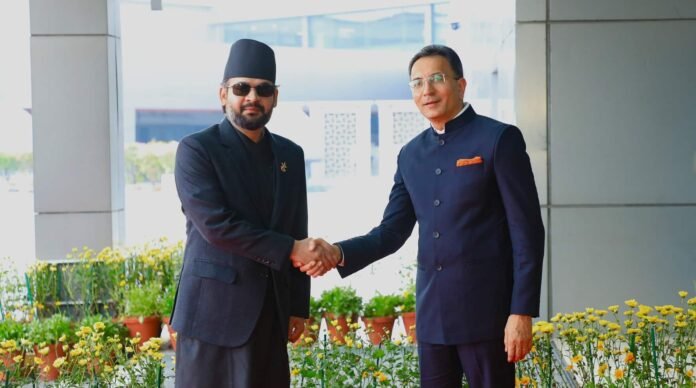
Prime Minister Narendra Modi and Nepal Prime Minister Balendra Shah hold bilateral talks in New Delhi on Monday, with energy, hydropower, railways, trade, connectivity and infrastructure at the top of the agenda. The meeting is the first in-person interaction between the two leaders and the centrepiece of Shah’s two-day state visit to India, which began on November 22.
Shah arrived in New Delhi on Sunday afternoon and was received by Minister of State for Commerce and Industry Jitin Prasada. External Affairs Minister S Jaishankar called on him on Sunday evening. The visit is Shah’s first bilateral trip abroad since he took office in March 2026, after leading the Rastriya Swatantra Party to victory and forming a government.
“Privileged to call on PM Balendra Shah of Nepal on his visit to New Delhi this evening. India cherishes the special friendship with Nepal. Look forward to his engagements with PM Narendra Modi tomorrow,” Jaishankar said in a post on X.
Energy and hydropower at the centre
Energy cooperation is expected to be among the most important areas of discussion, with both sides looking to expand cross-border electricity trade and hydropower development.
India and Nepal already have a long-term power trade agreement that envisages India importing up to 10,000 MW of electricity from Nepal over 10 years. India currently imports around 1,200 MW of power from Nepal every year. In 2025-26, Nepal earned about NPR 1,800 crore, roughly Rs 1,129 crore, in net revenue from electricity exports to India.
Nepal has also been exporting electricity to Bangladesh through the Indian grid since November 2024, and both sides are working to add new high-capacity transmission lines. Indian entities are involved in developing several hydropower projects in Nepal, including the 900 MW Arun-3 Hydroelectric Project, which is under construction.
The two sides are also expected to discuss infrastructure assistance and investment in projects that can strengthen Nepal’s economic growth and connectivity. According to reports, a $2 billion Indian development package is under discussion, part of which would fund reconstruction after the glacial floods that struck Nepal in August.
Ayodhya to Janakpur train to be flagged off
Railway connectivity is another key part of the talks, and the visit will see the virtual flag-off of the Saryu-Kamala Express, a new weekly train linking Ayodhya in Uttar Pradesh with Janakpur Dham in Nepal.
The two prime ministers will flag off the service virtually from Delhi on Monday. Railway Minister Ashwini Vaishnaw and Uttar Pradesh Chief Minister Yogi Adityanath are also scheduled to take part in the event in Ayodhya.
The 604-km journey between Ayodhya Cantt and Janakpur Dham will take about 19 hours. The train will begin regular operations from November 28 and run once a week. Around 1,100 people are expected to travel on the inaugural direct service.
The direct rail link is expected to strengthen religious tourism, trade and people-to-people ties between the two countries. Ayodhya is associated with the birthplace of Lord Ram, while Janakpur is traditionally regarded as the birthplace of Goddess Sita. The proposed Raxaul-Kathmandu railway link is also among the projects the two sides are exploring.
Trade, investment and business ties
Economic cooperation, including trade, transportation, investment and infrastructure development, is expected to feature prominently in the talks.
India is Nepal’s largest trade, transit and investment partner, while Nepal enjoys duty-free access to the Indian market. India is also Nepal’s biggest export destination, accounting for around 80 per cent of the country’s goods exports, and accounts for almost one-third of the foreign direct investment Nepal receives.
A Nepal-India Business Forum is scheduled during Shah’s visit. The forum aims to attract Indian investment into Nepal and give business representatives from both countries a platform to explore new areas of collaboration. A small number of businessmen and industrialists have joined Shah’s entourage to hold discussions with the private sector in India.
The two sides are also expected to exchange memorandums of understanding across education, health, agriculture, sports, disaster management and human resource development. They will virtually inaugurate completed projects in connectivity and energy cooperation and lay foundation stones for new initiatives, including an integrated check post at Banbasa in Uttarakhand’s Champawat district.
A full day of engagements
Shah will be given a ceremonial welcome at Rashtrapati Bhavan before proceeding to Rajghat to pay respects to Mahatma Gandhi. He will call on President Droupadi Murmu before his one-on-one meeting with PM Modi at Hyderabad House, followed by delegation-level talks.
According to Nepal’s Foreign Secretary Amrit Bahadur Rai, the two prime ministers will lead delegation-level discussions on Monday, followed by a joint press conference. Modi will host an official luncheon in honour of Shah and his 34-member government delegation.
The talks could also take stock of outstanding issues between the neighbours, including the long-standing boundary dispute over Lipulekh, Limpiyadhura and Kalapani. India has consistently maintained that these territories are part of Uttarakhand, and has rejected any role for third parties in resolving the dispute.
Nepal’s Finance Minister Swarnim Wagle has expressed hope that the visit would be historic. Former Nepalese Ambassador to India Shankar Prasad Sharma said the visit could establish a fresh and forward-looking foundation for bilateral relations.
Frequently Asked Questions
What is on the agenda of the Modi-Balendra Shah talks?
The two prime ministers are discussing energy, hydropower, railways, trade, connectivity and infrastructure, along with MoUs in education, health, agriculture, sports, disaster management and human resource development.
What is the Saryu-Kamala Express?
The Saryu-Kamala Express is a new weekly train linking Ayodhya Cantt in Uttar Pradesh with Janakpur Dham in Nepal. The 604-km journey takes about 19 hours, and regular operations begin on November 28.
How much electricity does India buy from Nepal?
India currently imports around 1,200 MW of power from Nepal every year under a long-term agreement that envisages imports of up to 10,000 MW over 10 years. Nepal earned about NPR 1,800 crore in net revenue from electricity exports to India in 2025-26.