
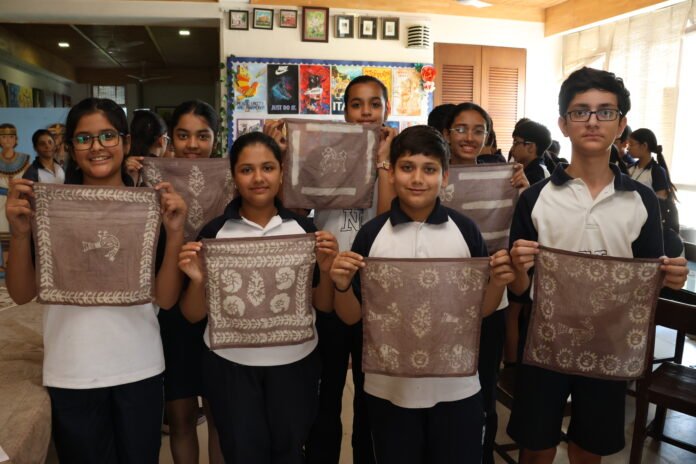
Jaipur: In an engaging celebration of India’s traditional art forms, Grade VII students of Neerja Modi School participated in a hands-on Dabu Printing Workshop, exploring the rich cultural heritage of Rajasthan and discovering the artistry behind one of its most distinctive textile traditions. The workshop was conducted by Dheeraj Chhipa from Bagru, a seventh-generation practitioner of the age-old Dabu printing craft.
The interactive session offered NMS students an opportunity to learn about traditional Dabu printing, a centuries-old Indian resist-printing technique deeply rooted in Rajasthan’s textile heritage. Through demonstrations and practical activities, students experienced how natural materials, traditional wooden blocks and indigenous knowledge come together to create intricate designs on fabric.
Exploring the Traditional Art of Dabu Printing
Dabu printing is a traditional hand-block printing technique in which a specially prepared resist paste is applied to fabric to prevent selected areas from absorbing dye. The paste used in the process typically comprises locally sourced materials such as black clay, lime, wheat chaff, Babool tree gum and sawdust.
During the workshop, Mr. Chhipa introduced students to the preparation and application of this distinctive resist mixture. Using traditional wooden blocks, the young participants stamped patterns onto fabric, carefully applying the paste to create their own designs.
Once the fabric is dyed, the areas protected by the resist paste retain their original colour, revealing striking patterns against the dyed background. Indigo and other natural or vegetable-based dyes have traditionally been used to produce the rich hues and characteristic motifs associated with Rajasthani Dabu print fabric.
The origin of the word “Dabu” is commonly traced to the Hindi word dabana, meaning “to press”, reflecting the technique’s essential process of pressing the resist paste onto fabric.
Traditional Motifs Bring Creativity to Life
The workshop soon transformed into a vibrant space of creativity as students experimented with a variety of wooden printing blocks. Motifs inspired by nature and Rajasthan’s cultural landscape captured their imagination, with the peacock emerging as a particular favourite among the participants.
Some students also explored distinctive shapes such as bulbs and camels, adding their personal touch to the traditional art form. Each impression offered a lesson in precision, patience and the importance of maintaining consistency while working with hand-carved blocks.
One particularly memorable moment highlighted the power of teamwork. Two friends joined their pieces of fabric together and carefully positioned a butterfly-shaped block across the seam. When they lifted the block, half of the butterfly appeared on each piece of fabric. Placed together, the two halves formed a complete butterfly.
The simple yet meaningful exercise demonstrated how collaboration, coordination and attention to detail can transform individual efforts into a beautiful shared creation.
Dabu Printing: A Lesson in Sustainability and Heritage
Beyond its artistic appeal, the workshop introduced students to the environmental significance of traditional textile crafts. Mr. Chhipa explained how naturally sourced materials and traditional dyeing methods form an important part of the Dabu printing process.
The session encouraged students to appreciate the value of sustainable textile printing, responsible material use and the preservation of indigenous craftsmanship. It also highlighted how traditional skills can offer valuable lessons in environmental awareness at a time when sustainable fashion and eco-friendly textile practices are gaining increasing importance.
By engaging directly with a seventh-generation artisan, students gained insight into the dedication, patience and knowledge required to preserve a craft passed down through generations.
Connecting Young Learners with India’s Cultural Roots
The Dabu Printing Workshop at Neerja Modi School went beyond a conventional classroom activity, offering students an immersive introduction to Rajasthan’s living cultural heritage. It enabled them to connect history with hands-on learning while developing an appreciation for India’s diverse artistic traditions.
Through the experience, Grade VII students discovered that traditional crafts are not merely artistic techniques but also expressions of community identity, inherited knowledge and sustainable living.
As students created their own printed designs, they experienced the joy of learning by doing and understood the importance of safeguarding indigenous art forms for future generations.
The workshop served as a meaningful reminder that when traditional craftsmanship meets experiential education, young learners gain more than a new skill—they develop a deeper respect for cultural heritage, creativity, collaboration and the environment.