
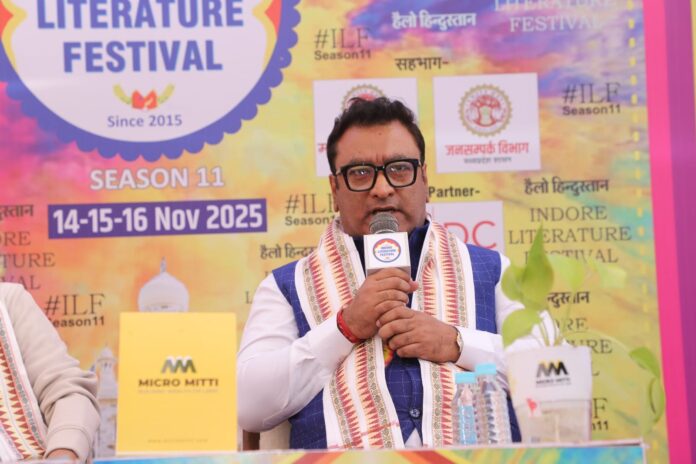
In contemporary Indian literary circles, Anish Kanjilal has emerged as a distinctive voice whose speeches at literary festivals combine philosophy, history, and literary insight. Known for his poetry collections Fateless 13 and 11 Oracles, Kanjilal has gained recognition not only as a poet but also as a compelling public speaker who inspires audiences across India.
His appearances at prominent festivals—such as the New Delhi World Book Fair 2025, Indore Literature Festival 2025, Toshali Literature Festival, Bhuvaneshwar 2025, Kolkata Literary Carnival 2025, Adamas university literature festival 2026 and Sahityam 2026— have positioned him among influential speakers engaging with literature’s role in society, leadership, and cultural transformation.
Literature as a Force of Change
One of the central ideas in Kanjilal’s speeches is the transformative power of literature. At Sahityam 2026, he reminded audiences that books are not merely repositories of stories but forces that shape human thought and social movements. According to him, literature influences philosophy, politics, and leadership, often silently guiding the evolution of societies.
He illustrated this argument with historical examples, explaining how writers such as Leo Tolstoy influenced the philosophy of Mahatma Gandhi, particularly in shaping the ideas of non-violence and moral resistance. By highlighting such connections, Kanjilal emphasized that literary works can inspire real-world transformations far beyond the printed page.
Championing the Habit of Reading
Across multiple festivals, Kanjilal repeatedly stresses the importance of reading as the foundation of intellectual growth. Speaking to students and young writers at Sahityam 2026, he asserted that knowledge cultivated through reading builds confidence and intellectual discipline. He famously summarized his message with a simple yet powerful command: “Read.”
According to him, a well-read mind develops patience, depth of thought, and the ability to engage meaningfully with complex ideas—qualities that are increasingly vital in a fast-paced digital age.
Exploring the Craft of Writing
At the Indore Literature Festival, Kanjilal delivered an insightful session on the creative process. He described writing as an emotional and psychological journey rather than a rigid discipline. Calling himself a “mutinous character,” he explained that he often rejects conventional structures in order to create narratives that feel authentic and emotionally resonant.
In his talk, he moved across literary and philosophical references—from Albert Camus and Franz Kafka to Rabindranath Tagore and the Bhagavad Gita—demonstrating how diverse texts can shape a writer’s imagination and narrative voice.
He also advised aspiring writers to observe everyday life closely, as even the most ordinary moments can become powerful literary material.
Literature, History, and Cultural Memory
During his speech at the Toshali Literature Festival, Kanjilal examined the relationship between literature and history. He argued that literary works can revive historical narratives and deepen society’s understanding of the past.
Discussing writers such as Margaret Atwood and Charlotte Perkins Gilman, he praised literature’s role in illuminating social struggles and marginalized voices. His address highlighted how storytelling often preserves truths that formal historical records may overlook.
Poetry in the Modern World
At the New Delhi World Book Fair, Kanjilal participated in a panel titled “Poetry: Why It Matters in Today’s World.” In this discussion he defended poetry as a medium capable of expressing complex emotional and philosophical realities that ordinary language struggles to capture.
For him, poetry bridges the everyday and the metaphysical—allowing writers to articulate the intangible dimensions of human experience.
Inspiring the Next Generation
Beyond literary analysis, Kanjilal’s speeches consistently address the younger generation. He encourages students to cultivate intellectual curiosity, question established ideas, and engage deeply with literature.
As both an educator and the founder-director of Educare – The Institute, he combines academic mentorship with literary engagement, guiding students toward creative and critical thinking.
Conclusion
Through his speeches at literary festivals across India, Anish Kanjilal has established himself as more than a poet—he is a literary thinker and mentor who connects literature with philosophy, history, and leadership. His talks emphasize three enduring principles: the transformative power of literature, the necessity of reading, and the courage required to write authentically.
In an age of rapid technological and cultural change, Kanjilal’s message remains timeless: books continue to shape minds, nurture imagination, and quietly influence the course of society.