
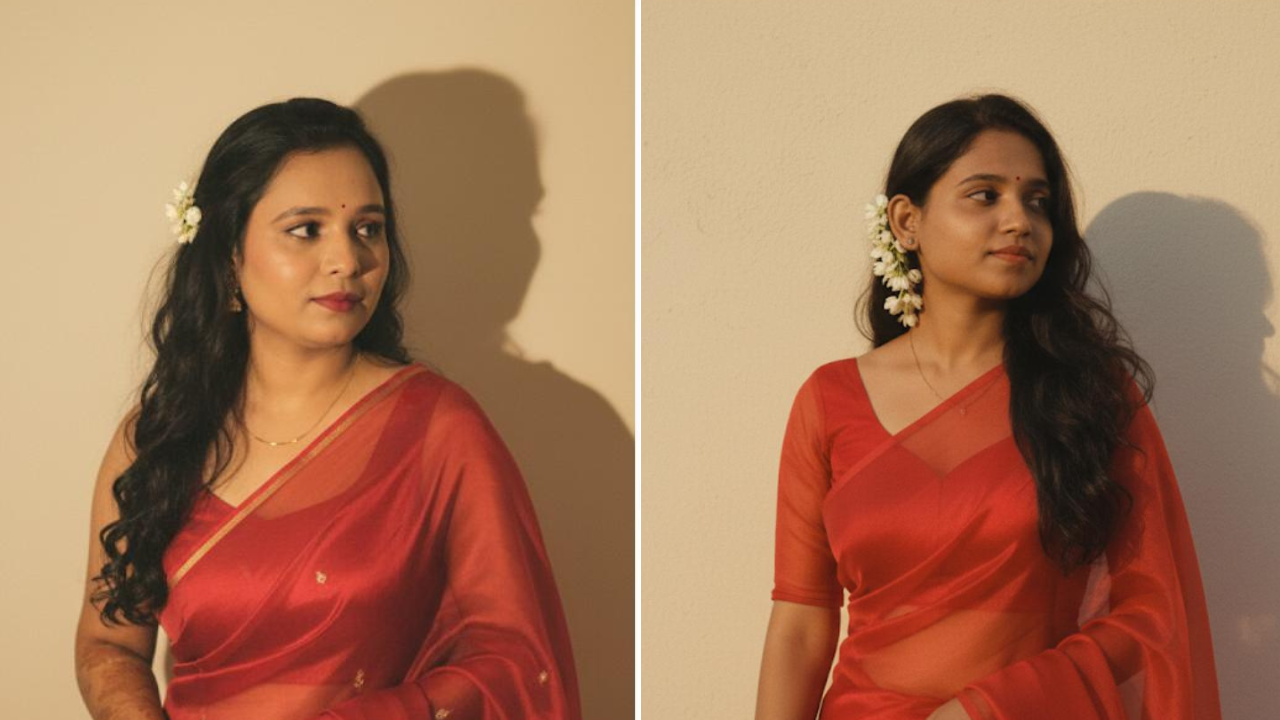
Gemini Saree AI Trend
The internet is obsessed with the new Gemini Nano Banana AI saree trend, where users upload their photos into Google’s Gemini Nano model and instantly receive glamorous AI-generated images of themselves in sarees set against vintage-inspired backdrops. Instagram feeds have been flooded with these creative results, making the trend one of the biggest viral sensations of the week.
But what started as a lighthearted experiment has now raised serious concerns about user privacy.
Viral Instagram Video Turns The Trend ‘Creepy’
An Instagram content creator who joined the trend recently startled her audience by sharing a “creepy” detail about her AI-edited photo. In her video, she explained that while the generated picture looked elegant—complete with a saree and nostalgic background—it also included a personal physical detail that she did not expect.
The woman revealed that the Gemini-generated picture visibly recreated a mole on her body that was not highlighted or mentioned in her uploaded image prompt. “How Gemini knows I have mole in this part of my body? You can see this mole… this is very scary, very creepy… I am still not sure how this happened,” she expressed while urging users to be cautious.
Why The AI Saree Photo Shocked Viewers
The accurate depiction of her mole quickly alarmed viewers. While many people considered the Gemini-produced saree looks to be fun, this revelation demonstrated how AI tools can capture and replicate sensitive physical details that often go unnoticed.
Social media comments reflected a growing sense of unease. One user wrote that the situation felt like “digital surveillance,” while another warned, “AI sees more than we think it does.”
AI Privacy Concerns: What Users Should Know
This incident sparked a wave of online debate about how AI platforms process and retain user images. Privacy experts suggest that advanced AI platforms do not just apply filters but may analyze even the minute details of a face or body in order to generate hyper-real results.
Key concerns raised include:
- Whether personal images are stored after uploading.
- How AI models might use subtle identifiers like moles, scars, or skin patterns.
- The risk of sensitive images being misused or accessed outside of user consent.
The woman’s warning message—“Please be safe with whatever you’re uploading on social media or AI platforms”—has struck a chord with thousands of viewers.
Expert Opinions on AI Image Processing
AI researchers note that generative tools like Gemini rely on deep neural networks trained to preserve detail. When fed with a user photo, the AI can automatically enhance and extrapolate data. This may explain how a small mole, already present but unnoticed, was emphasized in the final output.
However, experts warn that while this may not mean direct privacy violations, it highlights how advanced AI has become at detecting and re-creating real physical characteristics. Without clear user knowledge of how their content is stored or processed, concerns about safety remain valid.
Social Media Reaction to the Controversy
The incident has gone viral, with thousands of Instagram users double-checking their own Gemini saree images. Some have deleted their uploads altogether, fearing hidden details may also have been unintentionally exposed. Memes, warnings, and heated debates are currently circulating on platforms like Instagram Reels, X (formerly Twitter), and Reddit.
The event has transformed the AI saree trend from one of fascination to one of digital caution, raising questions about how much users should trust generative AI models in playful social experiments.
AI Trends and Digital Safety in India
India has been quick to embrace AI-powered creativity tools, but this controversy shows the growing need for awareness and safety rules. Experts have long warned that deepfake technologies and AI-driven filters could blur the line between harmless fun and potential misuse.
Government discussions around AI regulation are already underway, but this particular episode could accelerate demands for clearer guidelines on image privacy, transparency in data handling, and stricter consent policies.
Should You Join AI Viral Trends?
While generative AI tools can be fun and visually impressive, users are advised to:
- Reconsider uploading personal close-up photos.
- Avoid providing sensitive data to AI editing tools.
- Understand privacy policies and how image data might be used.
- Think twice before participating in viral challenges that involve personal images.
The Instagram user’s story is a strong reminder that what begins as an entertaining filter may leave behind lasting privacy risks.
The Gemini Nano Banana AI saree trend
The Gemini Nano Banana AI saree trend is a viral social media challenge where users upload their selfies to Google’s Gemini Nano Banana image-editing tool to transform their photos into retro, Bollywood-style portraits featuring elegant sarees and vintage backdrops. This AI-driven trend lets users customize their images by choosing saree styles, colors, and classic film-inspired settings, creating glamorous, stylized edits that evoke nostalgia for the 1970s-90s Bollywood era.
Anyone can participate by accessing the Gemini app’s Nano Banana feature, uploading a clear solo photo, and entering a descriptive prompt to generate their personalized saree look. The trend has gained massive popularity on Instagram as people recreate the timeless elegance of iconic Indian actresses and classical movie posters using just their photos and AI technology.
Woman call the Gemini AI saree trend “creepy”
A woman called the Gemini AI saree trend “creepy” because when she used the Gemini Nano Banana AI tool to generate her saree-themed photo, the AI edited image included a very personal and unprompted detail—a mole on her body that she had not highlighted or mentioned in the image she uploaded. She found it unsettling that the AI not only applied the saree and vintage backdrop but also accurately reproduced this subtle, private physical feature without any explicit input from her.
In her viral Instagram video, she questioned, “How Gemini knows I have mole in this part of my body? You can see this mole… this is very scary, very creepy.” She warned others to be cautious about what photos they upload to AI platforms, emphasizing privacy and safety concerns around how AI models might detect and retain hidden details from personal images. This incident sparked widespread reactions and discussions about AI privacy risks and data security on social media.
Conclusion: From Fun to Fear
The Gemini Banana AI saree trend went viral for its creative transformations but is now under scrutiny due to a woman’s shocking mole revelation in her AI-edited picture. While some argue it was a harmless result of detailed editing, the widespread reaction proves that users increasingly hesitate to trust AI platforms with private images.
As AI technology continues to advance, moments like this highlight the importance of digital caution, user awareness, and improved regulations. What may begin as a trend can sometimes uncover the darker realities of how AI truly sees us.