
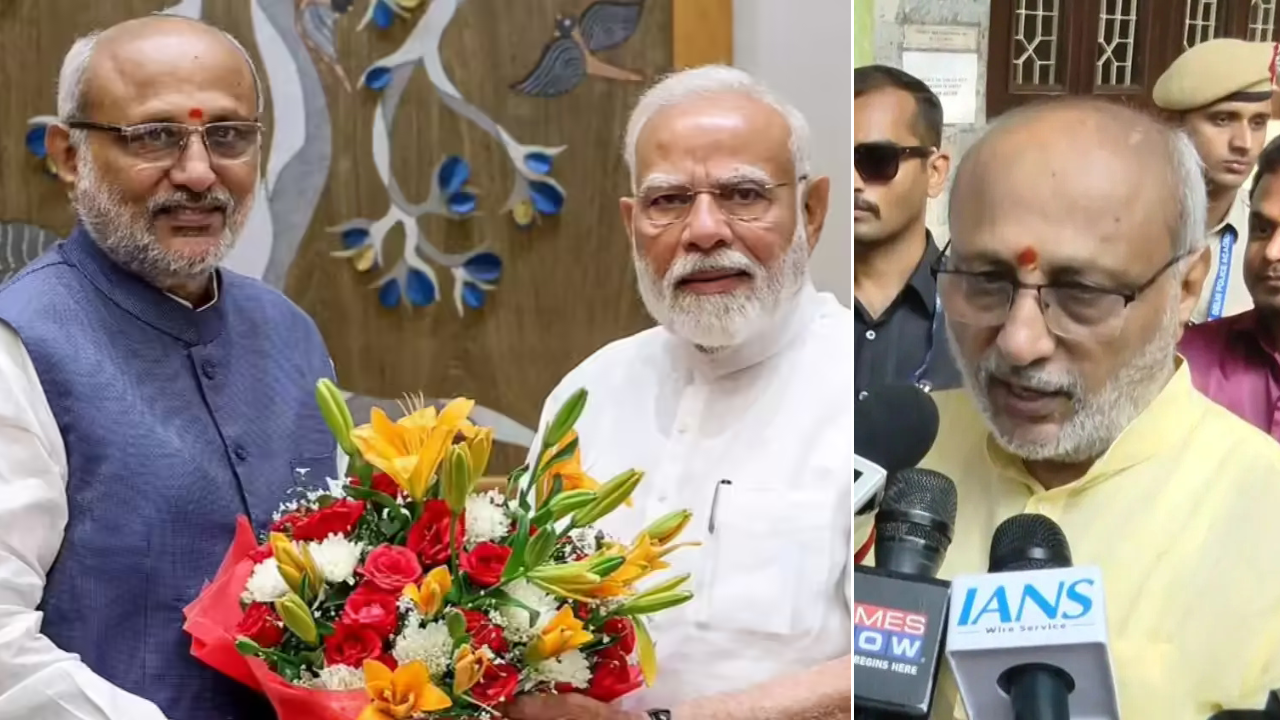
Marking a pivotal moment in India’s political narrative, Chandrapuram Ponnusamy Radhakrishnan has been elected as the nation’s 15th Vice President, an event he has described as a “victory of nationalist ideology” that underscores the nation’s evolving parliamentary landscape and ideological aspirations.
Radhakrishnan, the candidate of the ruling National Democratic Alliance (NDA), secured a decisive victory in the Vice Presidential polls held on Tuesday, garnering 452 votes against opposition candidate Justice B. Sudershan Reddy, who polled 300 votes. This 152-vote margin not only demonstrates the NDA’s strong parliamentary presence but also marks one of the most keenly observed ideological contests in recent years.
About C.P. Radhakrishnan’s journey
C.P. Radhakrishnan’s political journey spans nearly five decades of active involvement and leadership in Indian politics. Born on October 20, 1957, in Tiruppur, Tamil Nadu, he began his political career as a young member of the Rashtriya Swayamsevak Sangh (RSS) and officially entered politics in 1974 when he was elected to the Jan Sangh’s state executive committee. Over time, he emerged as a prominent leader in Tamil Nadu’s BJP, serving as the party’s state president from 2004 to 2007.
During his presidency, Radhakrishnan embarked on a 93-day “Ratha Yatra,” covering about 19,000 km across Tamil Nadu to promote causes such as linking Indian rivers, implementing a uniform civil code, eradicating untouchability, and combating terrorism and drug abuse. He also led multiple padayatras (journeys on foot) to raise awareness on various social and political issues.
Radhakrishnan was elected to the Lok Sabha from Coimbatore twice, in 1998 and 1999, holding parliamentary roles like chairmanship of the Standing Committee on Textiles and membership in various consultative committees. He also chaired the Coir Board from 2016 to 2020, during which coir exports peaked significantly.
In 2023, he was appointed Governor of Jharkhand and later held additional governorship duties in Telangana and Puducherry. In July 2024, he became the Governor of Maharashtra. C.P. Radhakrishnan’s election as India’s 15th Vice President in September 2025 marks the culmination of his extensive political and administrative experience, reflecting his reputation as a seasoned leader and consensus-builder in India’s evolving political landscape.
“Election Is an Ideological Fight” In his first remarks after the victory, Radhakrishnan framed the election as a battle of ideologies, stating that “from the voting pattern, we understand that the nationalistic ideology has emerged victorious.” He directly addressed the opposition’s narrative, which had positioned the election as an ideological struggle between contrasting visions for India. “It is a victory for every Indian, and we all have to work together if we have to make India a developed nation by 2047,” he added, emphasizing unity and collective progress over partisan politics.
The Vice President-elect stressed that in a thriving democracy, both the ruling party and the opposition are invaluable, likening them to two sides of the same coin. He assured that the interests of democracy would be upheld in his tenure as the ex-officio Chairperson of the Rajya Sabha, India’s upper parliamentary house.
A Career Rooted in Nationalism
C.P. Radhakrishnan’s ascent to the nation’s second-highest constitutional office caps a long and distinguished political career. Strongly rooted in the Rashtriya Swayamsevak Sangh (RSS) and the Bharatiya Janata Party (BJP), Radhakrishnan is a two-time Member of Parliament from Coimbatore and a former BJP state president in Tamil Nadu. His consistent championing of a nationalist agenda has framed much of his public work, including his tenures as Governor of Maharashtra and Jharkhand before contesting for the Vice Presidency.
His election is being interpreted as a reaffirmation of the country’s ideological and political direction, further consolidating the ruling alliance’s influence in national institutions. Prime Minister Narendra Modi was among the first to congratulate Radhakrishnan, expressing confidence that the new Vice President would “strengthen Constitutional values and enhance Parliamentary discourse”.
Record Turnout and Parliamentary Unity
The 2025 Vice Presidential election witnessed a record turnout, with 767 out of 781 eligible MPs casting their votes—a remarkable 98.2 percent participation rate. Of these, 754 votes were cast, 15 found invalid, and 752 were counted as valid, making the required majority of first preference votes 377. The high participation underscores the importance attached to this election within the country’s legislative circles.
Interestingly, the election outcome also reflected a notable instance of cross-voting, with 15 MPs believed to have voted for the NDA candidate despite the opposition’s claim of complete unity among its block. This development hints at possible ideological shifts or changing alliances, spotlighting the dynamic nature of India’s parliamentary politics.
Reactions from Across the Political Spectrum
Opposition leaders acknowledged the clear mandate but called for the Vice President to embody parliamentary independence and fairness. Congress President Mallikarjun Kharge and other opposition figures noted that while they accepted the outcome, they expected the office to uphold democratic values and respect constitutional traditions. Meanwhile, the ruling alliance celebrated the result as evidence of its robust national vision and growing acceptance in the country’s polity.
Vision for “Viksit Bharat 2047” Looking ahead, Radhakrishnan has laid emphasis on the imperative of moving beyond political divides and focusing squarely on development. He reiterated his commitment to “Viksit Bharat 2047”—the aspiration for India to reach developed nation status by the centenary of its independence. “We should not do politics in everything; now we will have to concentrate on development,” Radhakrishnan told reporters, underlining his platform of national progress anchored in unity, democracy, and constitutional values.
Commitment to Democratic
Ideals “As I take on this new responsibility, my foremost goal is to serve every citizen, facilitate parliamentary dialogue, and foster inclusive development,” Radhakrishnan affirmed. “Our democracy thrives when voices from all corners are heard with respect. I will work tirelessly to ensure both the ruling party and opposition participate in shaping India’s future”—a statement reflecting readiness to preside over the Rajya Sabha with a spirit of fairness and consensus-building.
Conclusion:
A New Chapter The election of C.P. Radhakrishnan as Vice President opens a new chapter in India’s constitutional journey, blending the assertion of nationalist ideology with a promise of broader national development and democratic engagement. As he prepares to assume office, expectations rise for leadership that combines experience, inclusivity, and unwavering commitment to India’s parliamentary values